
COMMENT | Covid-19 bill is months too late
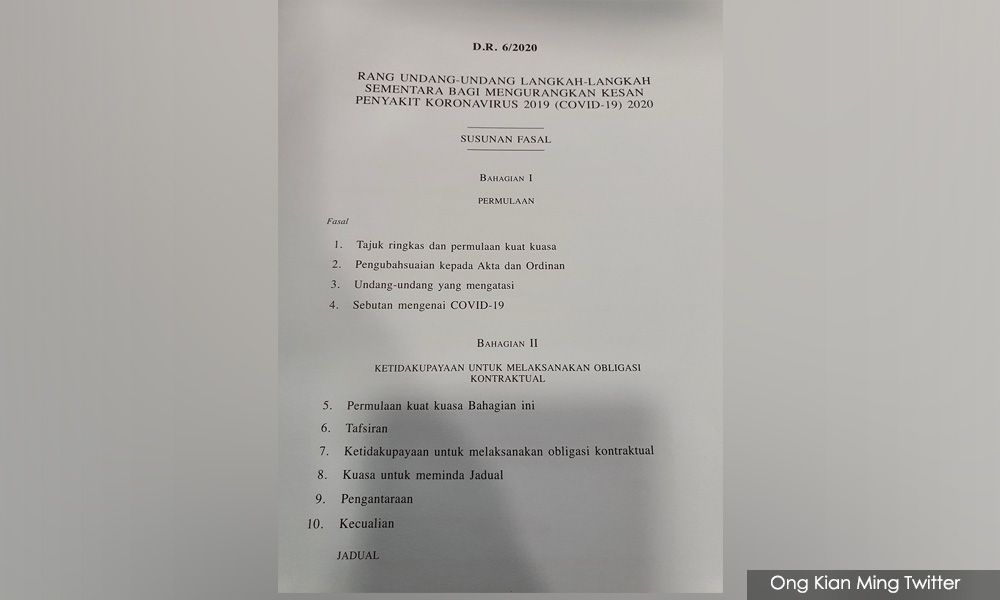
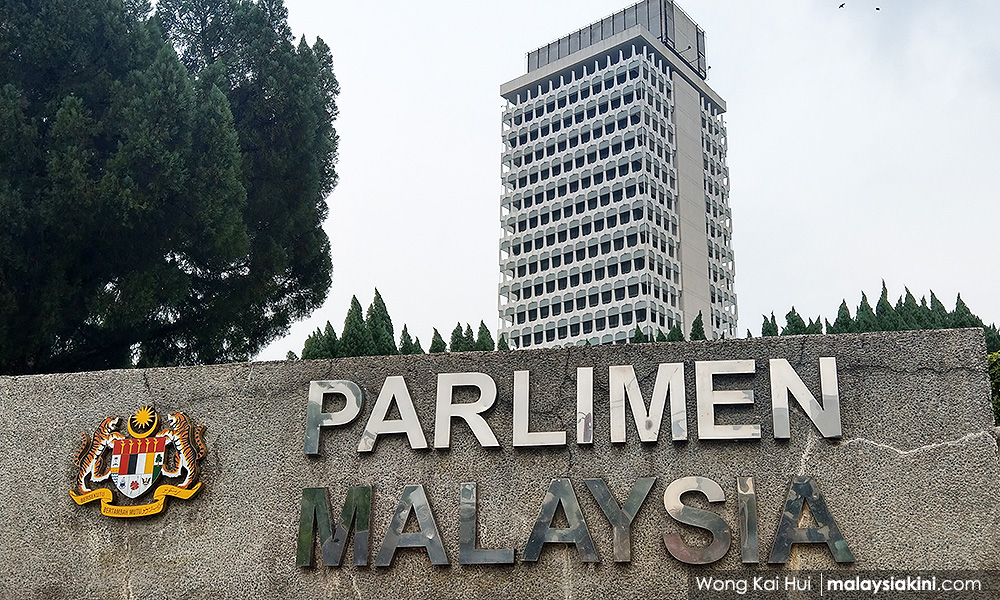
COMMENT | Earlier this week, the government tabled the bill on temporary measures to lessen the impact of the Covid-19 pandemic for its first reading in the Dewan Rakyat.
According to reports, the "Temporary Measures for Reducing The Impact of Coronavirus Disease 2019 (Covid-19) Bill 2020" seeks to support the various economic packages announced by the government as well as to "reduce the financial and social impact brought about by the pandemic".
Other countries have also enacted laws to deal with the impact of the coronavirus that has ravaged the world for most of 2020. Singapore, for example, tabled and passed its version of a Covid-19 law in April 2020.
There is no question that there is a need for such a bill to be enacted in Malaysia. After nearly two months of the movement control order (MCO) that was implemented to combat the Covid-19 pandemic, we are now...
COMMENT | Earlier this week, the government tabled the bill on temporary measures to lessen the impact of the Covid-19 pandemic for its first reading in the Dewan Rakyat.
According to reports, the "Temporary Measures for Reducing The Impact of Coronavirus Disease 2019 (Covid-19) Bill 2020" seeks to support the various economic packages announced by the government as well as to "reduce the financial and social impact brought about by the pandemic".
Other countries have also enacted laws to deal with the impact of the coronavirus that has ravaged the world for most of 2020. Singapore, for example, tabled and passed its version of a Covid-19 law in April 2020.
There is no question that there is a need for such a bill to be enacted in Malaysia. After nearly two months of the movement control order (MCO) that was implemented to combat the Covid-19 pandemic, we are now well within the recovery MCO period.
The recovery MCO replaces the previous conditional MCO, which in turn, replaced the original MCO.
Our Covid-19 numbers, despite new clusters and occasional spikes, have been under control. Economic and business activities have also resumed, even if not at the pre-MCO level. New social (or physical) distancing norms are being followed, although arguably not at a satisfactory degree.
However, the impact of the pandemic is still being felt. Unemployment numbers, although easing slightly last month, are still at a worrying level. Many legal obligations have been disrupted or could not be performed because of the various restrictions.
Thus, a law to deal with these issues is sorely needed. We needed such a law much earlier in the year, yet we are only seeing this bill tabled now.
When many called upon the government to convene a full Parliament sitting in May and even earlier, the government claimed that the Covid-19 situation meant that a full sitting cannot be held. Other countries, some which faced much worse conditions, could still hold full Parliamentary sessions to scrutinise executive actions and to pass specific legislation to deal with the pandemic.
This bill will likely pass the Dewan Rakyat. It will then need to be tabled in the Dewan Negara, which only sits in September. The earliest that the Covid-19 bill can come into force is at the end of September or early October. That would mean that eight months would have passed since the MCO was first announced.
Bangi MP Ong Kian Ming had issued a statement on Aug 14, 2020, which details the various weaknesses of the bill. Other MPs will certainly point out more areas for improvement or criticise the bill when it comes up for debate in the coming weeks.
One crucial weakness that will hamper the effectiveness of the bill is the fact that while its effect is backdated to March 2020, any legal action taken within the period of March 2020 to whatever date it before it comes into force will be valid and binding.
For example, if a contract has been terminated in this crucial period because of the inability of one party to perform its obligations due to the coronavirus, the termination is valid despite the provisions of the law itself.
The worst impact of the pandemic is felt in the first half of the year. Yet the bill will do nothing to give protection to those impacted if an action has already been taken.
Admittedly, the bill could not possibly be backdated to undo any action that has been taken. Thus, this weakness cannot be remedied, and the fault lies with the refusal of the government to hold a Parliamentary session earlier to pass such laws.
As usual, the losers are not the government or the Perikatan MPs with their cushy government and government-linked company positions. The losers once again are the people.
SYAHREDZAN JOHAN is a civil liberties lawyer and political secretary to Iskandar Puteri MP Lim Kit Siang.
The views expressed here are those of the author/contributor and do not necessarily represent the views of Malaysiakini.