




Covid Bill: Raising national debt limit necessary - economists
The government's tabling of a bill to raise the national statutory debt limit from 55 percent to 60 percent of the gross domestic product (GDP) was a necessary move, say economists today.
Responding to the tabling of the Temporary Measures for Government Financing (Coronavirus Disease 2019 [Covid-19]) Bill 2020 in the Dewan Rakyat, three economists concurred that the move would allow the government access to more funds for targeted responses aimed at helping people to overcome hardships during the current global health crisis...
The government's tabling of a bill to raise the national statutory debt limit from 55 percent to 60 percent of the gross domestic product (GDP) was a necessary move, say economists today.
Responding to the tabling of the Temporary Measures for Government Financing (Coronavirus Disease 2019 [Covid-19]) Bill 2020 in the Dewan Rakyat, three economists concurred that the move would allow the government access to more funds for targeted responses aimed at helping people to overcome hardships during the current global health crisis.
Bank Islam Malaysia Bhd chief economist Dr Mohd Afzanizam Abdul Rashid said an increase in the debt limit would give more flexibility for the government to prescribe additional fiscal stimulus in the event of further contraction in economic activities.
"As it is now, uncertainties surrounding Covid-19 remain elevated, and the resurgence of new cases could potentially affect economic activities.
"Therefore, a higher debt limit would provide the financial wherewithal to withstand the Covid-19 impact," he told Malaysiakini.
As a result of a higher debt limit, Afzanizam said the rakyat could look forward to more targeted assistance if the situation worsens, while the government must take steps to promote the assistance provided.
"So measures like wage subsidies and programmes like reskilling and retraining for the unemployed as well as tax incentives to promote the economic sectors can be expected," he said, adding that the rakyat, in turn, needs to be ready to grab the newly available opportunities.
Universiti Malaysia Sarawak's (Unimas) senior professor of the economic and business faculty, Prof Shazali Abu Mansor said that a projected positive impact of the move would outweigh its potential negative impact, particularly when used as intended to assist the people in need.
"The debt that the government has acquired or about to acquire is for the main purpose of helping the rakyat, through all the stimulus packages announced.
"As we can see during the epidemic, the government has been helping the rakyat across the board to reduce the burden of those affected," he said when contacted.
The bill, which covers the period of Feb 27, 2020, to Dec 31, 2022, was tabled earlier today.
Aside from increasing the debt ceiling to accommodate additional borrowings by the government, the Bill will also officially establish the Covid-19 Fund for various stimulus packages which have been announced under the RM260 billion Prihatin and RM30 billion Penjana packages.
It is also looking to backdate and validate all related sums paid by the government from Feb 27, when the first stimulus package was announced.
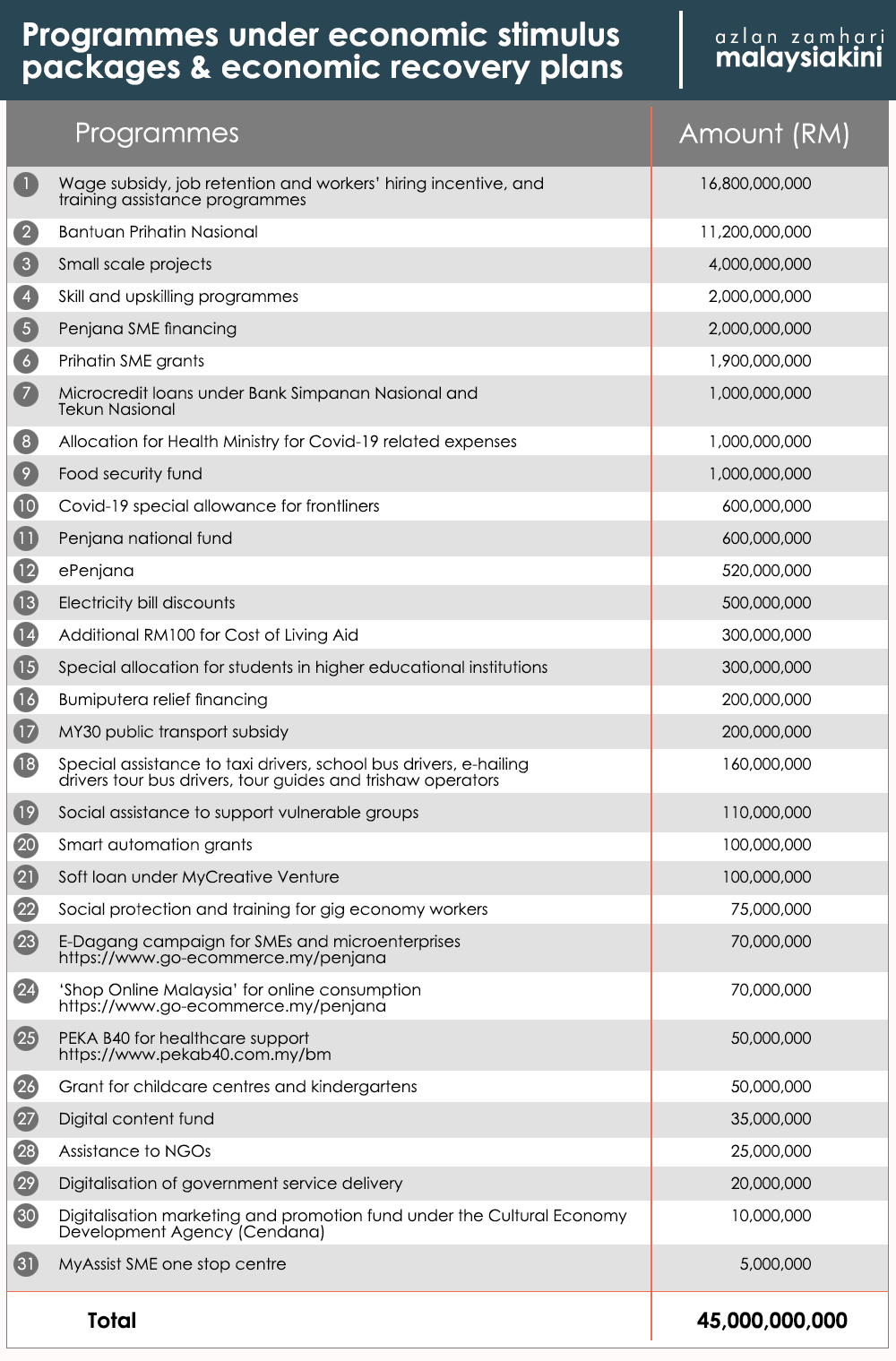
The Bill further lists out all the programmes under the economic stimulus packages and recovery plans worth RM45 billion.
This includes RM16.8 billion under the wage subsidy as well job hiring and retention scheme, RM11.2 billion for Bantuan Prihatin National, an RM1 billion allocation for Health Ministry Covid-19 related expenses, the RM2 billion Penjana SME financing, RM1.9 billion Prihatin SME grants, RM600 million special allowance for frontliners and RM500 million discounts for household electricity bills.
The new proposed debt limit, meanwhile, referred to the sum of funds received under the Government Funding Act 1983 and the total ceiling sum raised under the Loan (Local) Act 1959.
Looking beyond the numbers, Sunway University economics professor Yeah Kim Leng said the tabling of the bill was a necessary move to maintain government integrity and rule of law.
"The government will need to seek parliament’s approval to raise the limit because otherwise, breaching the limit will be deemed as illegal and the government can be challenged in court," he told Malaysiakini.
Quizzed on the long-term impact of a higher debt ceiling, Yeah pointed to an increase in debt servicing payments although its impact would be mitigated by the current low-interest-rate environment.
"Another important implication is shrinking fiscal space, in other words, reduced flexibility of the government to borrow and spend should the need arise.
"Higher debt is also associated with increased financial risk and weaker sovereign creditworthiness," he added.
'Minimal negative impact'
Yeah, however, said Malaysia would likely avert a credit rating downgrade despite the higher debt ceiling.
"Given that the debt shock is one-off and that most countries, including the triple-A-rated sovereigns, are in a similar situation, a rating downgrade is unlikely.
"A quick economic recovery and a credible medium-term plan together with commitment to fiscal consolidation will enable the country to avert a rating downgrade," he explained.
Afzanizam, who echoed Yeah's view, said a rating downgrade is unlikely, citing figures that reflected the confidence of fixed income investors with the government's credit level.
"So by extension, the rating agencies could be on the same page, and in that sense, the sovereign rating should be fairly stable," he said.
Additionally, Afzanizam said any negative impact could be further mitigated by positive demand from foreign investors on Malaysian Government Securities.
"Their share of ownership stood at 37.3 percent as of June, from 35.9 percent in the preceding month," he added.
It was previously reported that the federal government debt to GDP ratio stood at 52.5 percent as of last year, but since earlier stages of the Covid-19 outbreak, economists had predicted the figure would expand beyond 55 per cent this year.






Report this comment
Are you sure you want to delete this comment?
This action cannot be undone.