


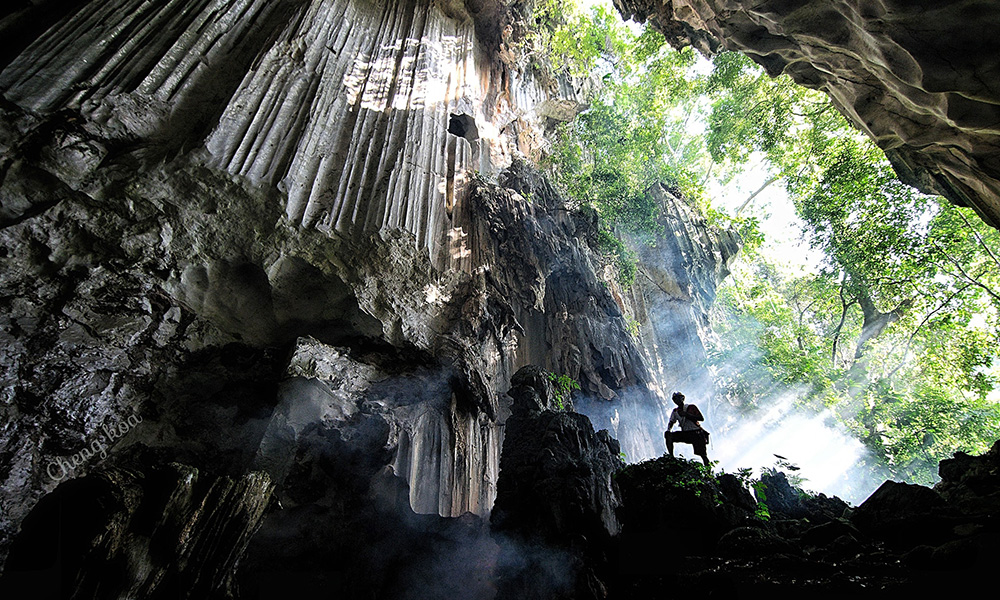

COMMENT | Limestone caves and hills: Are we destructive barbarians?
COMMENT | How should we treat our majestic limestone hills and caves? Should we protect them for their many long-term benefits? Of being landmarks in our landscape? For their recurring income from tourism?
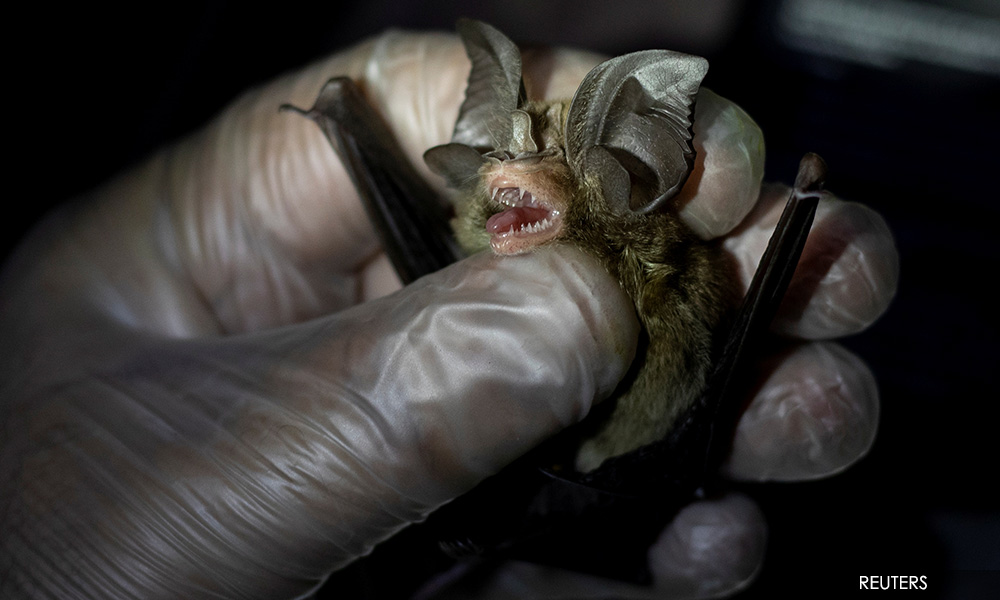
How about so that bats have homes and can keep doing their priceless biological service of pollinating durian trees and eating insect pests? And to preserve the many unique species there, which may hold the cure for cancer or other diseases?
Yet, against all these benefits, Malaysia seems to have chosen another route - to hack them down for one-off, short-term gains, because it’s the cheapest way to get limestone, instead of paying a bit more to dig underground for it.
The current controversial quarrying of Gunung Baling in Kedah, by the PAS-led state government, is just the latest in many assaults on our limestone heritage - which has taken millions of years to become such splendid sculptures of nature, better than any master artist's ink paintings of Chinese landscapes - only to be demolished within months.
It's like some uncivilised tribe knocking down antique shophouses in Malacca - to just sell off the bricks and tiles.
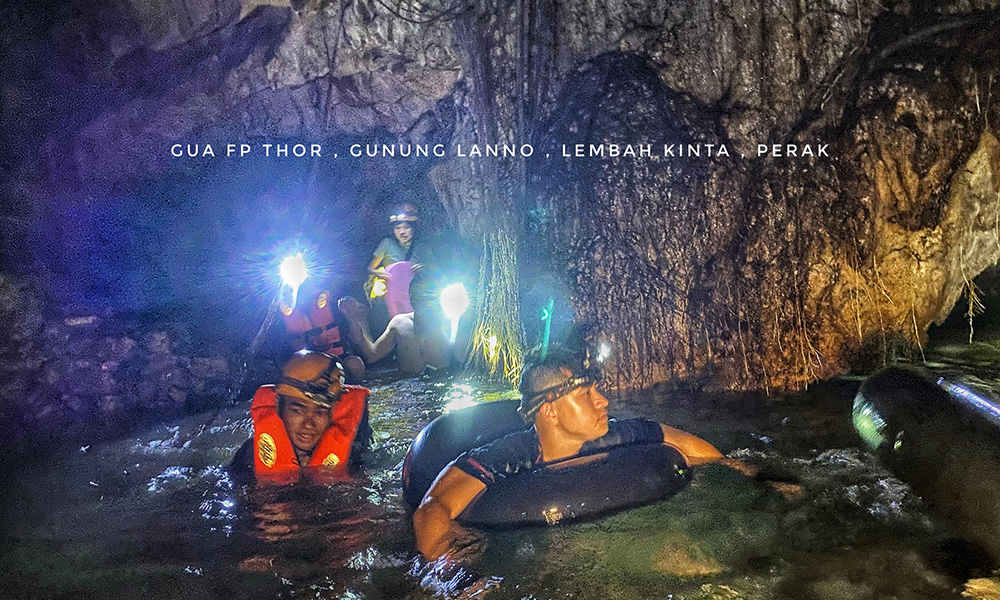
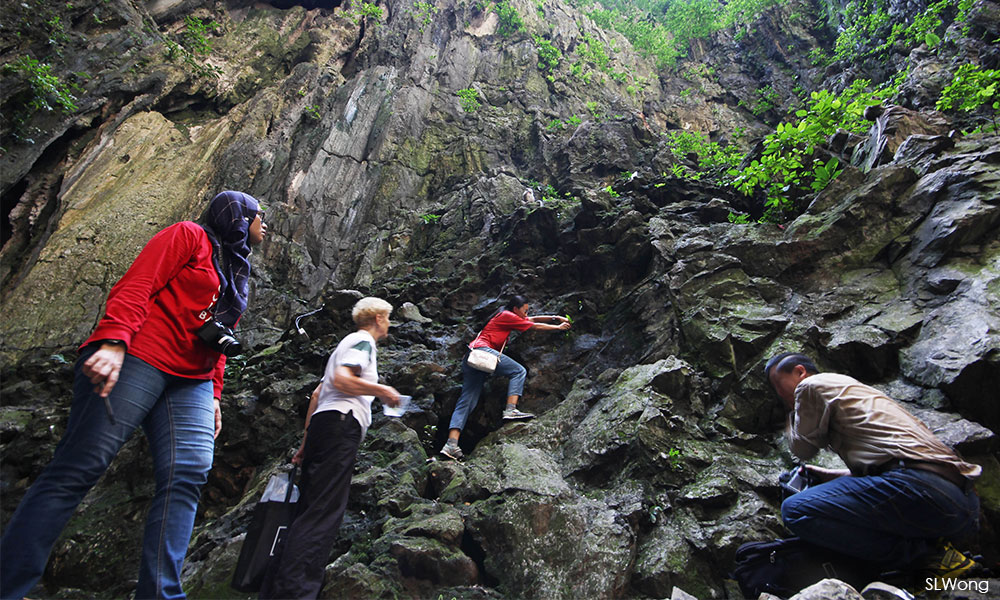
This writer has actually been to Gunung Baling, or rather inside it, at a wonderful cave called Gua Layang. Having done adventure caving, I can testify that all the climbing, crawling, ropes, helmets, and lights are an adrenaline rush that can make anyone feel like Indiana Jones exploring glorious hidden chambers.
Adventure caving may seem like niche tourism for now, but it may be the next big thing. Remember that few people wanted to go into “scary jungles with snakes” in the past, but see how hiking has now exploded in Malaysia...
COMMENT | How should we treat our majestic limestone hills and caves? Should we protect them for their many long-term benefits? Of being landmarks in our landscape? For their recurring income from tourism?
How about so that bats have homes and can keep doing their priceless biological service of pollinating durian trees and eating insect pests? And to preserve the many unique species there, which may hold the cure for cancer or other diseases?
Yet, against all these benefits, Malaysia seems to have chosen another route - to hack them down for one-off, short-term gains, because it’s the cheapest way to get limestone, instead of paying a bit more to dig underground for it.
The current controversial quarrying of Gunung Baling in Kedah, by the PAS-led state government, is just the latest in many assaults on our limestone heritage - which has taken millions of years to become such splendid sculptures of nature, better than any master artist's ink paintings of Chinese landscapes - only to be demolished within months.
It's like some uncivilised tribe knocking down antique shophouses in Malacca - to just sell off the bricks and tiles.
This writer has actually been to Gunung Baling, or rather inside it, at a wonderful cave called Gua Layang. Having done adventure caving, I can testify that all the climbing, crawling, ropes, helmets, and lights are an adrenaline rush that can make anyone feel like Indiana Jones exploring glorious hidden chambers.
Adventure caving may seem like niche tourism for now, but it may be the next big thing. Remember that few people wanted to go into “scary jungles with snakes” in the past, but see how hiking has now exploded in Malaysia?
Or how about normal tourism? Consider the throngs that visit Ipoh’s cave temples or Sarawak’s Mulu Caves. Or look at Guilin in south China, where the main attraction is the karst landscape (the geological name for limestone hills and caves). In the first six months of 2019, it saw 62 million visitors who spent US$12.3 billion (RM50.7 billion). Can we capture a small slice of this pie?
Landscape value
What about Ipoh? Should its global brand name be the City of Limestone Towers? Or the City of Flattened Hills? What is the value of a landscape? Not just for tourists, but for us Malaysians. Can we enjoy pleasant surroundings only if we buy an upmarket house with fancy landscaping? By right, the rakyat’s enjoyment of charming hills should be reason enough to conserve them.
But if we insist on putting a ringgit value to everything, well, posh resorts such as the Banjaran Hotsprings Retreat already show how our magnificent limestone hills are better money spinners when left standing, rather than demolished.
What we’re doing now is like melting down exquisite copper artworks to make pots and pans - it’s what barbarians do because they don't know how to value finer things.
Can Kinta Valley karst be another Guilin tourist magnet? Yes, said former Perak menteri besar Zambry Abd Kadir in October 2012: “We want to make the limestone hills here a tourist attraction. We have a similar geography to Guilin in China.”
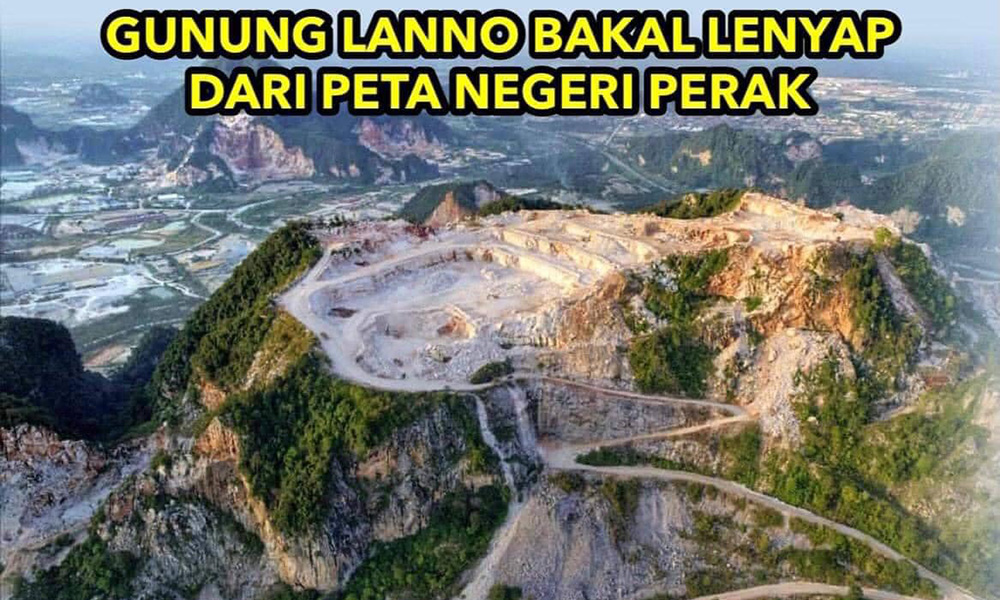
Yet, for years, it remained empty talk and everyone travelling the North-South Highway could see how the limestone hills around Ipoh were being butchered before their eyes.
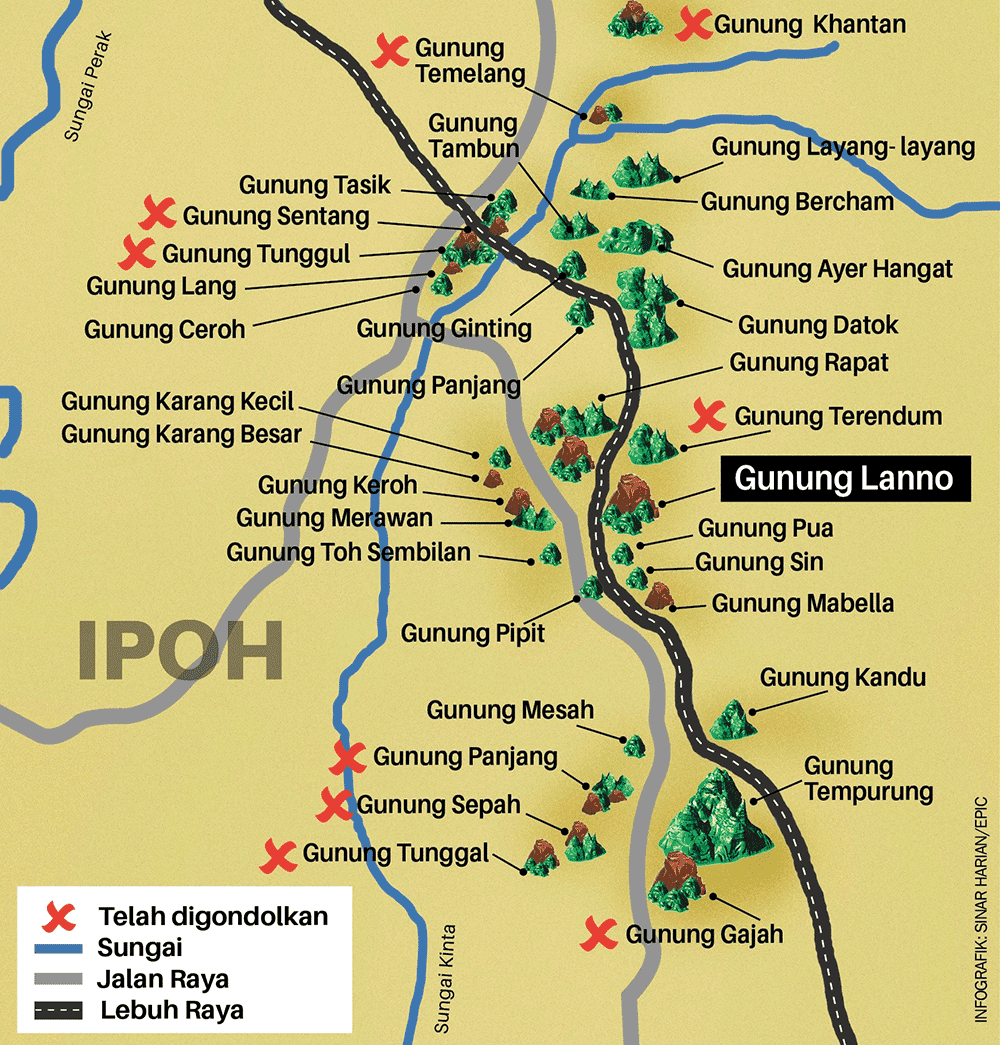
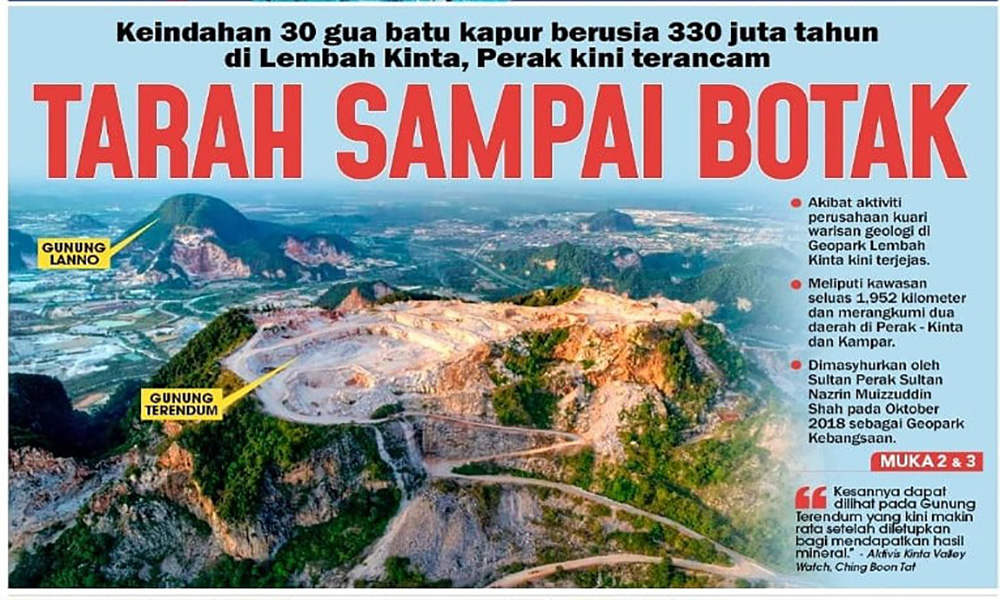
Some good sense finally prevailed when Pakatan Harapan won the elections. Shortly after, in October 2018, the Kinta Valley Geopark was declared. However, this is just a first step with only 18 areas being protected (including forests and waterfalls) while many other limestone sites have been strangely excluded.
Kinta Valley Watch, a karst conservation group, cautions that another 30 exquisite caves may soon disappear due to quarrying, including the 330 million-year-old Gunung Lanno (with 44 caves inside) at Simpang Pulai, near Ipoh.
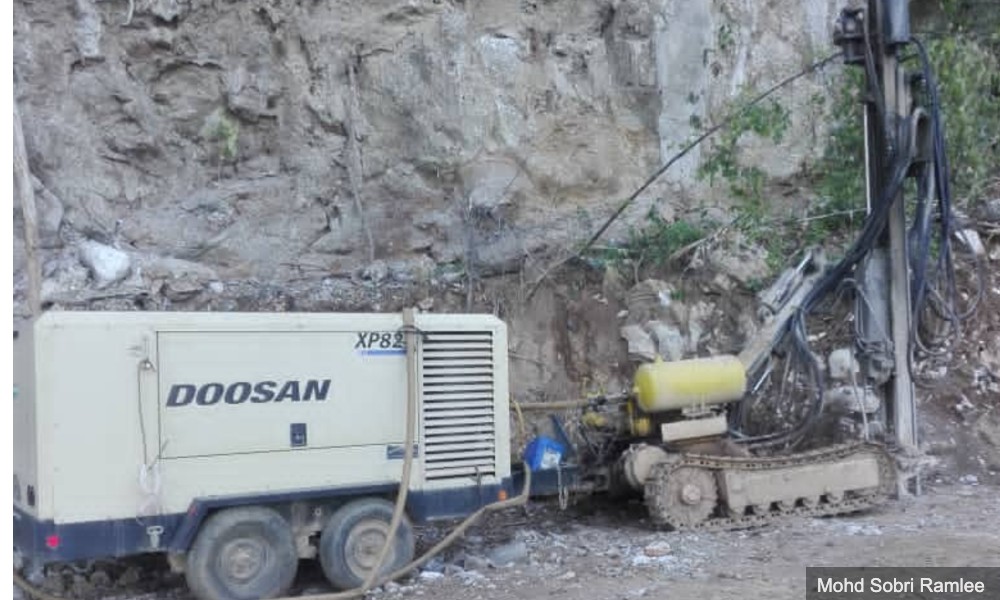
Another vulnerable site is Gua Mat Soorat, within Ipoh, where ancient fossil teeth were discovered. Photos of quarrying at various caves and hills led to a social media uproar in late 2020, with many saying that the geopark status didn’t really provide any protection.
Bats and living libraries
I admit I myself cared little for caves until I went for the Basic Caving Course organised by the Malaysian Nature Society back in 2013. Then I learned that the bats that live in caves are crucial as the main pollinators of durian, petai, langsat, and rambutan.
What will happen to our agricultural harvests when the bats are gone? Bats are also critical for rainforests to regrow after logging, as they disperse seeds in their droppings.
They also control insect pests. In Thailand, each wrinkle-lipped bat eats about 1,130 white-backed planthoppers that destroy rice, every day! The bat population saves almost three million kilos of rice - enough to feed 26,000 people for a year.
Hymeir Kamarudin, an expert on karst landscapes, told me that jagged limestone outcrops are like treasure islands of biodiversity. They are land versions of the world-famous Galapagos Islands, as every hill stands “isolated” amidst a “sea” of surrounding forest, and evolved their own unique flora and fauna after millions of years.
These hills hold huge numbers of endemic species (found nowhere else in the world). For example, 50 to 75 percent of land snail species of West Malaysia live here.
Much of this has not even been studied, said Hymeir, and who knows what hidden treasures they hold? Imagine our great national pride if a Malaysian limestone hill is the place where the worldwide cure for cancer or diabetes is found. Yet, when the specialised habitat of each hill is destroyed, gone too are the unique flora and fauna on them.
Apart from being “living libraries” of biodiversity, our caves are also “time capsules” of ancient fossils, with recent discoveries, including a stegodon (an extinct elephant) and the fish-eating Spinosauridae dinosaur.
And here’s another asset - water! Limestone hills capture and store rain, which then slowly replenishes groundwater, while in Indonesia, quarrying has led to dry taps. In fact, I’ve been told that Ipoh’s karst-filtered water is the secret to the local ladies' radiant skin and why the hor fun, or kway teow noodles, there are extra delicious!
Win-win solution
Our karst conundrum reflects our politics and society. Are we like barbarians, willing to destroy national treasures that we can't even recognise, just for short-term gains? To buy some fancy foreign cars? Or do we value the long-term benefits from sustainable asset management for our grandchildren?
Those who say that we need limestone for construction and cement are right. Surprisingly, we can do both - mining and conservation, namely have our karst cake and eat it too. The solution is to dig for limestone underground so that we can preserve the majority of hills and caves above ground.
Scientific research has shown that 80 percent of limestone is actually underground with only 20 percent above ground, as conservation group Kinta Valley Watch points out.
Ramli Mohd Osman, a geoscience researcher, has noted that idle tin mining land in Perak has 21 billion tonnes of limestone reserves lying beneath, more than enough to last us decades.
Mining limestone beneath the surface is not exotic rocket science either, in fact, it’s already being done at Tasek, Ipoh and Malim Nawar, Kampar.
Sounds like the perfect win-win solution, yes? Well, there is a small problem, as Ramli noted, for the cost of digging underground is “marginally higher”. Is that why the Perak state government is still dawdling over its so-called “sustainable mining plan” with this and that excuse?
Do businesspersons, perhaps with political backing, prefer taking the cheapest way out and just knock down our marvellous limestone hills? Perhaps, some may feel, why bother preserving the beauty of this country when their children will migrate to Australia, where foreigners will then teach them conservation?
For the backdoor government politicians, why conserve local landscapes when what really turns them on are foreign luxury brands like Birkin? Sigh, the colonised mind.
Since mining is a state matter, the only hope is for state governments to make laws so that companies pay that little extra to dig underground, rather than destroy what’s left of our karst treasures. It needs a bit of strategic vision from politicians, rather than the shallow mindset of “grabbing all you can” while in power.
I really hope they act for the greater, long-term good of tourism, agriculture, the environment and to maintain a lovely landscape. For our grandchildren’s futures. Rather than just the short-term pleasure of buying foreign luxury cars - which will become rusty junk in 25 years.
ANDREW SIA is a veteran journalist who likes teh tarik khau kurang manis. You are welcome to give him ideas to brew at tehtarik@gmail.com.
The views expressed here are those of the author/contributor and do not necessarily represent the views of Malaysiakini.




Are you sure you want to delete this comment?
This action cannot be undone.