




Syariah law in Aceh
When you ask Acehnese people what they think of the way Syariah law is interpreted and applied in Aceh, you'll get many opinions. Working for a local NGO (Forum Bangun Aceh) in Banda Aceh for five months, I had a chance to hear the richly-textured thoughts and feelings of many Acehnese people about syariah law that has been implemented since 2003 in their homeland.
As for me, I knew nothing about syariah Islam, beyond the fact that it was in place in Aceh and I was entering a very devout society.
Syariah law itself literally means "the path to a watering hole," it is an ethical, moral and legal framework of rulings on everyday life, including the act of worship and all human interaction and transaction.
When you ask Acehnese people what they think of the way Syariah law is interpreted and applied in Aceh, you'll get many opinions. Working for a local NGO (Forum Bangun Aceh) in Banda Aceh for five months, I had a chance to hear the richly-textured thoughts and feelings of many Acehnese people about syariah law that has been implemented since 2003 in their homeland.
As for me, I knew nothing about syariah Islam, beyond the fact that it was in place in Aceh and I was entering a very devout society.
Syariah law itself literally means "the path to a watering hole," it is an ethical, moral and legal framework of rulings on everyday life, including the act of worship and all human interaction and transaction.
It is in the interpretation of Syariah law that these rulings become specified rules, enforceable by the religious authorities of a state. In Aceh, these make up the Aceh qanun.
Before I continue, it must be clear that I am not talking about syariah Islam as is found in the Quran and the Sunnah (the teachings and deeds of the prophet Muhammad). This article focuses on the interpretation and implementation of Syariah law in Aceh.
On top of my frequent conversations with Acehnese co-workers and friends about Syariah, I conducted a series of interviews with officials from the Provincial Office for the Department of Shariah (Dinas Syariah), the Syariah police (Wilayatul Hisbah) and the Syariah Courts (Makamah Syariah) to hear the official perspectives on Syariah Islam interpretation and implementation in Aceh. I found out that there are many problems with the way Syariah Islam is being interpreted and implemented in Aceh.
The most common complaint about the interpretation of Syariah was that it does nothing to stop corruption. Aceh, like the rest of Indonesia, pays a high price for rampant, systemic corruption which percolates through all layers of governance, decision-making, law enforcement, and since the tsunami, aid work. There is a lack of will to stop corruption.
When I asked M Saleh Suhaidi, head of Syariah and Social Research at the Syariah Department, what his department was doing to stop corruption, he said that there will be a new ruling on "stealing" later in 2006. There is no mention of the term "corruption" because, in his words, "stealing is a more general term, that includes corruption." It appeared the Dinas Syariah was not
doing anything to investigate the cases of corruption involving Oxfam and Save the Children's building contracts, widely reported in local and national newspapers. He answered Syariah Law could not do anything because "when NGOs do not register money, then the contractors do bad jobs, you cannot prove anything."
In my interview with the Secretary of the Syariah Courts, Pak Basri said there had been no corruption cases until now. I asked him what is the biggest challenge to stopping corruption? He shrugged and said there is no challenge, but there must be proof, "a lot of evidence in writing, witnessesit is complicated." The thinly-veiled lack of will (or incapacity) to fight corruption within the institutions that are supposed to be upholding Islamic morality and ethics, was upsetting to say the least.
Unfair to women
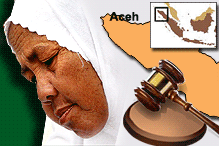 A second strong complaint is being voiced by local and national women's organisations and activists, and some international NGOs and shared by many students, aid workers and NGO leaders.
Syariah interpretation in the Qanun discriminates against women. Suraiya Kumarazzaman, the founder and executive director of Flower Aceh, a local women's organization, says the Qanun contains more laws than there are in the Quran. She says "they have no right to arrest people for not wearing jilbab for instance, when it is not considered a crime in Al Quran." When I was in Aceh, there were frequent reports of women caught in sweeps (what some Acehnese called 'razziah') for not covering their heads, and they often complained they were treated like prostitutes by Syariah police.
Moreover, when probed, M Saleh Suhaidi, the members of the Syariah police and Pak Basri of the Shariah Courts, all admitted the Qanun was still unfinished, although implementation has already started. For instance, the Syariah police officer Pak Suwardi, said there was "no clear punishment and witness information" in the current Qanun. Yet, they had already caught and got several people arrested and punished under Syariah Law. Although one of the requirements for becoming a Syariah policeman is for an Acehnese to be able to read and interpret the Quran,
Pak Suwardi needed to be reminded by my Acehnese translator that the Quran states you need four witnesses for adultery. Earlier, he had said they had arrested a couple for adultery with only two witnesses, both of whom were Syariah police. While the important rulings in Syariah are ambiguously conveyed in the Qanun, others with no basis in the Quran are being added. For example, Syariah police can be spies, go undercover, and men and women cannot be alone at close quarters.
A lot of people complain of this discrepancy between the Quran and the Aceh Qanun. What is the point of only partially applying Syariah Islam, or focusing on a few rulings, while ignoring others, when it is a holistic structural framework that covers all aspects of day-to-day public and private life?, they asked.
New era
Ironically, Syariah officials claim to be heeding the people's preferences when compiling the Qanun. MS Suhaidi admitted this was a "teething period" for Syariah Law in Aceh. He said they were "getting feedback from the people" and adjusting the Qanun. Pak Basri said that depending on how people respond, the enforcement of the Qanun may include all of the Hudud laws, including more serious corporal punishments.
Yet, the people they are supposedly listening to, do not even know where they can get their free copy of the Qanun, nor do they know where and when they can attend any meetings to decide about the Qanun. MS Suhaidi said there are yearly meetings where the public can participate. It was coming up in June 2006, and although it was already mid-May, he said he didn't know where and when exactly. Moreover, when people do voice their concerns about Syariah in Aceh, they are stigmatised, especially if they are women. Earlier this year, a local newspaper's frontpage headline declared that a female activist 'taubat', a strong disparaging term which means to become a good Muslim, after she was reported to have criticised Syariah Law interpretation and implementation in Aceh.
Here's a new era for Aceh, a chance to rebuild and prosper after 30 years of conflict, and the devastating tsunami. Like it or not, Syariah Law is here in Aceh for now. The current Syariah interpretation in Aceh is widely contested, creating, through its contents, and by its enforcement, deep concerns about its ability to establish the justice, freedom, equality and dignity it is supposed to.
While Aceh's Islamic jurists, scholars and officials would like to think their interpretation of Syariah comes close to the Syariah rulings of the Quran, it remains human interpretation. And every interpretation, as M Saleh Suhaidi said, is specific to its cultural, historical, social, economic and political context, and to that, I'd add personal too. So it is important that the contents and enforcement of the Qanun be constantly challenged, and opinions be voiced freely, without being stigmatised and defiled for being a bad Muslim.
Aceh is going through a learning process with regards to Syariah Law. Dr Muzzamil Siddiqi, president of the Fiqh Council of North America, described one of the goals of Syariah as promoting and protecting religion, life, mind, honor and property. Indoctrination has never achieved such ideals. But cultivating dialogue and giving voice to the Acehnese people, will bring Aceh closer to the true Syariah Islam.
JULIETTE LIZERAY is worked in Aceh from Dec '05 to May '06, for the Forum Bangun Aceh (FBA) a local NGO engaged in livelihood and education rehabilitation. She is a Master's student of Anthropology and Development at the London School of Economics and can be reached at
yu_mingyu_ming@yahoo.com


