




In memory of Kamarulzaman Teh, freedom fighter
At 10.30am on November 5, 2002, a 82-year-old man from Pahang passed away in his old comrades' house in southern Thailand ending a life that was to become an epitome of the true history of the struggle for independence of his and our - homeland.
No many people in his homeland knew about him anymore at that time but four years later, the posthumous biography of Kamarulzaman Teh or more affectionately known to his friends as Pak Zaman (1920-2002) has finally seen the light of day.
At 10.30am on November 5, 2002, a 82-year-old man from Pahang passed away in his old comrades' house in southern Thailand ending a life that was to become an epitome of the true history of the struggle for independence of his and our - homeland.
No many people in his homeland knew about him anymore at that time but four years later, the posthumous biography of Kamarulzaman Teh or more affectionately known to his friends as Pak Zaman (1920-2002) has finally seen the light of day.
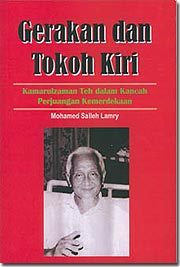
Authored by a retired historian and anthropologist of Universiti Kebangsaan Malaya (UKM), Dr Mohamed Salleh Lamry, the Malay-language Gerakan dan Tokoh Kiri Kamarlzaman Teh dalam Kancah Perjuangan Kemerdekaan (SIRD, Petaling Jaya, 2006) is indeed a very meaningful tribute to a man who, after fighting off the Japanese invader, was nearly hanged by the British colonialists and certainly incarcerated for 22 years for his political conviction from 1948 to 1970.
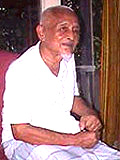 Kamarulzaman Teh, born in 1920 in Kampung Tanjung Broga of Mukim Sanggang, near Pahang's Temerloh, completed five years of Malay-language primary school education and studied up to Standard 7 in the English-language Clifford School in Kuala Lipis before graduating from the Serdang Agricultural School in Selangor. After that, he worked as a Malay agricultural subordinate under the colonial administration from 1940-1941.
Soon after the Japanese invasion and occupation of Malaya, Kamarulzaman joined the underground resistance with his Chinese friends in coordination with the 6th Independent Regiment of the Malayan People's Anti-Japanese Army (MPAJA) operating in western Pahang. In 1943, he joined and was admitted into the Communist Party of Malaya (CPM) which then organised and operated the only functioning resistance to the occupation after the British's 70-day Malayan Campaign.
Not overnight conversion
The conversion from a Malay kampung boy and junior government officer to a card-carrying member of the Communist Party of Malaya certainly did not happen overnight. According to Mohamed, there had already been communist cells in western Pahang as early as the 1920s and some of their Chinese members became friends of Kamarulzaman who enjoyed reading, among other books, Victor Hugo's Les Miserables which propagated the ideas of liberty, equality and fraternity.
 Moreover, when Kamarulzaman was a school boy in late 1920s and early 1930s, he had already heard about the names and legends of renowned Indonesian Marxists and agents of the Communist International (Comintern) like Mas Alimin Prawirodirja (1898-1964) and Ibrahim Datuk Tan Melaka (1894-1949) who visited Malaya several times in the 1920s to survey the ground for the establishment of a communist party. Mas Alimin also appears in
Alias Chin Peng: My Side of History
as a guest of the Malayan communists in 1946 in Kuala Lumpur on his way home to Jaya from the Soviet Union and China.
Moreover, when Kamarulzaman was a school boy in late 1920s and early 1930s, he had already heard about the names and legends of renowned Indonesian Marxists and agents of the Communist International (Comintern) like Mas Alimin Prawirodirja (1898-1964) and Ibrahim Datuk Tan Melaka (1894-1949) who visited Malaya several times in the 1920s to survey the ground for the establishment of a communist party. Mas Alimin also appears in
Alias Chin Peng: My Side of History
as a guest of the Malayan communists in 1946 in Kuala Lumpur on his way home to Jaya from the Soviet Union and China.
On the morning of June 20, 1948, Kamarulzaman was arrested on a charge of illegal possession of firearms and he was tried in court, convicted and sentenced to death by hanging but his sentence was later commuted by the then Sultan of Pahang. Kamarulzaman continued to serve time in Kuala Lumpur and Seremban until 1962.
Immediately after his conditional release in 1962, he was again detained without trial or charge for another eight years under the Internal Security Act which was legislated two years earlier to consolidate all the emergency powers, which include indefinite detention without charge or trial.
Worked for bus company
While under prolonged detention, his wife who married him in 1947 asked for divorce and left him. In the 1950s while he was inside the colonial jails, he was made an honorary member in absentia of the Headquarters of the all-Malay 10th Regiment of the communists' Malayan National Liberation Army (MNLA) led by Abdullah CD.
Upon his final release from incarceration after 22 years, he took up a job with a bus company in his hometown Temerloh and joined the legal People's Socialist Party of Malaya. He also became a central committee of the party from 1981 to 1989 and also contested for the parliamentary seat of Temerloh for the party in the 1974 general election.
As a sequel to the Gerakan Kiri Melayu dalam Perjuangan Kemerdekaan (Penerbit UKM, Bangi, 2006), Kamarulzaman Teh's posthumous biography zooms in the more micro aspects of the earlier book: it focuses only on the origin and development of the political ideas and movements of the Malay Left in Pahang as well as one representative personality whose life story and political transformation was typical.
The author, Mohamed Salleh Lamry, who retired after serving as an associate professor in UKM's Faculty of Socal Sciences and Humanities, has certainly performed a great public service of rediscovering the long lost dimensions of the anti-colonial movement and struggle for independence.
JAMES WONG WING ON, a former MP, now enjoys reading and writing about history. He can be reached at james@malaysiakini.com


Are you sure you want to delete this comment?
This action cannot be undone.