




Straightening out Malaysia
Call me an incurable optimist, but my first reaction to the announcement of the cabinet's cancellation a few months ago of further work on the project variously referred to as the "half", "scenic" or "crooked" bridge was that it might be the beginning of the end for half-baked, cynical and crooked activities in Malaysia.
 A full stop, at last, to the squandering of public money on grandiose, graft-riddled, ego-building schemes, and a message to the self-interested and self-enriching politicos, civil servants, crony capitalists, kickback-paying contractors and other beneficiaries of such schemes that the people and at least some authorities in Malaysia would no longer tolerate or fund crooked bridges, crooked roads, crooked gas pipelines, crooked dams, crooked land deals, crooked public, commercial and housing developments, crooked waste disposal, crooked jails, crooked logging... and so on. And on and on and on.
Call me an incurable optimist, but my first reaction to the announcement of the cabinet's cancellation a few months ago of further work on the project variously referred to as the "half", "scenic" or "crooked" bridge was that it might be the beginning of the end for half-baked, cynical and crooked activities in Malaysia.
 A full stop, at last, to the squandering of public money on grandiose, graft-riddled, ego-building schemes, and a message to the self-interested and self-enriching politicos, civil servants, crony capitalists, kickback-paying contractors and other beneficiaries of such schemes that the people and at least some authorities in Malaysia would no longer tolerate or fund crooked bridges, crooked roads, crooked gas pipelines, crooked dams, crooked land deals, crooked public, commercial and housing developments, crooked waste disposal, crooked jails, crooked logging... and so on. And on and on and on.
I also fancied, rather foolishly as it now seems, that the dumping of the crooked bridge project might spell the demise of not just other crooked infrastructure projects, but of bent activities of every kind, from crooked floats of two-ringgit companies crookedly awarded mega projects with or without the tedious tender process, through crooked "enforcement" of the health, safety, environmental, traffic, parking and other regulations, statutes and laws, to the sometimes clearly crooked administration of the law itself, as witnessed in, by way of that extreme example, the Anwar Ibrahim sodomy trial.
I could go on and on here about the catalogue of crookedness that all honest and upright Malaysians have very good cause to be angry about, as so very many of them apparently are, but unfortunately I don't have the evidence-amassing resources of a major news organisation.
 Not that this would help me much, to judge from what I see and hear in the "mainstream" press and on Media Prima's free-to-air television channels. Despite the premier's stated approval of criticism, most of the print and electronic media seem as meek, mealy-mouthed and outright crooked as ever when it comes to "investigating" and "reporting" on matters like the famous crooked bridge, on which their stories and government "transparency" were as murky as the troubled waters the structure in question was supposed to cross.
In fact most of the newspapers don't actually reveal or report on crooked schemes at all, but confine themselves to printing the officially-sanctioned "spin" on those that for one reason or another can no longer be concealed, hushed-up or ignored.
Unconvincing claims
 I'm personally no more convinced by the claim that "Singapore demanded too much sand and airspace" is anything like the whole story on why the crooked bridge project was terminated at such vast and ill-justified expense than I am by the usual ritual hand-wringing and platitudes with which the media habitually cover - or rather help cover up - the sort of crookedness that causes one fiasco after another.
Among these are:
- the still unexplained and unaccounted-for AP scandal;
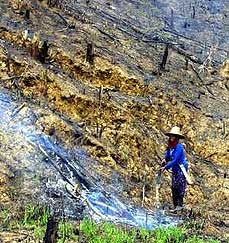 Then there are the far-from-straight answers we've been getting on the question of whether Malaysian companies are responsible for at least some of the illegal burning causing the smoke from Sumatra and Borneo. Foreign Affairs Minister Syed Hamid Albar recently as good as conceded that they are when, in the course of calling on Indonesia last week to co-operate in tackling the haze, he made the curious remark that "we can take action against the perpetrators but it may not stop the problem".
If Malaysia can take action against the perpetrators, why doesn't it? And what possible motivation or excuse could it have for failing to take such action against these firebugs year after hazy year?
On a brighter note, one senior civil servant who does seem to come across as a straight-shooter is Customs director-general Abdul Rahman Abdul Hamid, who seems determined to prosecute a number of companies, including one controlled by Senator Muhammad Abdul Ghani and his son, which are suspected of using "cloned" APs to import more cars than they're entitled to.
But let's not get too hopeful that this seeming straight-forwardness signals a general trend. It appears that the palatial mansion being built for Port Klang state assemblyperson Zainal @ Zakaria Deros without a permit on land alientated by his wife Zizah Ngah in a low-cost housing area is not to be demolished as illegally-constructed buildings are supposed to be, and as indeed many less pretentious ones have been.
I agree with Transparency International president Ramon Navaratnam that this istana be allowed to stand, if for no other reason than as a symbol; a concrete example to any of us who were so nave as to see the dumping of the crooked bridge project as some kind of positive sign, that a great deal of straightening-out remains to be done.


Are you sure you want to delete this comment?
This action cannot be undone.