




The palace and the premier
The nonchalance with which the Umno supreme council shrugged off the multiple scandals involving former Klang municipal councillor Zakaria Md Deros must have stunned many.
This leads to the inevitable question: Has the prime minister's much hyped - but now almost forgotten - reform agenda to combat corruption and restore integrity to the government come to an end?
Zakaria, also a Selangor assemblyperson, was found to be illegally building a palatial residence on land acquired under dubious circumstances. He was also operating an illegally built restaurant on state reserve land.
The nonchalance with which the Umno supreme council shrugged off the multiple scandals involving former Klang municipal councillor Zakaria Md Deros must have stunned many.
This leads to the inevitable question: Has the prime minister's much hyped - but now almost forgotten - reform agenda to combat corruption and restore integrity to the government come to an end?
Zakaria, also a Selangor assemblyperson, was found to be illegally building a palatial residence on land acquired under dubious circumstances. He was also operating an illegally built restaurant on state reserve land.
On Nov 2, the Umno supreme council deliberated the Zakaria case which had dominated the headlines.
Emerging from the meeting, party president and premier Abdullah Ahmad Badawi announced that the only action to be taken would be to tell Zakaria to withdraw from the swearing-in ceremony for councillors scheduled on Nov 8.
Asked why no further action would be taken, including reviewing the position of the Klang division chief, Abdullah said Zakaria had been a good leader and his wrongdoings were not party matters.
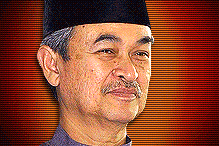 "It has to do with the government. It is enough for us to decide that he should not be appointed councillor," Abdullah explained.
With this, the transgressions that had enraged decent-minded people and brought into serious question the integrity of the ruling coalition's governance system were swept under the carpet.
Such arrogance and contempt for public opinion by Umno and the prime minister in covering up the wrongdoings of the ruling elite is a matter of the gravest concern to the nation.
It not only signifies that Abdullah has given up any pretension to a reform agenda, but also casts doubt on his ability to uphold the rule of law.
Absence of curiosity
To understand the seriousness of the implications, we need to consider what was involved in the Zakaria case:
- He was building a four-storey 17-room mansion, reputed to cost RM8 million, without planning approval from the Klang Municipal Council (MPK).
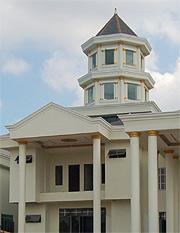 Amidst the complexity of the case against Zakaria, a main question for anyone who has seen a photo of his mansion-in-the-making has to be: Gosh, where did he find all that money to build this palace, being only a councillor, not a tycoon?
Regrettably (or rather as expected), no one in authority has expressed similar curiosity. If Abdullah's government is determined to wipe out corruption, shouldn't the Anti-Corruption Agency (ACA) and Inland Revenue Department have jumped in to investigate the legitimacy of Zakaria's apparent wealth and tax records?
Why the deafening silence from the relevant agencies? Or is it taken for granted that someone from the ruling elite is entitled to ostentatious but unaccounted-for wealth? The answer seems to be a resounding 'yes', judging from Umno's handling of this case and the nonchalance of the law enforcing agencies.
With this understanding, it does seem logical that Umno should have dispensed with the Zakaria case the way it has done - quit the council, full stop, lest it stirs a hornet's nest. Expressed alternatively, it is called optimum damage control - appearing to punish but actually preserving the status quo so that both the public and the culprit remain happy.
Umno is of course aware that if a full probe were conducted, strictly according to law, that the consequential damage may spread like wildfire since its own structure is so fire-prone.
Irresistible conclusions
Under current political realities, citizens may be powerless to force the ruling coalition enforce laws on the elite, but surely the people are entitled to express concern. This is what I propose to do.
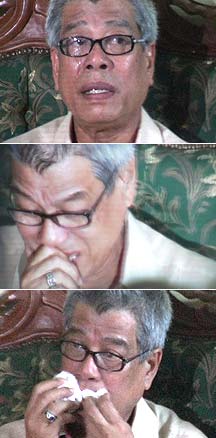 By examing the list of ways in which Zakaria (
photo
) has breached the laws, we may draw a few irresistible conclusions.
By examing the list of ways in which Zakaria (
photo
) has breached the laws, we may draw a few irresistible conclusions.
First, Umno leaders like Zakaria have been acting as if they are above the law.
Second, such breaches by the ruling elite are deemed acceptable by the authorities, since these have been going on with impunity for many years.
Third, the breaches deemed to be corrupt practice - such as alienating state land on illegitimate grounds or below market value - could not have been committed without collusion from other parties such as the land office, state executive council and the chief minister. Thus, apart from the beneficiaries of these corrupt acts who are surely guilty, other people connected to these acts may also be found guilty for either abetment or dereliction of duty.
Fourth, all the relevant authorities who wilfully condoned the breaches of law are guilty of neglect and the officers concerned ought to be subjected to disciplinary action or severe punishment if found to be involved in corruption.
Fifth, the culture of corruption, elitist abuse of power, inefficiency and apathy have seeped through both the political leadership and civil service in Selangor, from chief minister through the state executive council to the municipal councils. Equally alarming, is that federal enforcement bodies such as the ACA, police, attorney general and the housing and local government ministry have been proven impotent in bringing the culprits to book.
Sixth, since Umno dominates Barisan Nasional (BN), the political culture exemplified by the conduct of Zakaria and his associates must be be prevalent in the country with the exception of Kelantan, which is controlled by PAS.
Questionable logic
Returning to Abdullah's press conference, I fail to see his logic in letting Zakaria off lightly.
He said Zakaria's political position should not be disturbed because of transgressions of law are a government matter. If that is the case, why wasn't his case handled by the cabinet? Why should his fate have been decided by the Umno supreme council and not the federal cabinet?
(Incidentally, doesn't this incident confirm the oft expressed opinion that it is Umno which wields real power, not the BN?)
Abdullah also said Zakaria is a good party leader. This exertion is strange indeed. Can a scandal-tainted person known as a habitual and atrocious transgressor of the law be a good leader? If a prime minister answers 'yes', what can we make of him and his leadership?
 Abdullah considers the deprivation of municipal councillor-ship as good enough punishment for Zakaria. But what about the legitimacy of his wealth, tax records, acquisition of state land alienation of land to a third-party at a price injurious to the state?
Since this scandal has assumed top prominence, creating a crisis of confidence, shouldn't an effective prime minister have promptly ordered proper action - waking the ACA and police from their slumber - and restore confidence to the government?
With the dictatorial power vested in the government, there is no doubt that Umno will ride roughshod over this incident without hindrance, but it will serve the party well to ponder how far it can proceed without bringing calamity to itself and the nation.
As for Malaysians, this provides a good insight and a chance to take stock of the true state of governance that our elected leadership is providing.
Can we afford to keep the status quo? If not, is there any hope that the same leadership will bring about the changes needed to avert disaster?
KIM QUEK is a retired accountant.


Are you sure you want to delete this comment?
This action cannot be undone.