


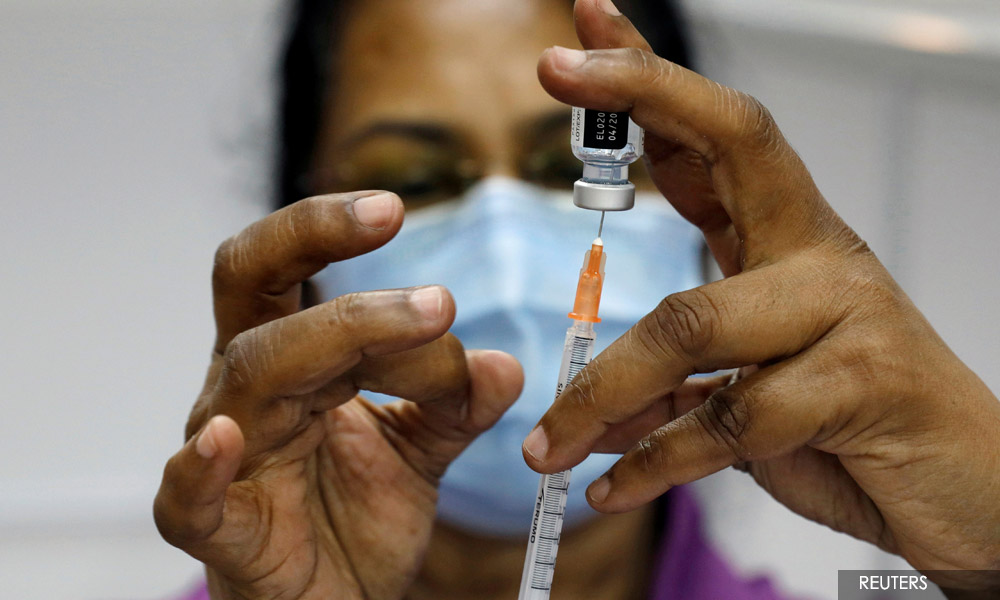

COMMENT | Should we force Malaysians to take vaccines?
COMMENT | The first known anti-vaxxer was a pastor in the United States. Bearded, stern-looking, and dignified, Henning Jacobson’s portraits hang in the homes of anti-vaxxers today, far outstripping his reputation as a founder of an immigrant church of poor labourers.
Cambridge, Massachusetts was the epicentre of the deadliest disease known in history in the 17th century: smallpox. The city has made vaccination mandatory, and they went door to door to persuade people to vaccinate – not unlike what we have today.
When they reached Jacobson’s door, he refused vaccination and said that nobody could tell him what to put in his body.
Jacobson had reasons to fear. The vaccination mandate was implemented like a dark operation. The government would send a team of vaccinators – like SWOT teams – into small districts in the middle of the night, inspect their arms for vaccine scars; if there were none, the vaccinators would inject the needle into their arms.
People were afraid. They were “jumping out of windows and...
COMMENT | The first known anti-vaxxer was a pastor in the United States. Bearded, stern-looking, and dignified, Henning Jacobson’s portraits hang in the homes of anti-vaxxers today, far outstripping his reputation as a founder of an immigrant church of poor labourers.
Cambridge, Massachusetts was the epicentre of the deadliest disease known in history in the 17th century: smallpox. The city has made vaccination mandatory, and they went door to door to persuade people to vaccinate – not unlike what we have today.
When they reached Jacobson’s door, he refused vaccination and said that nobody could tell him what to put in his body.
Jacobson had reasons to fear. The vaccination mandate was implemented like a dark operation. The government would send a team of vaccinators – like S.W.A.T teams – into small districts in the middle of the night, inspect their arms for vaccine scars; if there were none, the vaccinators would inject the needle into their arms.
People were afraid. They were “jumping out of windows and running the other way, or are getting doctors to sign phoney vaccination certificates”. On a few occasions, downright violence was used to enforce vaccines.
Jumping out of the window to avoid vaccines
With the backing of the community and lawyers, Jacobson’s case reached the Supreme Court and it was the first time the ultimate question of “individual liberty versus collective interest in a pandemic” was dealt with extensively.
In the courtroom, familiar anti-vaccine arguments such as “unnatural”, “ungodly”, “unconstitutional” were presented – not unlike the microchip theory we have for the Covid-19 vaccine today which combines all three in one.
The court decided that as long as a person is fit to receive vaccination, an individual does not have a right to refuse vaccination, because the collective interest of health and safety far outweighs an individual’s right.
In fact, real liberty could only exist if you do not present existential harm to another individual. In the same way, the government can raise an army and require anyone to be a soldier, the government could require vaccination in the war against a deadly disease.

Although the government was victorious, the decision unleashed a concerted anti-vaccination movement that described vaccination as a form of “medical tyranny”, among others.
Every pandemic since then has seen a rise and emboldening of the anti-vax movement resulting from mandatory vaccination measures.
But it was precisely the mandatory mass vaccination campaign that smallpox became the first human disease to be completely eradicated from humanity.
It took more than half a century later before we had another human disease in the form of AIDS. We conquered a disease because we made vaccination mandatory.
There are two main lessons we could take from Jacobson’s story. One, mandatory measures always carry a risk of strengthening the anti-vax movement.
Two, everyone must expect to compromise their individual liberty and choice, whether in the form of vaccination injection or stripping of basic privileges – something has to give.
Why making anti-vaxxers life difficult is justified
The game plan, therefore, is to put mandatory measures as a last resort but to scale up restrictions on the unvaccinated population so that their lives are increasingly difficult and inconvenient.
The government should empower business sectors, society, and individuals to set their desired vaccination rules.
If a restaurant, fashion boutique or mall wants to require vaccination before entry, they ought to be encouraged.
If a company wants to make vaccination mandatory for office work, or even imposing a financial penalty for such failures, they could be given the power to do so. If a couple wants to disinvite friends who are unvaccinated to their wedding, that ought to be allowed.
This is because any humane government must take the side of science, economy, and feasibility. The scientific evidence of vaccine efficacy and its correlation in pressing down Covid-19 cases and hospitalisation count is overwhelming, removing any real opposition against its use.
On the economy, sectors that have been severely affected by the pandemic like entertainment, restaurants, schools, ought to be given the chance to save themselves by taking the side of vaccines.
Lastly, although we could still appreciate the value of personal choice and individual liberty, it pays to ask how long more could we sensibly persuade anti-vaxxers to change their minds?
We could try diverse education approaches, build trust through community leaders, and provide proven case studies, but how many more ways could we do it before the cost of changing one anti-vaxxer’s mind becomes too high?
Granted, the anti-vax groups are not a monolith. Not every anti-vaxxer is combative, uncooperative, and arrogant.
That is why we give this diverse group of people the space to figure out, but unlike most optional items in this world, the clock for the pandemic is always ticking. The longer we wait, the bigger the threat.
As the weeks go by and the contours of normalcy return with a small group of vocal anti-vaxxers as the final barrier, it is fair to say to them: “Time’s up.”
JAMES CHAI is a political analyst. He also blogs at www.jameschai.com.my and he can be reached at jameschai.mpuk@gmail.com.
The views expressed here are those of the author/contributor and do not necessarily represent the views of Malaysiakini.









Report this comment
Are you sure you want to delete this comment?
This action cannot be undone.