




Endgame for Umno?
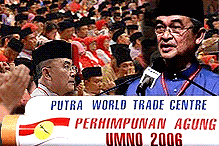
Amidst the sound and fury of sensitive issues of race and religion, most of it bordering on sedition, the Umno annual general assembly last week was eerily silent on the greatest scourge that is slowly but surely destroying the country - uncontrolled corruption.
Equally sidelined during the meeting was the one policy (hitherto taboo) that is most likely to revitalise Umno and the country - restoration of meritocracy.
Instead of confronting the real threats of economic challenges through globalisation, the delegates were overwhelmingly obsessed by imaginary threats to race and religion.
Amidst the sound and fury of sensitive issues of race and religion, most of it bordering on sedition, the Umno annual general assembly last week was eerily silent on the greatest scourge that is slowly but surely destroying the country - uncontrolled corruption.
Equally sidelined during the meeting was the one policy (hitherto taboo) that is most likely to revitalise Umno and the country - restoration of meritocracy.
Instead of confronting the real threats of economic challenges through globalisation, the delegates were overwhelmingly obsessed by imaginary threats to race and religion.
That makes one wonder: Is Umno still relevant to this country in this revolutionary era of the borderless battle of the brains, where the fate of a nation is decided by the efficiency, creativity and competitiveness of its people?
Let us get to the bottom line quickly. Why were the delegates so angry if not because many are experiencing economic hardship? Why is prosperity slipping through our fingers if not because new investments are dwindling? And why are new investments dwindling, if not because investor confidence is wanting? In simple language, Malaysia has become increasingly uncompetitive.
 The true picture of the stock market is not pretty, although Umno president and premier Abdullah Ahmad Badawi seemed proud that it had closed at 1,040 - a new height that apparently signalled investor confidence in Umno's leadership.
The index of 1,040 is still some 20 percent below the previous spike. Many indices in this region have been repeatedly hitting new historical heights in recent days. Worse than the index is our market capitalisation. While others have multiplied, we have slipped from the second largest in Asia (excluding Japan, in 1996) to the bottom - a pale shadow of the past.
No amount of excuses can hide the failure of our leadership and disastrous performance of our economy, including Pak Lah's empty boast that he could have doubled Foreign Direct Investment overnight, had he relaxed investment rules.
If what he says is true, how does he explain the fact that private investment was 36 percent of our gross domestic product in 1995, but is only 12 percent now at a time when investment rules have only become more liberal?
The plain truth is that our political leadership has been fooling around in steering this nation with untenable ideology and outrageously antiquated policy for far too long. In the course of this, Umno has not only failed the nation, but also the Malays for whom the party claims to exist.
Poor comparison
It is easy for deputy party head Najib Abdul Razak to blame Umno's failure to achieve the objectives of the New Economic Policy (NEP) on colonialists, but the facts just don't tally.
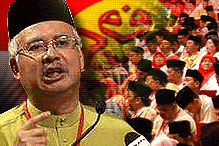 I quote from his speech (
The Star
, Nov 14): "The Malay Agenda is Umno's main task in uplifting the status of the Malays. In the course of history, from 1511 to 1957, we were under the rule of foreigners. After those 446 years of oppression, it is impossible that what is owed to the Malays can be repaid in a mere 20 or 30 years. In this struggle for the Malays, it must be firmly said that there is no time limit...."
I quote from his speech (
The Star
, Nov 14): "The Malay Agenda is Umno's main task in uplifting the status of the Malays. In the course of history, from 1511 to 1957, we were under the rule of foreigners. After those 446 years of oppression, it is impossible that what is owed to the Malays can be repaid in a mere 20 or 30 years. In this struggle for the Malays, it must be firmly said that there is no time limit...."
Najib seems to suggest that, for Malays to progress satisfactorily, the following must be fulfilled:
- They must be adequately compensated by this country for the centuries of wrongs done to them by colonialists.
- Umno must be given a long duration to upgrade the situation of the Malays, so as to bear a reasonable proportion to the 4 centuries of oppression (say 1 or 2 centuries?).
This assertion cannot bear any rational analysis and can best be debunked by looking at some examples.
Japan and Germany were physically and literarily flattened and much of their male population annihilated during World War II. Yet, within two decades, the two rose like a phoenix from the ashes to eventually become the world's second and third most powerful economies respectively.
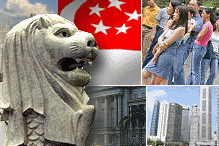 Nearer home, Singapore, part and parcel of Malaysia only four decades ago, ascended to the ranks of the developed and the richest within three decades of its separation from Malaysia.
Weren't the Japanese and Germans in worse shape than Malaysians who have had the good fortune of receiving Independence on a silver platter half a century ago? Didn't Singaporeans also bear the same colonial yoke as Malaysians?
Did the Singaporeans, Japanese and Germans arm themselves with the mentality that the world owes them a living?
Why should Malaysia lag so far behind Singapore, not to mention Japan and Germany? (By the emphatic insistence of all Umno leaders, Malay Malaysians are lagging even further behind than the average Malaysian).
The answer must lie in the qualities of the people and competence of leadership, not the colonial or wartime past. Singapore certainly cannot be considered better endowed by nature than Malaysia. Neither can Japan or Germany.
Corruption and abuse
Then what is wrong with our people and leadership? This is where Malaysians must search their conscience and look for honest answers, if we want to extricate ourselves from the quagmire of economic malaise and endless squabbles on race and religion.
If an independent body of consultants were engaged to provide answers as to what plagues the country, I am quite sure it will come up with the usual list of ills that we are all familiar with - rampant corruption, cronyism and nepotism; low integrity and efficiency of the government; impaired education system producing unemployable graduates; uncontrollable crime rate; deteriorating morality, social problems, etc
 All these can be traced to a corrupt and inefficient political leadership bedeviled by racism and corruption. But isn't Malaysia practising democracy? Why do the people return ab inept political leadership again and again to misrule the country? The answer lies in the fact that the people have been compartmentalised into racial groups and brainwashed into voting along racial lines.
This explains why Umno has to constantly whip up racial sentiments, so as to ensure that its bedrock of electoral support remains sufficiently consolidated to face off electoral challenges. Furthermore, the ruling coalition's electoral superiority has been constantly and critically augmented through devious manipulation of the election process, by abusing the power of incumbency.
How has Umno keep its sheep within the fence all these years? By manipulation of the NEP, the affirmative action plan originally intended to alleviate poverty among all Malaysians, but which soon degenerated into a gigantic umbrella that shelters corruption, cronyism and nepotism under the guise of helping the Malay masses.
This has been done by allegedly dishing out government contracts at inflated prices or through dubious disposal of public assets in opaque circumstances to cronies. Thus billions have been lost from the public coffers, in addition to hampering a competitive economy and stifling genuine entrepreneurship.
True, under NEP, many Malays have benefitted through easily available education facilities and economic opportunities, resulting in the creation of a respectable middle class of professionals and businessmen. But the vast majority remains relatively poor and neglected.
Rampant self-enrichment has resulted in the Malays having the worst intra-community disparity of wealth, and Malaysia in turn has among the worst in income disparities in this region.
It is not difficult to see why Umno is fighting tooth and nail, even to the extent of publicly drawing a keris and threatening to shed blood, to keep the NEP. It is in many ways their lifeline.
It enables leaders to amass wealth which oils the political machinery to maintain or ascend the party ladder (otherwise known as money politics). Above all, the NEP is an invaluable instrument to hoodwink the Malay masses into giving Umno undivided support during elections.
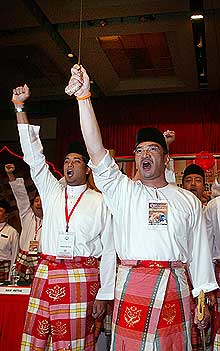 While delegates may have walked away from the conference hall with the satisfaction that their tribal cries must have hit their targets, that the NEP is for keeps, and that Umno hegemony is assured, they should be well warned of the serious consequences ahead.
The lingering tenure of the NEP in its present form, in an ambience of intensifying racial and religious extremism, is a sure recipe for disaster in such a multi-racial and multi-religious country like Malaysia in this age of quickening globalisation.
The minority races may be too weak to force any changes, but global market forces will mete out punishment to such an anachronistic society sooner or later.
National disintegration is on the cards when the economic noose tightens. By then, Malays may be the biggest losers, for they have been made least equipped to fend for themselves.
KIM QUEK is a retired accountant.


