




COMMENT | Should Anwar be blamed for Harapan's Malacca defeat?
COMMENT | Should opposition leader Anwar Ibrahim be blamed for the defeat of Pakatan Harapan in the recent Malacca state election?
The answer is most definitely not.
An analysis of the Malacca election results will conclusively show that Harapan’s defeat is due to two main factors: a) the massive loss of Malay votes and b) the heavy absenteeism of non-Malay voters.
Such loss of Malay support is due to...
COMMENT | Should opposition leader Anwar Ibrahim be blamed for the defeat of Pakatan Harapan in the recent Malacca state election?
The answer is most definitely not.
An analysis of the Malacca election results will conclusively show that Harapan’s defeat is due to two main factors: a) the massive loss of Malay votes and b) the heavy absenteeism of non-Malay voters.
Such loss of Malay support is due to the migration of Bersatu from the Harapan coalition to team up with new partner PAS, which is a result of the Sheraton coup. The latter was originally engineered by then Harapan interim prime minister Mahathir Mohamad to avoid having to hand over the premiership to Anwar as promised earlier.
The non-Malay voter absenteeism is due to the accumulated disillusionment of the Chinese community during Harapan’s short-lived rule over its failure to effect meaningful reforms under the autocratic Mahathir.
The latter cold-stored Harapan’s reform agenda while meticulously ensuring that Anwar was ostracised from his administration.
Anwar a scapegoat
It is seen from the above reasons that the seeds of Harapan’s Malacca defeat were planted by Mahathir during his treasonous premiership.
It is hence the height of injustice to single out Anwar as the scapegoat for Harapan’s disappointing electoral performance.
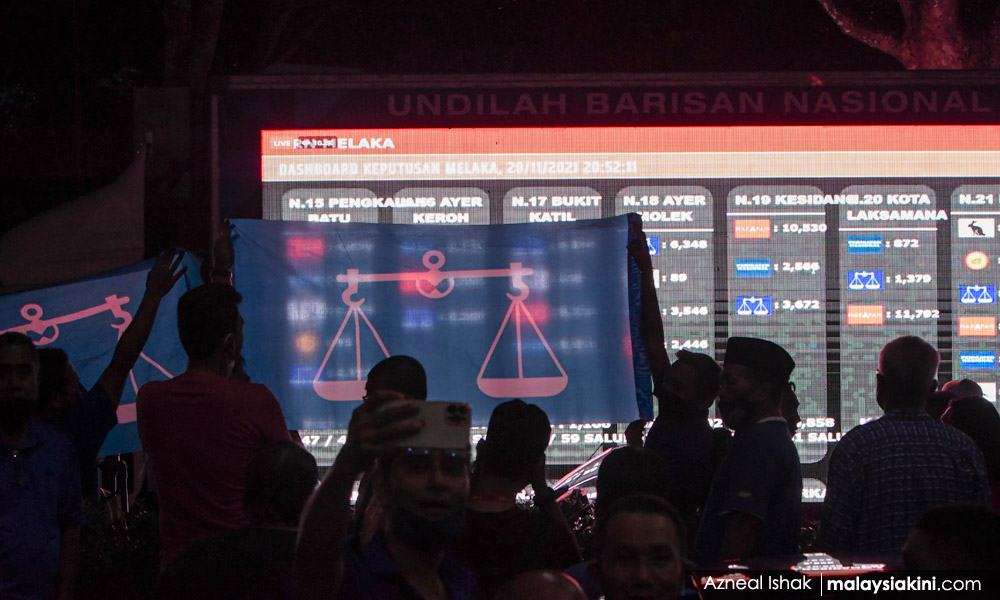
It is also the height of irony that DAP leaders should publicly call for Anwar’s resignation as the Harapan leader when it is DAP which should take the blame for its servile stance towards Mahathir’s betrayal, thus infuriating the Chinese community.
Such fury was given vivid expression when Harapan was humiliated by a crushing defeat in the Tanjong Piai by-election in Johor in Nov 2019, three months before its fall through the Sheraton coup.
At this stage, let me quote some figures from analyst Bridget Welsh’s analysis to illustrate in quantitative terms Harapan’s loss of Malay votes and the extent of absenteeism of non-Malay voters.
Compared to GE14 in 2018, Harapan’s share of Malay votes has been halved from 29 percent to 15 percent, while the turnout of Chinese and Indian voters have drastically plunged by one third, from 84 percent to 55 percent, as compared to Malay voter turnout which declined only 16 percent, from 85 percent to 71 percent.
Such changes in turnout of voters along racial lines resulted in Harapan’s defeat in many marginal seats, as the Chinese are almost monolithically supportive of Harapan, then, as well as now.
As for DAP’s assertion of PKR’s acceptance of former Umno leader Idris Haron as its candidate as the main cause of an electoral backlash against Harapan, this claim is neither logical nor factual.
Idris Haron is no frog
Idris was no political “frog” as alleged. He didn’t jump from Umno to PKR. He was sacked by Umno long before he joined PKR.
He was disaffected by the then Malacca government led by Umno’s Sulaiman Ali and wanted the chief minister’s resignation, and Malacca Harapan saw it as an opportunity to restore its GE14 mandate (stolen through the Sheraton coup) and supported Idris’ move to topple the chief minister.

In fact, Idris would have been hailed as a hero if the Malacca governor had toed the federal line by appointing a Harapan chief minister (who had the majority support through the Idris move) without resorting to a fresh election - to avoid a flare-up in the still-raging Covid-19 pandemic.
If there had been a backlash due to Idris’ PKR candidacy, there would have been a spike in Umno’s share of popular votes, but there was none.
There was only the loss of Harapan’s Malay votes to the new team of Bersatu-PAS and the loss of Chinese votes through their disinterest.
Now that we have settled the issue of the real causes of Harapan’s defeat in Malacca, what is most important for Harapan is to stop the current finger-pointing and reconsolidate the camaraderie of its component parties - to plan and act rationally as one united force to bring the much-needed reforms to revitalise the country.
Treat the Malacca episode as a learning lesson and the steppingstone for the greater things to come in GE15.
KIM QUEK is the author of the banned book ‘The March to Putrajaya’, and best-seller ‘Where to, Malaysia?’.
The views expressed here are those of the author/contributor and do not necessarily represent the views of Malaysiakini.




Report this comment
Are you sure you want to delete this comment?
This action cannot be undone.