


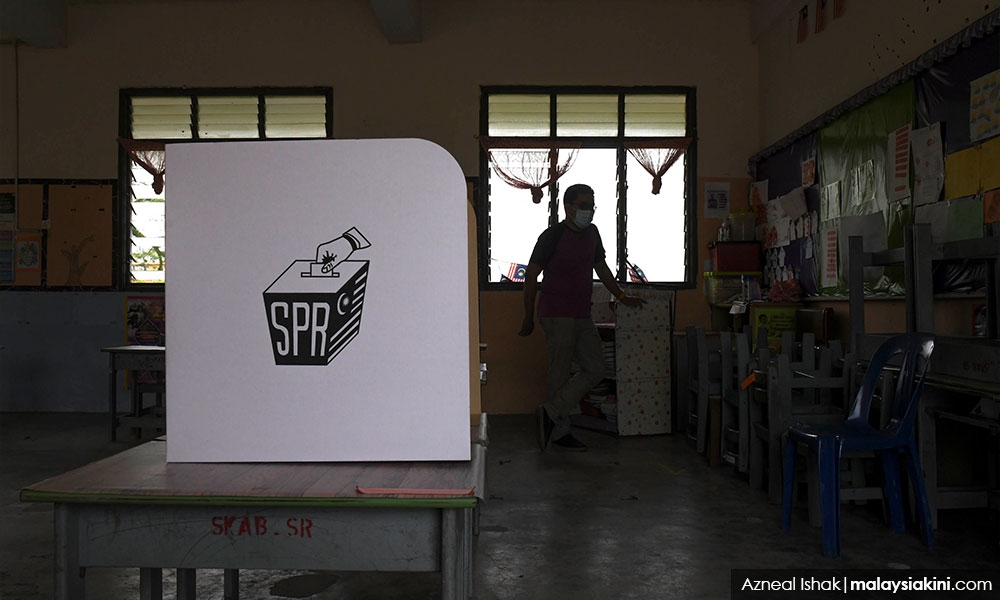

COMMENT | Do we need early elections amidst Omicron?
COMMENT | As speculated, the dissolution of the Johor State Legislative Assembly has been granted royal consent on Jan 22.
Not only will an early election take place for Johor but should Umno win big, Prime Minister Ismail Sabri Yaakob would face tremendous pressure to dissolve the Parliament.
Ismail would be hard-pressed to tear apart the Memorandum of Understanding (MoU) on Political Transformation and Stability with Pakatan Harapan which can keep his government in power till July 31, 2023.
Hence, examining the sensibility and legitimacy of having an early election is necessary now so that the public will be more informed for future early elections.
False comparison with Malacca and Sarawak
The common excuse that has been thrown around to justify an early election for Johor or even Malaysia is this: if Malacca and Sarawak can have their elections without causing a spike in Covid-19 cases, why can’t Johor and Malaysia...
COMMENT | As speculated, the dissolution of the Johor State Legislative Assembly has been granted royal consent on Jan 22.
Not only will an early election take place for Johor but should Umno win big, Prime Minister Ismail Sabri Yaakob would face tremendous pressure to dissolve the Parliament.
Ismail would be hard-pressed to tear apart the Memorandum of Understanding (MoU) on Political Transformation and Stability with Pakatan Harapan which can keep his government in power till July 31, 2023.
Hence, examining the sensibility and legitimacy of having an early election is necessary now so that the public will be more informed for future early elections.
False comparison with Malacca and Sarawak
The common excuse that has been thrown around to justify an early election for Johor or even Malaysia is this: if Malacca and Sarawak can have their elections without causing a spike in Covid-19 cases, why can’t Johor and Malaysia?
This is also basically saying, the 2020 Sabah state election which caused the third wave doesn't need to be a reference point anymore.
This view ignores an important factor: the Omicron variant and the context between the three state elections, and that of Johor and Malaysia.
The Malacca and Sarawak state elections were held after 91.4 percent of Malaysian adults were vaccinated, as of Oct 15, 2021.
However, the emergence of the highly infectious Omicron variant – which landed in Malaysia on Nov 3 – had now effectively made having two doses of vaccines no longer fully vaccinated. Hence, we now have to take booster doses.
Within slightly more than one and a half months, the Omicron cases have risen from 1 to 439 by Jan 18, with 186 new cases between five days from Jan 14 to 18.
Now when did the state elections take place in Malacca and Sarawak?
With 495,195 voters, the Malacca poll ended on Nov 20, nearly two weeks before Omicron’s arrival, while nomination for the Sarawak poll took place a day after the first Omicron case was reported.
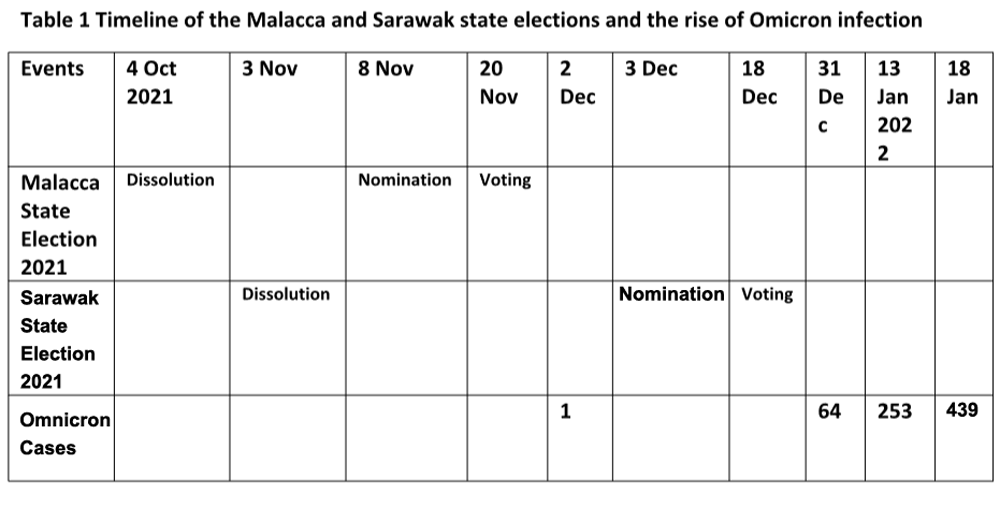
Despite a much higher number of 1,252,014 voters, Sarawak did not report any Omicron outbreak, likely due to three reasons. First, Sarawak was separated from the peninsula by the South China Sea, enabling border control.
Second, the Omicron spread was still in an early stage, recording only 64 nationwide by Dec 31, two weeks after the poll ended. Third, a stringent set of SOP was imposed on elections, which suppressed campaign activities and effectiveness.
Do the favourable conditions in Sarawak mean the same for Johor and the whole country?
Clearly not. First, Johor is not separated from the rest of the peninsula by sea, and after the implementation of Undi18 and Automatic Voter Registration (AVR), Johor is estimated to have 2.6 million voters, twice the number of Sarawak’s voters in December 2021.
Second, Omicron is roaring and has reached 439 cases by Jan 18.
Third, even strict SOPs would be hard to enforce now that dissolution happens before the Chinese New Year. Going overboard would instead alienate some Chinese voters, whom BN hoped to woo back.
To avoid the worst, the Communications and Multimedia Ministry must offer RTM to provide digital campaigning for all parties and candidates, including state-level and constituency-level debates, as better substitutes for rallies and canvassing.
More importantly, the Health Ministry must monitor the numbers closely and if necessary, recommend a state of Emergency before the Johor state poll causes the fifth wave.
Is the EC ready?
Three days ago, Prime Minister Ismail Sabri Yaakob said it is up to the Johor government to decide whether to seek dissolution.
That is constitutionally correct – whether or not a state may have an early election depends on the chief minister who has the sole power to seek assent and the ruler who has the sole power to assent to or decline such a request.
Administratively, another body that should be consulted: the Election Commission (EC). While the EC can decide the nomination and polling dates, the poll must happen within 60 days from dissolution.
If the Johor state legislative assembly is dissolved today, then the state election must be held latest by March 23.
Here comes the challenge. Undi18 and AVR will bring an estimate of 800,000 new voters on top of the 1,817,999 in GE14, or a 44 percent increase.
In 2018, 1.8 million voters were assigned to a total of 964 polling districts (normally one school as polling center per polling district) and 3,486 polling streams (classrooms).
If the 800,000 new voters are to be put into polling streams with 400 voters on average per centre - the Covid-adapted limit imposed by the EC in the Chini by-election - that would require 2,000 streams (classrooms).
As a stream/classroom is normally attended by one presiding officer (Ketua Tempat Mengundi, KTM) and four clerks, another 10,000 election officials would be needed at the lower level, and most of them would likely be first-timers.
The EC has a responsibility to constantly inform the public of their readiness to administer elections. This would allow the public to assess whether the request for dissolution should be sought and consented to.
What the EC must do now is to fix the nomination and polling dates prudently, to give itself the greatest room to carry out its tasks. If necessary, it should fix by or around March 23 than to please the politicians who want to rush it.
The EC must avoid the mess it caused in 2004 because of ill preparation.
Make early elections the exception, not the rule
By design, governments and legislatures in the standard Parliament do not have fixed terms. The legislature can anytime bring down the government through votes of no-confidence or budget defeat and install another new government without going through a new election.
To ensure that the government is not held at ransom by a small group of lawmakers, or trapped by an outdated mandate, an ousted Head of Government (Prime/Chief Minister) has the power to seek an early election to update the electorate’s mandate, instead of resigning.
But consenting to such a request is normally vested in the hand of the Head of State (Monarch or President) who provides another check and balance.
For example, if a new election is expected to return another Parliament with a similar outcome, then it makes no sense for the request for dissolution to have been assented to.
Parliamentarians should instead negotiate for a new stable government formed within the same Parliament.
In pre-2004 Malaysia, after decades of one-party predominance and strongman rule, the power to seek early elections was abused to the extent that a prime minister could irresponsibly and contemptuously tease the opposition, the media, and the public into a guessing game of the election date, while he waited for his “inspiration”.
Frequent changes of government and elections – not to be confused with merely having federal and state elections separately – are bad for economic stability and policy continuity.
Many diplomats and foreigners have expressed their concern about Malaysia’s instability and deteriorating investment climate.
We need not compromise democracy for stability. Instead, we just need to adopt a broader and more up-to-date understanding of democracy and introduce some necessary measures.
First, we should demand every government serve their full term unless they are sacked by the legislature. If necessary, we can introduce a fixed-term Parliament/legislature law.
In fact, Umno has promised a modified version of such a law in Malacca to ensure that the government lasts for at least four years.
Second, we can and should avoid mid-term elections like that in Malacca by introducing a Constructive Vote of No Confidence (CVNC) mechanism, such that no PM or CM can be sacked without a new PM or CM backed by a new majority being available.
Finally, in a hung Parliament, the public should apply pressure for the government and opposition to enter a Confidence and Supply Agreement (CSA).
The era of the dominant party, which inevitably brings corruption and arrogance, is now gone and should not be resurrected.
In fact, if Johor voters want long-term stability, they can and should make clear their desire through ballot boxes.
WONG CHIN HUAT is an Essex-trained political scientist working on political institutions and group conflicts. Mindful of humans' self-interest motivation while pursuing a better world, he is a principled opportunist.
The views expressed here are those of the author/contributor and do not necessarily represent the views of Malaysiakini.



Report this comment
Are you sure you want to delete this comment?
This action cannot be undone.