



COMMENT | Should M'sia abandon its SWN 5G rollout?
COMMENT | Emir Research, a think tank which specialises in developing strategic policy recommendations, has recently published a series of four articles in which it raises important questions about how 5G mobile services should be rolled out in Malaysia.
It claims that “the so-called single wholesale network (SWN) model proposition by Digital Nasional Berhad (DNB), as it stands today, doesn’t hold water from the perspectives of nation-building, technical feasibility, financial and commercial viability as well as governance and integrity”.
In this note, Plum Consulting assesses the validity of this overall claim and the key arguments which Emir has made to support it in its four articles. Our assessment is made in the context of the Malaysian government’s decision between...
COMMENT | Emir Research, a think tank which specialises in developing strategic policy recommendations, has recently published a series of four articles in which it raises important questions about how 5G mobile services should be rolled out in Malaysia.
It claims that “the so-called single wholesale network (SWN) model proposition by Digital Nasional Berhad (DNB), as it stands today, doesn’t hold water from the perspectives of nation-building, technical feasibility, financial and commercial viability as well as governance and integrity”.
On this note, Plum Consulting assesses the validity of this overall claim and the key arguments that Emir Research has made to support it in its four articles. Our assessment is made in the context of the government’s decision between:
Continuing with the single wholesale network (SWN) run by DNB; and
Adopting the dual wholesale network (DWN) option favoured by four of the mobile operators.
Emir Research proposes that there should be two rather than one wholesale network, with each one run by a consortium of mobile operators.
Does Emir understand how SWN will operate?
Some of Emir Research’s observations are factually incorrect because of an insufficient understanding of the architecture of the DNB proposal.
In a “conventional” sharing arrangement, two or more operators would share a tower and may share electronics at the site, using one active radio access network (RAN) to transmit to both of their networks.
The DNB approach is different and is not network sharing. DNB is constructing a single 5G network with exclusive use of the 5G spectrum. This is not shared as such. There will be one set of electronics, using only 5G technology to carry data between base stations and end-user devices and using only the DNB frequencies.
There is no question of linking multiple RANs from different suppliers since there is only one RAN from one supplier.
DNB then links its radio network into the core networks of the operators using standardised network interfaces and the operators share the data capacity delivered to their core networks. They do not share within the radio network and they deploy their own core networks.
An example of the level of misunderstanding is Emir Research’s claim in Article 1 that, “It is unlikely that operators would agree to share active RAN if there is no way to accommodate multiple frequency bands.”
There is no active RAN sharing. The SWN will transmit using the 5G spectrum bands provided to it while the operators will continue to transmit on all their various spectrum bands just as they do now, using 2G, 3G, and 4G technologies.
Another factually incorrect claim by Emir Research in Article 1 relates to the ability of DNB to provide extensive coverage.
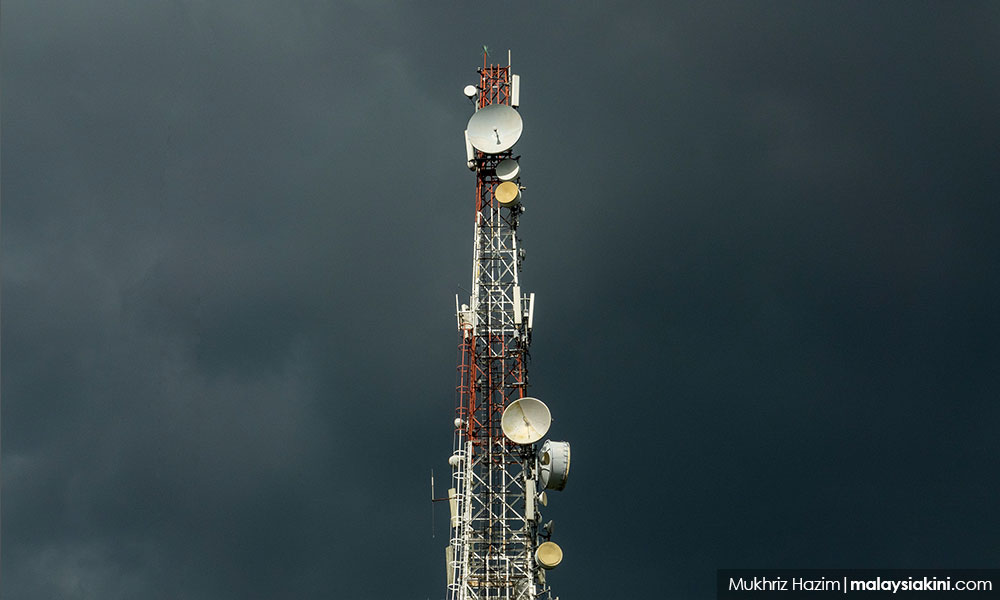
Emir said: “As reported by MalaysianWireless, Malaysia had nearly 23,000 4G LTE towers in 2018, covering roughly 80 percent of the population. So, essentially, how would having less than half the number of sites as 4G towers provide even broader coverage when 5G travels more than 50 times less the distance of 4G?”
It is not the case that 5G travels less far than 4G. Just like 4G, 5G is transmitted on a range of frequencies including at 700MHz and 3.5GHz. If the 700MHz frequencies are used then the coverage will be near-identical to 4G at 800MHz.
Furthermore, many of the 23,000 towers quoted by Emir Research offer duplicate coverage from competing operators in the same local area – especially in urban areas which broadly correspond to an 80 percent population coverage.
If a single monopoly tower company had operated from the start of the rollout of mobile networks, then the number of towers required might be significantly under 10,000.
Would DWN offer greater innovation in 5G services?
Emir Research asserts in multiple articles that the proposed SWN approach limits innovation through lack of competition at the network level and also at the equipment supplier level.
Again, Emir Research’s assertion demonstrates a lack of understanding of how the DNB SWN works in conjunction with each of the mobile operator’s networks. It is important to note that DNB will provide the 5G RAN and then direct the traffic to the core networks of each of the mobile operators.
These core networks will be from a range of equipment suppliers. It is in the core networks of each mobile operator that features are differentiated. Hence, there will be a diversity of solutions leading to rivalrous innovation in terms of the retail services offered.
Further, DNB could choose to add additional suppliers in the future if there were benefits in doing so.
A DWN would not lead to increased competition, spurring innovation at the infrastructure level either. Under the DWN, operators would divide into two groups, ideally with approximately equal market shares. Each group would form a consortium and set up an entity, similar to DNB, to plan and deliver their shared network.
Note that the operators would need to provide long-term commitment to their consortium. They would not be able to move from one consortium to another.
If they were to do so, this would result in the cost base of the consortium they left being spread across fewer operators, likely becoming unviable. It would require network expansion on one network to accommodate new subscribers.
If such a move were allowed, it would very likely lead to one of the DWN consortia collapsing and the result would be an SWN which has similar characteristics to that which DNB is implementing.
Each consortium is a monopoly provider to its constituent operators who cannot leave to join a different consortium. There is therefore little competitive pressure on the consortia.
Should the rollout of 5G services be demand or supply led?
Emir Research suggests that there are two approaches to delivering 5G which they term “demand-driven” and “supply-driven”.
By “demand-driven”, it appears to mean that the network is built in response to a clear demand for its capabilities while by “supply-driven” it means that the network is built in advance of predicted demand, or in the expectation that demand will build in due course.
Across most of its articles, Emir Research believes that the SWN approach is supply-driven whereas a demand-driven approach would be better for Malaysia.
In practice, all mobile deployment is based on predicted demand – an informed variant of being supply-led. This is true whether the operator is upgrading technology (e.g. 3G to 4G) or adding capacity to existing network technology.
In the latter case, for example, mobile operators predict the demand for data usage some years into the future and then model where their network will become congested as a result.
They then put in place plans for adding additional capacity. The predictions of demand growth are generally based on historical evidence from prior years as well as forecasts published by the industry.
The converse approach of waiting until there is congestion in the network and users are actively demanding more capacity, for example, by complaining of congestion, would be very detrimental to Malaysia.

Once congestion occurred, it could take years to address it. During this time, users would experience slow connections, caps on usage and unresponsive applications.
While it is clear that there is an immediate need for 5G to provide additional capacity, there is no guarantee that new applications will emerge to benefit from the enhanced capabilities provided by 5G.
However, it is not possible to wait for these applications and then build 5G. The applications can only emerge once there is a 5G network to support them. Important new applications have emerged throughout the 3G and 4G era and the global mobile industry, governments, and technology futurists are all expecting that this will continue with 5G.
In summary, the model followed by the entire mobile industry, and by DNB, is supply-driven, based on predicted demand. Emir Research is wrong to propose that 5G should be deployed only after the demand for it has emerged.
Is 5G needed yet given level of digital development?
In Article 3 Emir Research argues that there is little point in deploying 5G now in Malaysia because it lacks the digital skills and ecosystem needed to benefit from the advantages that it brings.
In Plum’s view Emir Research’s argument is flawed for two reasons:
The 5G deployment is part of a much broader national initiative, set out in Malaysia’s Digital Economy Blueprint that aims to deliver all the elements of the ecosystem and digital skills needed.
Emir Research underestimates the benefits that 5G can deliver by assuming that it is just a better form of internet connectivity. But the aims of 5G include much faster and cheaper mobile broadband, enhanced internet of things connectivity, and a raft of new applications through its low-latency high-reliability capabilities.
It is these promises that have resulted in governments around the world prioritising national 5G deployments. Clearly, there is strong global momentum behind 5G. Such evidence is in stark contrast to Emir Research’s negative view.
We note that the government recognised this problem when it initially chose the SWN option. “The government has decided to accelerate the deployment of 5G infrastructure network in Malaysia to realise the potential of 5G in creating new economic opportunities and innovation for Malaysia.”
Is SWN the best financial, economic option for 5G rollout?
Emir Research argues in Article 1 that the deployment of an SWN would damage the financial viability of the mobile operators and that this would, in turn, reduce foreign direct investment in Malaysia. This argument appears to put the best interests of the mobile industry ahead of the best interests of end-users.
According to Plum’s analysis, an SWN is more likely to be to the long-term benefit of end-users in that:
An SWN would lead to lower deployment costs and hence to lower end-user prices of 5G services than the DWN option favoured by the mobile operators given that:
Rolling out two wholesale networks would require twice as many 5G base stations under the DWN option because two networks need to be deployed.
The unit cost per base station may be marginally lower under the DWN option. But the overall ten-year cost of ownership under the DWN option will be over 70 percent greater.
These costs will need to be recovered through wholesale charges to individual mobile operators under either option. So wholesale charges would be 70 percent higher for the DWN option.
Wholesale costs represent around 50 percent of end-user costs of service delivery and hence competitive end-user prices. This means that the end-user prices will need to be around 35 percent higher for the DWN than for the SWN option.
An SWN would meet the government’s objective of fast 5G deployment better than other options. Compared with the DWN option the SWN requires only half as many 5G base stations, while the pool of skilled manpower available to make the deployment, in either case, is limited.
If, as Plum believes, an SWN is the option that offers the fastest deployment and the cheapest end-user prices, then this is likely to stimulate rather than reduce foreign direct investment.
Lower end-user prices would induce higher take-up of 5G services, which would stimulate both foreign direct investment and the whole Malaysian economy. Nor do we see why the SWN should result in a drop in market value by the mobile operators unless, under other options, they were able to charge significantly higher end-user prices.
Does SWN offer sufficient network resilience?
Emir Research said in Article 1 that the SWN is less resilient than having multiple networks. This is not true. DNB’s network will be built to be as resilient as any other mobile network. In the unlikely event that the DNB network failed, subscribers would automatically fall back to the 4G network of their chosen retail mobile operator, likely without even noticing this had occurred.
Under a situation where an operator runs an integrated 4G and 5G network, should this fail, all their subscribers will lose connectivity with no fallback. Hence, the SWN delivers increased resilience when compared with many other options.
Will putting SWN under DNB lead to poor governance?
In Article 2 Emir Research questions the way in which DNB will be governed: “Learning from the 1MDB scandal, financial oversight and prudence will be crucial for DNB. Relying on internal governance and code of business conduct subject to the oversight of the board of directors will not suffice.”
In Plum’s view, this is a false comparison. Emir Research’s argument ignores the fact that
DNB is a licensed telecommunications operator with a clearly articulated, detailed, and widely circulated business plan which has been scrutinised by the government, by the mobile operators and by the Communications and Multimedia Commission (MCMC).
As a licensee, just like any other telecommunications operator in Malaysia, DNB will be subject to close scrutiny and extensive regulation by MCMC, an independent regulator established by the MCMC Act. MCMC will monitor DNB’s progress against its plan and regulate the way it supplies wholesale 5G services to mobile operators and mobile virtual network operators (MVNOs) in terms of both price and non-price supply conditions.
The quality of DNB’s operations will be subject to minute by minute, transaction by transaction, scrutiny by the mobile operators each keen to ensure it secures the quality of service promised by DNB.
Has SWN worked anywhere else in the world?
Emir Research argues in Article 4 that because there is little evidence of the SWN model working well elsewhere then Malaysia should not adopt it.
The SWN concept is a relatively new one and it is too early to look for successes elsewhere. It typically takes a decade from network conception to profitable operation – making a comparison sooner than this may well lead to erroneous conclusions.
Nevertheless, the move to an SWN is clearly part of a trend. Over time, mobile operators have increasingly shared networks. Now, in a four-mobile operator market, there are often only two infrastructures, with pairs of mobile operators using the same masts, power, backhaul and more.
In the UK and New Zealand, there are also shared rural networks being deployed (which are SWNs for rural areas), and in some countries, new operators are deploying shared neutral-host networks in urban areas which may become the single 5G network for small cells in areas of high population density.
Emir Research lists eight examples of SWN “implementations” in its Article 4. But on closer inspection, we find that almost all of these are for 4G SWN’s - where the case for multiple wholesale networks is much stronger than for 5G networks.
In two cases (Mexico and South Africa), the implementations are not in fact SWNs and in one case (Brunei) the 4G SWN appears to have been successful.
In Plum’s view, this evidence provides little support for the hypothesis that a 5G SWN will not work.
Emir Research presents some other options such as monopoly provision in an area by a mobile operator coupled with national roaming. While there is insufficient detail for us to be able to evaluate these ideas, we note that there is even less evidence of their adoption globally.
It is unclear why Emir Research requires the case for the SWN in Malaysia to be supported by clearly successful historic deployments elsewhere while it does not demand such evidence for concepts that it supports.
Innovative new ideas, by definition, are not supported by existing evidence. This is no reason why they should not be pursued if they are logically sound.
Conclusions
Across four articles Emir Research has posed some searching questions about the SWN proposal. It is right and proper that such a major decision should be subject to scrutiny. But we have shown here that Emir Research’s concerns about the SWN are generally unfounded. Emir Research has not proposed a better approach either.
We conclude that an SWN, which offers a lower cost and faster 5G rollout than a DWN, is likely to be the best way to meet Malaysia’s policy goals for 5G services.
DIGITAL NASIONAL BERHAD has engaged PLUM CONSULTING to prepare this consolidated response towards Emir Research’s articles on the SWN 5G network proposal.
The views expressed here are those of the author/contributor and do not necessarily represent the views of Malaysiakini.




Report this comment
Are you sure you want to delete this comment?
This action cannot be undone.