


/file/publisher-c1a3f893382d2b2f8a9aa22a654d9c97/2023/03/4f8ac841c9616bf0087bd03ea9a55b80.jpg)

BOOK REVIEW | Thinking of colonial elites remains relevant today
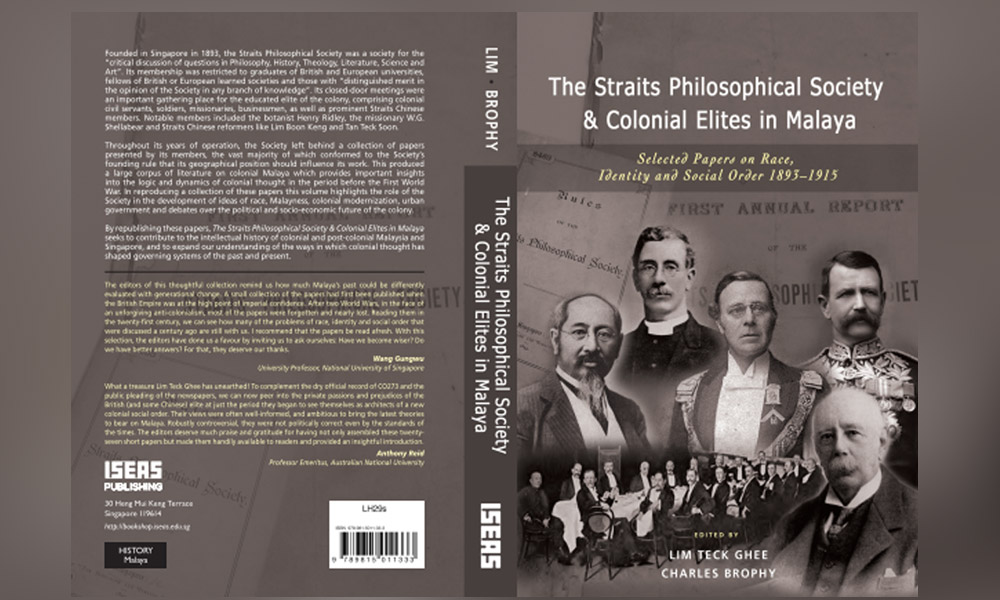
BOOK REVIEW | “The Straits Philosophical Society & Colonial Elites in Malaya” - A book providing the thinking of colonial elites on subjects of concern remains as relevant today as then, in the late 19th and early 20th centuries.
Indeed, previous preoccupations may not be so remote from our own as might at first appear.
How much has changed since then? To what extent have earlier ideas influenced subsequent policies?
Touching on topics which one would find in today’s mass media, print and digital platforms, may not only reveal the applicability of past perspectives on a range of important matters - notably “race, identity and social order” - but may also offer some insights on how to address current issues.
The endorsement by two leading scholars of Southeast Asian history should be sufficient to motivate readers to at least dip into this volume.
As Wang Gungwu suggests, this collection of essays invites us to ask: “Have we become wiser? Do we have better answers?” while Anthony Reid informs us that the “treasure Lim Teck Ghee has unearthed! ... [enables readers to] peer into the private passions and prejudices of the British (and some Chinese) elite…” as they seek to construct a new governmental system....
BOOK REVIEW | “The Straits Philosophical Society & Colonial Elites in Malaya” - A book providing the thinking of colonial elites on subjects of concern remains as relevant today as then, in the late 19th and early 20th centuries.
Indeed, previous preoccupations may not be so remote from our own as might at first appear.
How much has changed since then? To what extent have earlier ideas influenced subsequent policies?
Touching on topics which one would find in today’s mass media, print and digital platforms, may not only reveal the applicability of past perspectives on a range of important matters - notably “race, identity and social order” - but may also offer some insights on how to address current issues.
The endorsement by two leading scholars of Southeast Asian history should be sufficient to motivate readers to at least dip into this volume.
As Wang Gungwu suggests, this collection of essays invites us to ask: “Have we become wiser? Do we have better answers?” while Anthony Reid informs us that the “treasure Lim Teck Ghee has unearthed! ... [enables readers to] peer into the private passions and prejudices of the British (and some Chinese) elite…” as they seek to construct a new governmental system.
The editors’ introduction helps a reader to zero into topics worthy of note before moving on to other subjects. There are 27 papers organised into four parts. Beginning with Part 1, The Ideological Basis of Colonial Rule; Part 2 is entitled, Governing the Colony: Race, Crime, Opium, and Law; Parts 3 and 4 have to do with ethnicity, the former on the Chinese and the latter on the Malay sections of the population.
For instance, in Part 1, the essay, “The Disadvantages of Education for the Lower Classes”, goes some way to illuminate colonial mentality, their views as to which social strata merit access to education.
In Part 2, the paper on “The Reformation of British Malaya” illustrates the thinking of what should be done so as to fit into the deemed appropriate social order from the elite’s viewpoint.
As for Part 3, it might be advantageous to start with a survey on “The Chinese in British Malaya”, for the background and context before moving to other aspects which may be deemed interesting such as “Chinese Local Trade” and “Socialism Amongst the Chinese”.
The paper “Our Duty to the Malays” in Part 4 presents a familiar rationale for western colonisation, the intent of bringing progress to backward peoples. Subsequently, what can be anticipated to be “The Future of the Malay Race” was advanced.
Affirmative action
In the discussion on education for the “Lower Classes”, Tan Teck Soon, editor of the newspaper Daily Advertiser, criticised Gilbert E Brooke’s arguments based on social Darwinism ideas, and advocated education as a societal good.
Henry Ridley, more widely known for his work on rubber, wrote on “The Doctrine of the Survival of the Fittest as Applied to Man”. Ridley goes on in his Presidential Address to the Society, entitled “East and West”, to draw on Rudyard Kipling’s notion that East and West will never meet, perhaps on physical grounds but not likely on intellectual grounds.
James Aiken’s essay on what British Malaya needs, started a debate on affirmative action, currently still hotly discussed. Addressing the key issue of race, Aiken insisted that the Malays deserve to be brought “to the same level as other races” (p 214) as opposed to Arthur Knight’s implication that as “long hours of indoor work do not suit the Malay”, once they “secure remunerative employment… the tendency is to leave school too soon” (pp 227-8).
Next, also in Part 2, opium a major trade item, deserves attention. One essay focused on the moral problem - a harmful drug addiction - such that an Anti-Opium Society emerged, with criticism coming from missionaries and leading Chinese personalities while another essay acknowledged opium’s substantial contribution to government revenue.
The essays on crime and law touch on matters already raised in discussions on race and education plus delving into related topics - prisons, police, and the appropriateness of enforcing British norms on Asian communities with their older and preferred customs.
In Part 3, two essays were Tan’s while the other four were by Lim Boon Keng, including one touching on migration and his views on science and education “as these conduce to a nobler and higher view of life” (Straits Chinese Magazine, 1.1, March 1897).
Lim has been seen as “a pioneer of social change”, conceivably a polymath, involved in a range of activities including medicine, business and politics (CF Yong, Journal of Southeast Asian Studies, 1992: 420-421) to ensure the advancement of the Straits Chinese.
His conviction of the importance of China’s environment on the “viral qualities of the race” (p 287) merits mention. Not surprising that he wrote on “The Chinese Revolutionary Movement” and “Socialism among the Chinese” in Malaya, eulogising the version of socialism of Confucius (p 308).
Tan depicted Chinese traders serving as intermediaries, distributing goods (eg rice, salt, sugar) to rural Malays while collecting their jungle produce (e.g. gutta, rattan, areca-nut), not only in Malaya but also in Southeast Asian countries.
In Part 4, Kynnersley in his President’s Address argued that efforts to assist the Malays to progress were necessary, indeed the colonial administration’s duty. However, in Ridley’s essay, the limitations of the Malays with “less indication to develop on the lines of a higher civilization” was raised (p 366).
As space does not permit examination of the complexity of both past and present issues, and of numerous conflicting accounts, hopefully, this brief taste of topics raised and some disputes broached will prompt readers to explore subjects that resonate most with them.
LOH WEI LENG is a former professor in the History Department at the University of Malaya.
The views expressed here are those of the author/contributor and do not necessarily represent the views of Malaysiakini.
/file/publisher-c1a3f893382d2b2f8a9aa22a654d9c97/2021/04/c8ee76a9de147ccf766dc353f0d37a94.jpg)
/file/publisher-c1a3f893382d2b2f8a9aa22a654d9c97/2023/01/20d0fef538c06b361834838feced3fba.jpg)
/file/publisher-c1a3f893382d2b2f8a9aa22a654d9c97/2022/09/874159a8446152aef88c78091644fbcd.jpg)
/file/publisher-c1a3f893382d2b2f8a9aa22a654d9c97/2022/02/7c345e5d0795350427d9eb9632f29c52.jpg)


Report this comment
Are you sure you want to delete this comment?
This action cannot be undone.