




Dawn Raid: Who were the beneficiaries?
The Ijok by-elections have dramatically laid bare some 'skeletons from the cupboard' the implications of which, because they are of fundamental significance for the political well-being of our multiracial country, must be immediately rectified and rehabilitated by the winning political party.
The 'skeleton' here is the "Dawn Raid" at the London Stock Market in 1981 that was described with great pride and joy by the PKR candidate Khalid Ibrahim in terms "In mere hours Guthrie had become a Malaysian company".
This pride was rightly so because a newly independent country should assume ownership and take control of its major industries.
The record for this pre-emptive strike at home however was heavily criticized by the Deputy Prime Minister Najib Abdul Razak in the campaign by accusing Khalid of "lying" by not acknowledging the presence of the DPM's father, Tun Razak at the briefing for this takeover.
This accusation was shown to be erroneous, but Najib had a point in mentioning Tun Razak's immense interest in this question. In fact it is well known that the Umno leaders were only convinced of the possibility of this take over by the arguments of JJ Puthucheary in his pioneering book entitled Ownership and Control in the Malayan Economy (1960).
The Ijok by-elections have dramatically laid bare some 'skeletons from the cupboard' the implications of which, because they are of fundamental significance for the political well-being of our multiracial country, must be immediately rectified and rehabilitated by the winning political party.
The 'skeleton' here is the "Dawn Raid" at the London Stock Market in 1981 that was described with great pride and joy by the PKR candidate Khalid Ibrahim in terms "In mere hours Guthrie had become a Malaysian company".
This pride was rightly so because a newly independent country should assume ownership and take control of its major industries.
The record for this pre-emptive strike at home however was heavily criticized by the Deputy Prime Minister Najib Abdul Razak in the campaign by accusing Khalid of "lying" by not acknowledging the presence of the DPM's father, Tun Razak at the briefing for this takeover.
This accusation was shown to be erroneous, but Najib had a point in mentioning Tun Razak's immense interest in this question. In fact it is well known that the Umno leaders were only convinced of the possibility of this take over by the arguments of JJ Puthucheary in his pioneering book entitled Ownership and Control in the Malayan Economy (1960).
But Najib has gone on in the campaign to give details of very serious accusations that Khalid had in fact applied to acquire a 20% stake in Guthrie and had subsequently attempted to acquire 'more wealth for himself'.
Ironically, Najib goes on to say that instead the shares of Guthrie should be used for the poor of the country.
The Indian coolies
This is the cutting off point of this article. I happen to know James Puthucheary personally from our undergraduate days at the UM in Singapore till his demise, and I can say with some confidence that anyone knowing him will endorse that his entire advice and guidance to the government was based on the assumption that there would be some formula or equation to ensure a fair and equitable distribution of the assets of these huge rubber/oil palm companies.
What eventually happened of course was that the entire "lock, stock and barrel" was effectively handed over to the bumiputera-controlled PNB and shares allocated initially only to bumiputeras and very recently (and reluctantly) was token distribution allowed to non-bumiputeras.
But the entire discussion thus far has failed to ask the more basic question as to what happened to the interests of the thousands if not millions of the poor Indians in this takeover, whose contributions initially as 'coolies' under conditions of near slavery and subsequently even denied a monthly living wage, made it possible for the rapid and vast expansion of the rubber industry.
The huge profits accrued often at 500% per annum running consecutively for few years in the past together with the phenomenal profits with the switch to oil palm has simply passed them by.
There is even no mention whatever of a 'trickle down' effect.
Had these workers been represented by genuine leaders they may well have called for a restructuring of the entire estate system at the time of takeover through the setting up of cooperatives as was successfully done under the leadership of Tun Sambanthan.
Indeed the Prime Minister himself had strongly recommended listing on the stock exchange for Felda and there is nothing to have prevented a thinking of a restructuring of the industry in these terms at this time.
Glaring case of exploitation
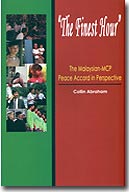 Finally, I happen to have just published a book (2006) entitled
The Finest Hour: Malaysian-MCP (Malayan Communist Party) Peace Accord in Perspective
, which the former Prime Minister Tun Dr Mahathir in his foreword, has described as a "bold and extraordinary" book with "stunning observations".
Finally, I happen to have just published a book (2006) entitled
The Finest Hour: Malaysian-MCP (Malayan Communist Party) Peace Accord in Perspective
, which the former Prime Minister Tun Dr Mahathir in his foreword, has described as a "bold and extraordinary" book with "stunning observations".
I believe for the first time I have been able to show that the Indian coolies were in fact instrumental in bringing about the declaration of the Emergency and subsequently early independence for Malaya.
This was because their strike action primarily intended to secure higher wages and better working conditions (supported by the MCP) had the effect of stopping the regular export of rubber on which the colonial government depended for profits and indeed to support the sterling bloc in the UK and the dollar arsenal for the US currency.
I have included an appendix in the book giving details of British brutality towards these poor innocent coolies because their strike action was paralyzing rubber exports.
As I see it, this is now also in fact belated 'pay back time' and it is absolutely incumbent on the successful candidate of the Ijok by-election to work towards what is perhaps the most glaring case of exploitation among all Malaysians from the past till today.


Are you sure you want to delete this comment?
This action cannot be undone.