




Tour of Pak Lah's police state
Who in his wildest dreams would have imagined Prime Minister Abdullah Ahmad Badawi’s ‘reformed’ Malaysia would dramatically degenerate into a virtual police state, all within the space of two general elections?
Who in his wildest dreams would have imagined Prime Minister Abdullah Ahmad Badawi’s ‘reformed’ Malaysia would dramatically degenerate into a virtual police state, all within the space of two general elections?
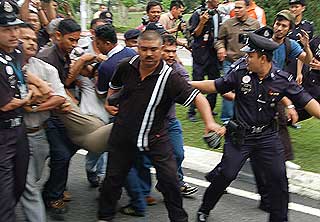 There was the ridiculous spectacle of arrests of opposition party and civic leaders (who only wanted to present a petition) to Parliament and roadblocks that sealed off access to the building on Dec 11.
That morning, the PAS headquarters was also cordoned off by police so as to prevent leaders of the party from going to Parliament House.
Where on earth can you find a democratic country indulging in such high-handed acts of contempt for democratic principles and such uninhibited abuse of police force?
What a big slap on the face of the prime minister who, only days before, had shamelessly declared to the world through an article in the Asian Wall Street Journal (Dec 7) what glorious democracy Malaysia has been practising!
To get a further view of the state of repression that the country has descended to, I list relevant events in reverse chronologic order:
• Dec 11: Arrests in and around Parliament House, and cordoning of PAS headquarters.
• Dec 9: World Human Rights Day. Arrest of Bar Council human rights committee chairperson for preventing government officials from removing a banner at the council premises. Arrest of lawyers and activists who were walking towards the council premises, after the Bar Council had cancelled its annual walk under pressure from the government.
•
• Dec 9: Arrest of scores of activists and opposition leaders in different parts of the country for participating in the Nov 10 rally organised by the Coalition for Clean and Fair Elections (Bersih).
• Nov 25: Hindraf rally of 30,000 in Kuala Lumpur against marginalisation of and driscrimination against Indian Malaysians. Brutal suppression with endless volleys of tear gas, chemically-laced water and use of batons by police. Subsequent arrest of 31 protesters, who were charged with attempted murder of a policeman; arrest of Hindraf leaders and later detention under the Internal Security Act (ISA).
•
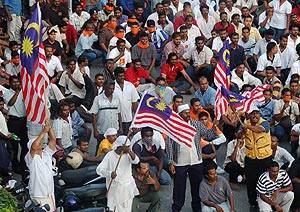
• Nov 10: Bersih rally of 40,000 in Kuala Lumpur to present a petition on electoral reform to the King. Police blockades and use of tear gas, water cannon and batons.
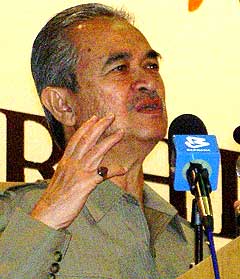 In an attempt to exonerate himself from accusation of reckless repression, Pak Lah said on Dec 10: “If the choice is between public safety and public freedom, I do not hesitate to say here that public safety will always win.” He had earlier alluded to demonstrators as law-breakers who threatened public safety and vowed to apply the dreaded ISA if necessary.
But what blatant lies these assertions are, when there is not a shred of evidence to indicate any intent, act or weaponry of violence on the part of participants throughout these assemblies. In fact these protesters should be commended for having exhibited exemplary discipline and self-restraint, particularly when subjected to harsh treatment.
The Human Rights Commission of Malaysia offered rebuke by pointing out that “the possibility of public disorder should be based on evidence, not speculation or imagination” and called for repeal of a legal provision that requires a police permit for public assembly. It further commented that “it appears that arrests and prosecutions are selective and seemingly biased”.
It should be clear, therefore, who the villains are in these shameful episodes of trampling on the people’s constitutional rights.
Panic within Umno
Why would Pak Lah and his cabinet resort to such dastardly acts that have put Malaysia to shame? I venture two main reasons.
First, his government has been rocked by a series of mega scandals of corruption and abuse of power since early this year.
These included the grisly murder of a Mongolian national with links to the top political hierarchy; dubious commissions that run into hundreds of millions of ringgit paid in respect of purchases of submarines and fighter jets; the almost simultaneous investigations of the top three crime-busters - deputy internal security minister, Inspector-General of Police and former Anti-Corruption Agency chief; the inflated spending of RM4.6 billion to create a ‘ghost town’ in Port Klang; the inflated RM6.75 billion naval vessel contract; the Auditor-General’s 2006 Report that revealed pervasive corruption across the full spectrum of the government; and thet Lingam tape that allegedly exposed judicial rot of the worst kind.
Any of the above scandals would have dealt a fatal blow to any democratic country. But, in Malaysia, thanks to collusion with the media , these are largely hidden from the masses. However, with increasing influence exerted by critics through a growing Internet, the government is beginning to feel the heat of critical public opinion. Needless to say, the regime’s popular support will change in inverse proportion to the spread of public knowledge of the ruling coalition’s incompetence and corruption.
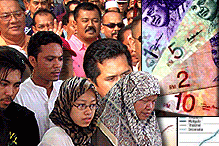 Economic hardships caused by spiraling inflation in an uncompetitive economy help to fester growing dissatisfaction against a leadership that is increasingly exposed as one which feathers its own nest by abusing the New Economic Policy (NEP), which has been hijacked by Umno to enrich its elite in the name of helping the Malay race. These abuses, built on racial discrimination, have in turn heightened resentment among minority races as well as accentuated class conflicts due to widening disparity of wealth.
To cling to power, Umno has to depend on a manipulated electoral system as pillar to its political hegemony. This is why it is so determined to retain Election Commission chairperson Abdul Rashid Abdul Rahman’s service. When tens of thousands of people take to the streets, Umno has reason to panic. What if these crowds were to swell to over 100,000? What if news of the evil deeds of the regime spread like wild fire through word of mouth among the disgruntled masses?
As Umno’s popularity wanes, would it implode in the midst of worsening internal power struggle? Or would it be deserted by its racial hangers-on who have been scrounging on its power, but whose roles as champions of their own racial groups are increasingly untenable in the light of Umno’s recent surge in racial arrogance and dominance under the competitive influence of Pak Lah’s ambitious son-in-law Khairy Jamaluddin?
These nagging thoughts are fair assumptions, judging from the Umno’s display of paranoia in clamping down so recklessly and insanely on any public expression of dissent.
Second, Pak Lah seemed to have been emboldened by the favourable findings of a recent opinion poll commissioned by the Umno-friendly New Straits Times , judging from his recent smugness over the results and sudden tightening of the police noose on the opposition. The spin doctors and sycophants who have insulated him from the real world might have convinced him that it is safe and timely to strike as hard a blow as possible against the opponents irrespective of what the constitution prescribes.
A word of caution for Pak Lah. Since when is an opinion poll in a highly-repressed state like Malaysia taken seriously? Democracies like the US or Australia which practice exemplary democracy can rely on opinion polls to predict the electoral outcome to the nearest percentage point.
But haven’t we noticed that opinion polls on political support are rarely conducted in countries in Africa, the Middle East, the former Soviet Union and large parts of Asia? Why? It is simply because the people are so repressed that few would feel at ease to give honest answers openly, especially if the answers are deemed unfavourable to those in power.
 The same goes for Malaysia, where an entrenched political culture of submission under threats of punitive consequences preclude any meaningful results from an opinion poll. Taking this into consideration, it is safe to assume that there will be a large margin of error in favour of the ruling power, if at all such a poll is conducted.
A case in point was the opinion poll conducted by the Merdeka Centre for Opinion Research in 2004 when Pak Lah won a sweeping electoral victory. Although his popularity rating then was found to be 91 percent, his Barisan Nasional (BN) coalition could only garner 64 percent of the popular vote.
Projecting this trend onto his present popularity rating at, say 70 percent, means he may only garner 49 percent of the popular votes for BN, a prospect not at all comfortable for the haughty Umno/BN.
Regardless what the true level of Pak Lah’s popular support is, he will be well advised to stand on the right side of history by honouring his oath of allegiance to the country and the constitution.
For any betrayal of his oath, by rampant violation of the constitutional rights of the people, may bring misfortune to himself and his party when the truth eventually triumphs. By then, his name would have been defiled for eternity.
KIM QUEK is a retired accountant and a member of opposition party PKR.


Are you sure you want to delete this comment?
This action cannot be undone.