




Police and human rights
The police force is an indisputable component of the civil service. Its duties are essentially to maintain law and order in any society. It is unimaginable to fathom a society without a police force. We need them to live a peaceful life and for personal safety and for the safety and security of the nation.
The police force is an indisputable component of the civil service. Its duties are essentially to maintain law and order in any society. It is unimaginable to fathom a society without a police force. We need them to live a peaceful life and for personal safety and for the safety and security of the nation.
For this to become a reality the people that make up the structure of this component of the civil society should be men and women of integrity, dedication and a bit of wisdom and love. On account of the vital functions of the police force it is the people who have agreed to let their money be used to maintain the livelihood of the serving people of this force.
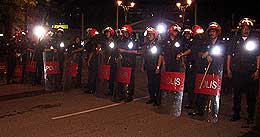 So the people have allowed their money to be used by the government of the day to maintain the police personnel and their families through proper salaries, housing, health care and all the benefits as enjoyed by any other civil servant. This is something that must be well understood by every police personnel.
Having said this, I will go a little further.
Yes, it is the duty of the police to maintain law and order, which is something every sane human being would hope for in their every day life. It is the law and order that guarantees the safety of human life. The safety of human life is in actual fact a human right per se. No one has the right to take away the life of another or to cause injury or suffering. I repeat once again the safety and security of human life is a human right. In other words the police is a direct provider and protector of human rights of every human being. It is by virtue of this duty that the police is duty bound to maintain and enforce that human rights be strictly provided to all human beings of the country. Again when we speak of human rights we also refer to the human rights towards enjoying privacy, freedom to live a free life to speak and express and at the same time to be a free participant of the social fabric.
Every individual is entitled to his social needs, religious needs, health care etc. He is entitled to a government that practices decency, accountability, courtesy and respect. This again is his human right. Having said this it is now my intention to propose that everything must be done to market the promotion and protection of human rights among the police personnel. What is the role of the police in a democratic society? Are the police the champions of human rights in this country? My gut feeling is that this subject matter of human rights has not been promoted in the police force at least not to my knowledge or perhaps not well enough.
Symbiotic issue
The fact that human rights is fundamental and an inherent characteristic of every human, then, the police is essentially there to protect this basic human right and they ought to be the champions of human rights itself. I must say that just like the doctors whose duty is to save human lives from death and disease the police force is the highest group of civil servants in the country wherein every citizen looks upon them for protection from death and destruction which is their basic human right. This being the case it is the duty of every citizen to ensure that the police be given the best attention in terms of remuneration, food clothing and shelter, health care, children's care etc.
Let us not forget that the police themselves are entitled to the best of human rights attention themselves. They need time to relax, to spent time with their spouses and children, personal fitness etc. The issue of human rights is symbiotic between the police and the rest of the population.
Here comes the challenging part. For the police the challenge is twofold. The first is to acknowledge that human rights play a central role in policing and the second is to overcome the mistaken impression that complying with human rights standards curtails police effectiveness. The police role involves human rights protection because police are entrusted to protect the right to life and police maintain order so that all other rights we possess can be enjoyed. They protect the right to assembly and freedom of speech, safeguarding people involved in public protest. They also have the obligation to protect people's rights from threats posed by known individuals or groups.
But the key issue is...
Sometimes the police may find itself in a tight situation when it comes to policing with human rights as an underlying factor. I would reckon this can be easily done with the following virtues in mind: respect, transparency, fairness and accountability. These are the virtues that must be inculcated into the minds of every policeman and woman in the country.
The two most important challenges to the police:
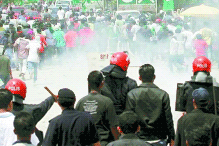 I would reckon there are two main challenges to the police. The first is to acknowledge that human rights play a central role in policing and the second is to overcome the mistaken impression that complying with human rights standards curtails police effectiveness. The police role involves human rights protection because police are entrusted to protect the right to life in serious crisis situations; and police maintain order so that all other rights we possess can be enjoyed. In the investigation of crime the police recognize that the rights of victims to physical integrity and property have been violated. They protect the right to assembly and freedom of speech, safeguarding people involved in public protest. They also have the obligation to protect people's rights from threats posed by known individuals and groups.
Police and human rights
How can the police protect and respect human rights while also investigating and preventing crime? For many in the police there is an inherent contradiction between these two requirements.
It may be helpful to explain in brief the conceptual basis of the relationship between policing and human rights to illustrate the proximity of human rights to policing. This relationship will highlight the positive role the police play in the protection of human rights. It will also be apparent that there is no contradiction between a human rights compliant police service and an effective police service.
Democratic policing is dominated by three core principles:
• the social contract
• public consent
• the balancing of rights
International human rights standards refer to the relationship between policing and human rights as a means of assisting in the maintenance of order. The maintenance of public order is achieved when the social contract, public consent and the balancing of rights are achieved.
I refer to Article 28 of the Universal Declaration of Human Rights::
'Everyone is entitled to a social and international order in which the rights and freedoms set forth in this Declaration can be fully realised.'
It is the role of the police to assist in the maintenance of this order. The order maintained by the police is one that shall be compatible with respect for individual freedom, human rights and the rule of law.
Social contract:
The police role within the social contract is to protect individual freedom and security to the best of their capability. The professional standards the police adopt to ensure compliance will be measured against international human rights law and standards that apply to the police as an organ of the state.
Public consent:
Policing is guided by norms and values. The notion of policing with the consent of the people is central to a democratic way of life. The police cannot assume that they always police with consent; they must therefore constantly work to ensure that the public supports their practices.
Balancing of rights:
The key issue for the police in achieving a professional service is to correctly manage the balancing act between protecting individual liberty and the maintenance of public order. Compliance with human rights principles by the police is the only way to attain this optimum balance. This holds particularly true where police powers allow limitation of people's rights: care should be taken to ensure that rights are protected in a balanced fashion. Balancing of rights refers to decisions made by police
in situations where a conflict of rights is involved and where police action may result in a limitation of rights. The decision as to where to strike the balance should not be arbitrary and should be based on the key principles of Legality, Necessity, Proportionality, Accountability and Non-discrimination.
Again I refer to the Universal Declaration of Human Rights:
'Everyone shall be subject to such limitations as are determined by law solely for the purpose of securing due recognition and respect for the right and freedoms of others and of meeting the just requirements of morality, public order and the general welfare in a democratic society.'
The manner in which a police service carries out its tasks has a direct bearing on whether society will perceive it as legitimate. The more professional a police service is able to maintain a balance in situations where opposing rights are at stake, the more credibility it will accrue to itself. The key areas where the police are challenged to respect human rights are those involving sensitive police actions, particularly aspects of criminal investigations, such as arrest, use of force, detention, and surveillance, use of informers and search and interrogation.
Four main reasons
There are four main reasons as to why the police commit human rights violations:
They may do so because they perceive it as justified on the basis of a 'noble cause', that is, the police may be tempted to act illegally on the grounds that they do so for a higher cause or the good of society. Thus they may acknowledge their wrongdoing while at the same time rationalizing it: The 'criminal' will be removed from society, and the public will be grateful to the police for ensuring this.
This form of rationalisation is dangerous, for it amounts to a practice of favouring a subjective police view of what is right and wrong over that of the rule of law. The reality is that, by breaking the law, the police become criminals themselves. Another factor facilitating human rights violations by the police is an exaggerated emphasis on obtaining results. In police organisations where there is too much emphasis on efficiency and where compliance with human rights standards are ignored or not viewed as relevant, similar problems may arise. This may develop into a mindset that emphasises thinking along the lines of 'the ends justify the means', the sole focus being on the results to be achieved (such as arresting and convicting a culprit) rather than on the means employed to achieve these ends. Focusing on 'results' while ignoring illegal or unethical policing methods may lead to the undermining of the legitimacy of the police, and ultimately to the undermining of the legitimacy of the state itself.
Pressure to take shortcuts by ignoring legal and ethical standards can become part of the ethos of a police organisation. This can lead to situations where issues of legality and respect for human rights are ignored or deliberately abused.
While the salient issues here have been obtained from international platforms which apparently is universal in values and ethics, but let us see this from our local Malaysian perspectives.
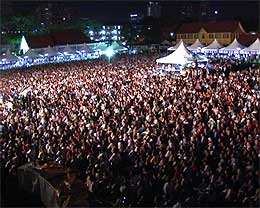 The April 14 gathering at Club Sulaiman, Kuala Lumpur. It has been reported that 20,000 people from all walks of life assembled at the club grounds to welcome and hear the PKR party officials after their successful performance in the recent March 8th Election. It is said there were more than 1,500 police personnel on duty at the vicinity. That is something to be appreciated because the police took upon themselves as their inherent duty to ensure law and order. The huge crowd of people were extremely well disciplined and it was obvious that they came as true Malaysians well behaved and decent. What disturbed me most and I am sure the entire crowd of 20,000 people is the manner in which the police moved in and stopped the former deputy prime minister in completing his speech. That in itself was bad public exhibition of gross violation of human rights by the police.
People are entitled to free speech and free assembly. There was no threat to national security nor were emotions being exploited to cause racial warfare. In fact speakers were exuberant in promoting racial integration among all races in the country which in my opinion is much required. I would even go one step further to say the police showed a bad example of human right violations before the huge crowd of law abiding citizens.
If the police were true to their beliefs that the gathering was in fact a threat to the national security and to the well being of the neighbourhood then they should have not allowed the function to have started in the first place. Here in this case they allowed the public to assemble and take their respective places. They even allowed most of the speakers to complete their speeches. What was most distasteful was when the police moved in to stop the former deputy Prime Minister from completing his speech. I call that rude and demeaning. This is a blatant case of violation of human rights by the Malaysian Police. I hope the IGP will render a public apology to the Malaysian public. Humility to admit wrong is a virtue most noble.
DR MATHEW SEBASTIAN is a dental surgen and a doctor of alternative medicine.


