




Circus of national politics
Politics is a central aspect of social organisation as it represents the activities that coordinate the interests and concerns of citizens.
Politics also presuppose an agreement on a set of rules to ensure representation of citizens in decision making and governance and to facilitate peaceful transition of power.
Politics is a central aspect of social organisation as it represents the activities that coordinate the interests and concerns of citizens.
Politics also presuppose an agreement on a set of rules to ensure representation of citizens in decision making and governance and to facilitate peaceful transition of power.
In most functional democracies, elected officials are replaced whenever they lose popular support in national elections.
Many Muslim countries have embraced the democratic process, but most have not yet succeeded in overcoming the old politics of palace intrigue that plagued governance in historical Muslim countries.
Sheer police and military power, as well as political conspiracy and trickery, are often used by the political elite in Muslim countries to seek or maintain power.
Malaysia and Turkey are among the very few Muslim societies that are ahead in practising democracy and holding their political leaders accountable, as both have a thriving multi-party system and markedly developed civil societies.
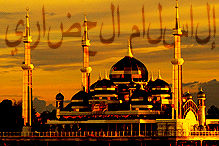 Recent events in the two countries illustrate the difficult transition to democratic governance in Muslim societies.
After a torturous route to political participation, the Islamically-inspired Justice and Development Party (known by its Turkish acronym APK) that represents the middle-class is locked in a power struggle with the nationalist elite.
The latter have shown willingness to use the judiciary and the military to undermine the standing of a popular political party that commands a two-thirds majority in parliament. The immediate conflict is over the constitutionality of allowing devout Muslim women to wear head scarves while on university campus.
Rather than recognise that wearing head cover is a personal choice and a religious obligation that must be protected by the democratic principle of freedom of religion, the nationalists accuse APK of undermining the secular tradition of Turkey, and are considering a ban on the party and its leaders.
The party chair and current Prime Minister Recep Tayyib Erdogan was imprisoned in the late 1990s for reciting a religious poem when he was mayor of Istanbul.
The nationalists apparently believe that they can fool the Turkish people by using democratic language and concerns to hide their desire to maintain a grip on power and deny their ideological opponents the opportunity to control state institutions through fair democratic competition.
Unhealthy grip on power
A similar struggle is underway in Malaysia. The leaders of the ruling coaltion, which has been in power since Malaysia gained independence in 1957, have apparently decided to maintain their grip on power by implicating an opposition leader in a sexual scandal.
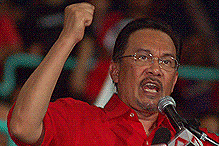 (PKR
de facto
leader) Anwar Ibrahim, who led the opposition into a major political victory in March, and who is poised to become the country’s next prime minister, stands accused of sodomy by a young political aide.
(PKR
de facto
leader) Anwar Ibrahim, who led the opposition into a major political victory in March, and who is poised to become the country’s next prime minister, stands accused of sodomy by a young political aide.
Deputy premier Najib Abdul Razak, a long-term rival of Anwar, admitted to meeting Anwar’s accuser in his residence two days before the latter made his damaging accusation.
The deputy prime minister is himself speculated widely to have some knowledge of the murder of a Mongolian translator, and his political adviser and two of his aides are among those charged with the crime. (He has consistently denied this.)
The current sodomy accusation is a rerun of a similar tactics used in 1998 to deny Anwar, then the Umno deputy president, the right to contest for the highest office.
Both Recep Erdogan and Anwar represent a new breed of democratic leaders in Muslim countries driven by a new vision of politics rooted in Islamic morality that stresses the social accountability of political leaders.
Both espouse commitment to religious freedom and to political and social pluralism. And both have shown the willingness to make great personal sacrifices to advance their vision of politics.
Rejecting trickery
However, the heroic acts of courageous leaders like Anwar and Recep, while greatly admirable and inspiring, would not be sufficient by themselves to transform Malaysia and Turkey into functional democracies.
Such transformation requires a new political awareness and activism that take away political power from the exclusive control of political elites and makes fair and equitable governance the concerns of engaging citizenry.
It requires the emergence of vibrant and assertive civil-society organisations that reject political trickery and manipulation, and demand that elected officials are held accountable for their statements and actions.
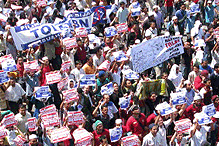 Most importantly, transformation to true democratic rule pre-supposes a citizenry that is not willing to be fooled by its elected officials.
The Quran gives a great insight into the source of power enjoyed by dictators and tyrants: their ability to fool the people to garner their support. This ability is, ironically, derived from the willingness of a corrupt people to be fooled into accepting false claims in exchange for gaining personal advantage.
The Quran presents the Pharaoh as the epitome of arrogant of arbitrary political power, and attributes his ability to govern with impunity to the willingness of his people to follow him, even when he made fool of them: ‘[Pharaoh] made fool of his people and they obeyed him, they were truly people given to corruption.’
While the contemporary ruling elite in nominal democracies may not compare in arrogance with the Pharaoh, the dynamics of retaining political control is often the same.
The efforts by the vestiges of arrogant and arbitrary power in Malaysia and Turkey are trying to maintain their political edge by fooling citizens through political games and trickery, thereby turning national politics into circus.
Their failure will signal the end of politics as the instrument of power-hungry leaders and the beginning of politics as an exercise in social responsibility. It will also make their two important countries a source of hope and inspiration for future transformation in other Muslim societies.
Will democracy take hold in modern Muslim societies?
The next few months are poignant with agonising fear and great hope, and the answer hinges on whether Malaysians and Turks will succumb to the intimidation of power or show the maturity and courage worthy of free and principled people.
DR LOUAY SAFI is the executive director of ISNA Leadership Development Centre, an Indiana- based organisation dedicated to enhancing leadership capacity. He writes and lectures on issues relating to Islam and the West, democracy, human rights, leadership, and world peace.


Are you sure you want to delete this comment?
This action cannot be undone.