


/file/publisher-c1a3f893382d2b2f8a9aa22a654d9c97/2025/03/4e13b4beb73bc60d0b46fb7e1bb44681.jpg)

HISTORY | Tan Cheng Lock’s unfinished quest for an inclusive nation
HISTORY | Tan Cheng Lock, a fifth-generation Peranakan Chinese from Malacca, holds a distinguished place in our nation’s history as a Malayan patriot and champion of an inclusive nation.
Tan helped lay the foundations of an independent Malaya in which people of different ethnic origins could live in peace and belong as equals. Long before Merdeka, he challenged racial exclusion, advocated self-government, and worked to forge a common Malayan identity. His contribution extended far beyond co-founding the Malayan Chinese Association (MCA).
Born on April 5, 1883, he came from a family that had been established in Malacca for more than a century. In her book "Tun Dato Sir Cheng Lock Tan: A Personal Profile by his Daughter", Alice Scott-Ross recounts that her father’s great-great-grandfather, Tan Hay Kwan, migrated from Fukien (present-day Fujian) to Malacca in 1771.
Educated at Malacca High School and Raffles Institution in Singapore, he began his working life as a teacher before entering the rubber industry in 1908. His business success enabled him to devote increasing attention to public affairs. He became a Malacca municipal commissioner in 1912 and was nominated as an unofficial member of the Straits Settlements Legislative Council in 1923.
Challenging the colonial colour bar
From the beginning of his legislative career, Tan campaigned against...
HISTORY | Tan Cheng Lock, a fifth-generation Peranakan Chinese from Malacca, holds a distinguished place in our nation’s history as a Malayan patriot and champion of an inclusive nation.
Tan helped lay the foundations of an independent Malaya in which people of different ethnic origins could live in peace and belong as equals. Long before Merdeka, he challenged racial exclusion, advocated self-government, and worked to forge a common Malayan identity. His contribution extended far beyond co-founding the Malayan Chinese Association (MCA).
Born on April 5, 1883, he came from a family that had been established in Malacca for more than a century. In her book "Tun Dato Sir Cheng Lock Tan: A Personal Profile by his Daughter", Alice Scott-Ross recounts that her father’s great-great-grandfather, Tan Hay Kwan, migrated from Fukien (present-day Fujian) to Malacca in 1771.
Educated at Malacca High School and Raffles Institution in Singapore, he began his working life as a teacher before entering the rubber industry in 1908. His business success enabled him to devote increasing attention to public affairs. He became a Malacca municipal commissioner in 1912 and was nominated as an unofficial member of the Straits Settlements Legislative Council in 1923.
Challenging the colonial colour bar
From the beginning of his legislative career, Tan campaigned against racial barriers to Asian participation in public administration, including restrictions on the admission of non-European British subjects to the Malayan civil service.
The issue went beyond employment. Colonial rule expected local people to contribute to the country while denying them access to its senior administrative service on racial grounds.
/file/publisher-c1a3f893382d2b2f8a9aa22a654d9c97/2021/12/af0d33a79bfbfdaa5a2a2e37c560f407.jpg "Sivachandralingam Sundara Raja The British traders turned colonial officers feature article 181221 francis light staue in penang")
Opening the service would recognise local ability and strengthen allegiance to the country. Although his demand did not yet amount to a comprehensive programme of Malayanisation, it challenged the use of race to determine fitness for senior administrative responsibility.
Envisioning a united Malaya
By 1926, Tan was articulating a political vision that extended beyond the interests of his own community. Speaking in the Legislative Council on Nov 1 that year, he said the ultimate political goal should be “a united self-governing British Malaya, with a federal government and Parliament… and with as much autonomy in purely local affairs as possible for each of its constituent parts”.
He also urged the creation of “a true Malayan spirit and consciousness” that would overcome racial and communal divisions.
These were forward-looking aspirations in a country divided administratively and organised largely along communal lines. He understood that political unification also required a sense of common belonging.
As historian KG Tregonning observed: “Tan Cheng Lock saw clearly long before any other nationalist the image of an independent Malaya.”
In 1926, however, Tan still envisaged self-government within a continuing British connection. His nationalism developed through constitutional advocacy and challenges to colonial policy.
His vision was, in essence, a Malayan Malaya: people could retain their cultural inheritance while giving their allegiance to a common homeland. Chinese ancestry did not make China their inevitable political home, nor did cultural difference make national unity impossible.
Recognising 'sons of the soil'
Tan developed this argument in his memorandum to colonial administrator Samuel Wilson in December 1932. The Malaya Tribune, reporting the memorandum on Dec 23 under the headline “Chinese Leader’s Five Points”, highlighted his concerns over education, the franchise, and the civil service.
Education, political participation, and access to public service would enable people to contribute to their country and help govern it.
He argued that fair treatment would encourage Malaya-born Chinese to become true “sons of the soil”, identifying fully with the interests of their homeland. Persistent distrust, he warned, could produce the opposite result, alienating them from Malaya and directing their attention towards China. He used the phrase to express an inclusive sense of national belonging.
/file/1141/543c8c2c7b3da03ad215374a56ea4b47.jpeg "Candy Yu a 10 year old traditional chinese opera performer from China pose for a photograph before a performance at Petaling Street Kuala Lumpur on Friday 11 August 2017 120817 02")
His reasoning exposed a contradiction that remains painfully familiar: how could a community be expected to demonstrate undivided loyalty while repeatedly being told it did not fully belong?
Tan also recognised the need to assist Malays economically. In the same 1932 memorandum, he accepted government assistance provided it did not seriously prejudice non-Malays and that comparable help would be extended to other communities where needed. His position showed that assistance to disadvantaged Malays could be reconciled with fair treatment for others.
He subsequently served on the Straits Settlements Executive Council from 1933 to 1935.
Fighting for a common constitutional future
After the Second World War, the question of who would participate in governing Malaya became central to its constitutional future. In December 1946, Tan chaired the joint-action movement that developed into the All-Malaya Council of Joint Action (AMCJA), bringing together organisations opposed to the proposed Federation settlement.
Working with the Malay organisations grouped in Pusat Tenaga Rakyat (Putera), AMCJA advanced the People’s Constitutional Proposals in 1947. Their cooperation demonstrated that Malays and non-Malays could formulate a common constitutional programme despite disagreements within their own communities.
The movement sought a united Malaya including Singapore, an elected central legislature with responsible self-government, and equal citizenship rights for those who made Malaya their permanent home and gave it their allegiance.
These objectives challenged both the political marginalisation of permanent inhabitants and the lack of wider public participation in constitutional negotiations.
Historian Bernard Z Keo records Tan’s involvement in promoting the hartal, or general shutdown, as a form of protest. A Malacca hartal in September 1947 preceded the countrywide action on Oct 20. The campaign did not prevent the establishment of the Federation of Malaya in 1948.
Its failure should not obscure its significance. Tan and his allies had demonstrated the possibility of a political movement that crossed communal boundaries and demanded that those who would live under a constitution should have a meaningful voice in shaping it.
Building cooperation, founding MCA
In 1949, Tan pursued intercommunal understanding through the Communities Liaison Committee, chaired by EEC Thuraisingham. His engagement with Onn Jaafar and other leaders required him to confront difficult questions about citizenship, Malay economic disadvantage, and the fears of different communities.
The formation of the MCA on Feb 27, 1949, gave him a new organisational platform. He became its first president, working with figures including Yong Shook Lin, HS Lee, and Leong Yew Koh.
/file/publisher-c1a3f893382d2b2f8a9aa22a654d9c97/2024/10/fa1e680b91a9855f474b695a62d461c4.jpg "MCA Malaysian Chinese Association generic party logo flag 161024")
MCA began its work amid the Emergency, declared throughout the Federation of Malaya on June 18, 1948, following escalating violence and the killing of three European planters by communist shooters at Sungai Siput, Perak, two days earlier.
The ensuing conflict pitted the colonial government against a communist insurgency seeking to overthrow British rule. Chinese communities faced intense suspicion, while the subsequent resettlement programme disrupted the lives of many rural families. In these difficult circumstances, MCA provided a constitutional avenue for Chinese political participation and undertook welfare activities alongside its political work.
In her book "Chinese Politics in Malaysia: A History of the Malaysian Chinese Association", political scientist Heng Pek Koon documents MCA’s assistance to people resettled in New Villages during the Emergency and the importance of funds raised through its sweepstakes. By helping displaced families rebuild their lives, the MCA linked political representation with practical relief.
There was a tension in Tan’s position: an advocate of common nationhood now headed an explicitly communal organisation. He sought to use that organisation to bring the Chinese community into a shared Malayan political future.
Political experimentation to independence
Tan’s subsequent course was not predetermined. He initially supported Onn’s Independence of Malaya Party, formed in 1951, which attempted to organise politics across communal lines.
The Umno-MCA electoral understanding for Kuala Lumpur’s municipal election in 1952 emerged through local leaders, notably HS Lee and Yahya Sheikh Ahmad. Tan subsequently backed closer cooperation with Umno under Tunku Abdul Rahman, adapting his political strategy to build support for self-government across communities.
The citizenship reforms of 1952 widened access to federal citizenship, marking a significant step towards a more inclusive political community. British journalist and author Noel Barber, in "The War of the Running Dogs: How Malaya Defeated the Communist Guerrillas, 1948–60", states that at midnight on Sept 14, 1952, 1.2 million Chinese, representing 60 percent of Malaya’s Chinese population, and 180,000 Indians became Malayan citizens.
The electoral partnership developed into the Alliance, with the Malayan Indian Congress (MIC) joining in 1954. Its victory in 51 of the 52 elected Federal Legislative Council seats in 1955 provided a powerful mandate to pursue independence.
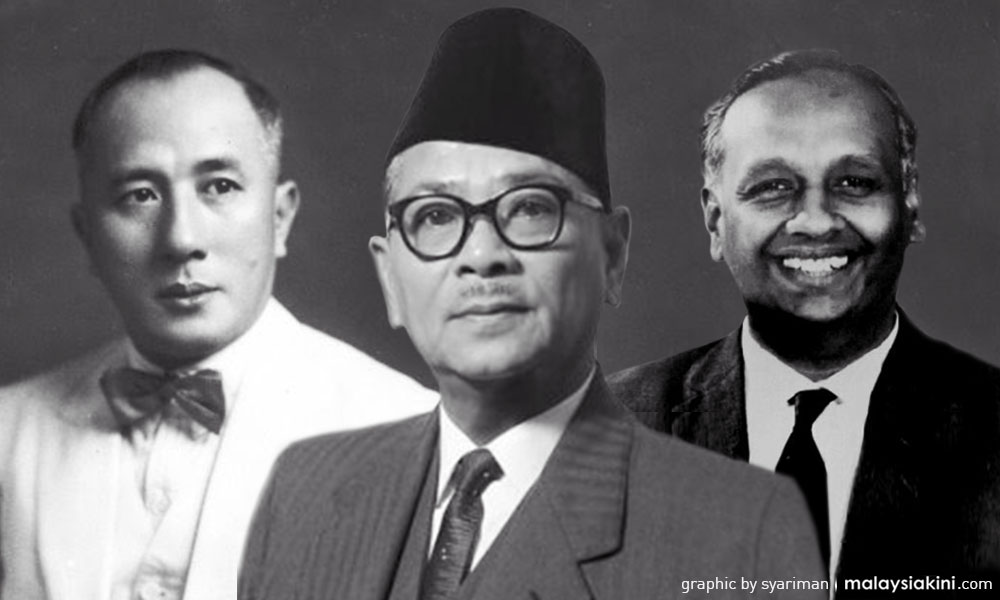
Tan helped make intercommunal cooperation credible within the Chinese community. His support strengthened Tunku’s argument that constitutional advance could rest on agreement among the country’s communities. When Malaya achieved independence on Aug 31, 1957, his decades of advocacy formed part of the foundation on which the new nation stood.
The compromise nevertheless had an inherent limitation. Cooperation among communal parties could secure agreement without necessarily overcoming communal thinking. Tan’s broader aspiration for a people united by common belonging remained unfulfilled.
In recognition of his public service, he was knighted by King George VI in 1952. In 1958, the Yang di-Pertuan Agong conferred on him the Seri Maharaja Mangku Negara (SMN), which carries the title ‘Tun’. Following his death on Dec 13, 1960, he was accorded a state funeral.
A struggle that remains our own
Tan’s unfinished struggle speaks directly to Malaysia today. We cannot preach national unity while allowing politicians to exploit racial and religious divisions. Nor can we celebrate earlier generations’ contributions while treating their descendants as perpetual outsiders. Malaysians should not have to keep proving that this country is their home.
We need a united, inclusive, and just Malaysia, with a government that serves all citizens fairly, regardless of ethnicity or faith. Public institutions must inspire trust across communities, while schools must teach a truthful and inclusive history that strengthens common belonging.
We must put an end to identity politics that breeds fear and exclusion. Leaders should be judged by their integrity, competence, and service. Claims to defend race or religion must never excuse corruption, injustice, or the sowing of discord.
Honouring Tan means pursuing the inclusive nationhood to which he devoted his life. A century after his 1926 call for a true Malayan spirit, how much longer will we allow the divisions he challenged to define our politics?
Malaysia is our shared homeland. Its future must belong to all Malaysians.
RANJIT SINGH MALHI is an independent historian who has written 19 books on Malaysian, Asian, and world history. He is highly committed to writing an inclusive and truthful history of Malaysia based upon authoritative sources.
The views expressed here are those of the author/contributor and do not necessarily represent the views of Malaysiakini.
/file/publisher-c1a3f893382d2b2f8a9aa22a654d9c97/2025/03/6d0af50e8b53ebebad52875da40f5319.jpg)
/file/1152/06ab8fda077a7ce93ecbab14f0c6bd73.jpeg)
/file/publisher-c1a3f893382d2b2f8a9aa22a654d9c97/2019/05/8f0b480b1af38b344f39b6e7ad18cd66.jpg)


We should all forget about Tan Cheng Lock. Today we have Anthony Lock and DAP doing a great job in fighting for the interests of the Chinese.
Ranjit Singh Malhi’s article is valuable, but it largely follows the “great man” theory of history. Tan Cheng Lock appears as an exceptional leader whose foresight advanced an inclusive Malaya. A people’s history would neither remove Tan nor diminish his courage. It would place him within the social forces that made his politics possible. Colonial Malaya’s wealth was produced by Malay cultivators, Chinese mineworkers and traders, Tamil estate labourers, railway workers, dockworkers and other communities. They lived in the same country but were governed through different legal, educational and oʻadministrative arrangements. Citizenship and political participation were restricted. Tan mattered because, as an English-educated Peranakan businessman and legislator, he could express demands growing among locally born communities that no longer regarded themselves as temporary immigrants. The great-man approach emphasises Tan’s opposition to the colonial colour bar, his advocacy of common citizenship and his leadership of the All-Malaya Council of Joint Action. Change appears to flow from his principles, negotiations and ability to persuade other prominent leaders. A people’s history reverses the viewpoint. Tan becomes a mediator between established power and a wider movement. The partnership between the AMCJA and Pusat Tenaga Rakyat united political parties, trade unions, women’s organisations, community associations and workers. Their 1947 People’s Constitutional Proposals called for self-government, common citizenship and institutions representing those who regarded Malaya as their permanent home. These proposals were a collective achievement, not one man’s creation. The contrasting interpretations are clearest in the All-Malaya Hartal of October 20, 1947. In great-man history, the hartal demonstrates the organisational success of Tan and the leaders who assembled the coalition. Ordinary people appear mainly as followers mobilised behind an enlightened programme. In a people’s history, however, the hartal is itself the central historical act. Workers stopped work, businesses closed and towns fell silent. Constitutional legitimacy was asserted not only in conference rooms but collectively in streets, workplaces and marketplaces. The people were not supporting actors in Tan’s story; Tan was one prominent participant in theirs. The colonial government nevertheless rejected the coalition’s demands and introduced the Federation of Malaya Agreement in 1948. The Emergency then suppressed or dispersed much of the left-wing and labour movement. Independence thereafter proceeded mainly through communal parties and leaders acceptable to colonial power. Tan Cheng Lock should therefore be remembered, but not isolated from the people who gave political force to the inclusive Malayan ideal. His quest remained unfinished partly because that wider movement was defeated and pushed to the margins of national memory. Great-man history asks what Tan envisioned. A people’s history also asks who laboured, organised, closed their shops and paid the price for making that vision a national dema
Excellent, Dr.Ranjit Singh Malhi! Good to look back to see the people involved in building this nation as today's younger generation is not given the right historical information on the various distinguished personalities involved - especially the non-Malays. Our government leaders need to wake up, and make sure that our real history is taught without bias in our educational institutions! And our museums must also have the right pavilions to depict personalities as well as events that shaped this country. I thought there was a new committee looking at our history books to revamp them towards a more realistic and accommodative one. Is the committee still functioning?
Are you sure you want to delete this comment?
This action cannot be undone.