




The knowledge growth
Reading the Fortune ‘500’ list of the world’s largest companies compels some questions. Why despite much globalisation are most of them (73 percent) still Western, is perplexing, though we have some suggestions. Why of the top 100 is there only one from South East Asia, and it’s from Malaysia? And what is the underlying principle that could explain the successes (and failures) implicit in the list?
 I think it’s quite simple. It’s all in compounding.
Reading the Fortune ‘500’ list of the world’s largest companies compels some questions. Why despite much globalisation are most of them (73 percent) still Western, is perplexing, though we have some suggestions. Why of the top 100 is there only one from South East Asia, and it’s from Malaysia? And what is the underlying principle that could explain the successes (and failures) implicit in the list?
 I think it’s quite simple. It’s all in compounding.
A steady five percent growth is not just five percent on last year’s product; it’s five percent on all the accumulated five percentages. We hear gasps when Japanese growth is down to one percentage but forget that it’s one percentage on a gigantic GNP, so the equivalent of 10 percentage on ten countries a tenth its size (and even that is only a relative few).
It’s why little Belgium can have a GNP equal to most of Africa all rolled up together. Walloons and Flemish don’t like each other but they don’t get in the way of economic growth. In the Ivory Coast, once a show-piece of Africa for rapid development, the south and north tore each other up in a savage civil war and now they’re back near the bottom of the pile.
Yes, Malaysia had a pretty bad mess up in 1969, but they used it creatively to come up with a new economic division of wealth that was better than any alternative available, and growth just kept chugging along and then soaring after Dr. Mahathir put in place a more creative development plan.
Fortune’s latest list shows the gigantic effect of compounding. For all that one hears about ‘emerging economies’ breaking economic growth records, most of those companies are still American, European - and, of course, Japanese, which now shows the compounding effect of 50 years of steady growth, even in the otherwise ‘flat’ years.
So 12 percent of the top 500 are Japanese - and almost a third is American.
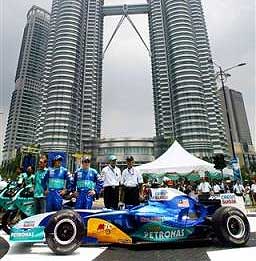
In the top 100, the one from Southeast Asia is of course Petronas, which will not surprise Malaysian readers. This shows the generation-l
 ong benefit of compounding, unlike its counterpart in Indonesia, which several times had to be restructured and almost started over from bankruptcy thanks to the rank corruption that has from time to time pervaded it.
A Thai company makes the second hundred and Singapore’s Flextronics is at the bottom of the third hundred. Now of course globalisation is gradually levelling the playing field. Already almost six percent of the top 500 are Chinese - and half as many from vastly smaller South Korea. But it’s hard to break through these barriers.
Scientific development
To be sure, the explanation for the predominance of the Western corporations is in large measure that they float on top of the world’s largest economies with most of their sales within these huge behemoths. But that argument is circular, since they not only float on the top, they are at the creating bottom. But at least it makes the point that, however visible Western countries are throughout the one-time ‘third world,’ the overwhelming predominance of the profit of most of them comes from their home markets.
The major instance of compounding though is in science, which buttresses industrial growth over both short and long term. The wealth and power of the West, it can be argued, is a result of the long-term compounding effect of scientific development.
China developed many scientific advances much prior to the West - but then a new emperor would ascend and declare science out of fashion, so all that advancement went dead for a few generations - along with lots of the scientists themselves. There was no cumulative effect, little compounding over time.
 By contrast, if a knowledge-hostile regime came to power in Europe, even in the Middle Ages, scientists could just move across a border - often to Holland or, if necessary, England.
You could burn Galileo at the stake but his followers held steady and his breakthroughs were available to scientists throughout the continent. Whether the world was flat or round was a question for testing, and replication was available to scientists almost everywhere. No one was ever able to shut down the science industry in Europe so advance just compounded upon advance.
World wars certainly slowed down the European advance (and cost it its empires abroad) but scientific ideas popped back. German scientists were again in the forefront of study soon after World War II; Einstein had long since fled to America. Small wonder that in the annual distribution of Nobel prizes in the sciences, almost all go to Europe and -overwhelmingly - America, which has reaped the benefit throughout the years of its welcome mat to scientists fleeing persecution, or just looking for a more welcoming research environment - the first Japanese Nobel winner was actually employed in MIT labs in Boston.
The lesson is obvious. Trying to slow down knowledge’s spread doesn’t work in the long term. knowledge just goes elsewhere and brings its benefits to those welcoming it to their shores.
Maybe China should think about this in trying to control the internet.
W SCOTT THOMPSON is a national security expert who served four
American Presidents and is a professor emeritus at the Fletcher School of Law and Diplomacy. He is the author or editor of 13 books on world political issues and resides in Washington, Bali and Manila.


Are you sure you want to delete this comment?
This action cannot be undone.