




BN a multicultural contradiction
As Umno’s political power continues to decline since the March general election, Barisan Nasional (BN) component parties like MCA, MIC & Gerakan are caught in a secret dilemma – whether they should feel happy about this development.
Happy, because a weakened Umno gives these long subservient race parties the first opportunity in decades to press as equal partners in the coalitions and recoup lost support in their communities.
As Umno’s political power continues to decline since the March general election, Barisan Nasional (BN) component parties like MCA, MIC & Gerakan are caught in a secret dilemma – whether they should feel happy about this development.
 Happy, because a weakened Umno gives these long subservient race parties the first opportunity in decades to press as equal partners in the coalitions and recoup lost support in their communities.
Not happy, because a lame duck Umno may result in BN losing political power altogether to Pakatan Rakyat - by extension themselves out of government.
In crude terms, a strong Umno is bad, because its arrogance will alienate minorities. However, a weak Umno is equally haphazard, because it loses traction as the pillar for satellite parties.
Therein lies a fundamental contradiction in the relationship between Umno and its parasitic partners. This contradiction, among others, will doom BN to eventual disintegration, due to a changing political landscape structurally as underlined by the March 8 election results.
Minorities no longer accept harsh racial discriminations, and they are convinced that parties alleging to represent them have failed to protect constitutional rights of minorities - having been hopelessly subjugated by Umno’s hegemony.
 People of all races have come to realise that the BN government has grossly mismanaged the country through corruption and inefficiency, and that Umno has widely abused the affirmative New Economic Policy for corrupt self-enrichment of party leaders and their cronies.
The majority of people of all races detests BN/Umno’s racial politics and yearns for restoration of democracy and the rule of law, which have been steadily whittled away in the past few decades. The people have accepted Pakatan as a viable alternative to incumbent BN, as evidenced by the 50 percent of votes cast in Pakatan’s favour in the March election.
Paradigms shifting
After being subjected to BN’s absolute dominance for five decades, the paradigm shift represented by the above changes is spectacular indeed, considering the fact that the country is still under repressive rule. This political awakening of the people would of course not have been possible if not for the rapid advent of the information revolution and the relentless campaigning by Pakatan.
And the beauty of this political process is that once the populace has become enlightened, it is irreversible. As time goes on, this enlightenment can only increase, as shown in the recent Permatang Pauh by-election, when PKR increased its majority against overwhelming odds.
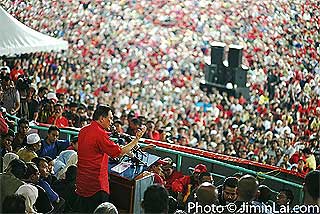 The results of the by-election, as well as subsequent opinion polls, have shown that while Pakatan’s support from all the three main races have increased, the increase with the Chinese and Indians is spectacular.
This is an important signal to the minority racial parties in BN that their days are numbered, unless Umno can make drastic changes to its policy of racial hegemony and corrupt governance through repressive rule. But there is not the slightest evidence that Umno is moving in this direction, despite harsh admonition and even warning of defection by partners.
In this respect, the present crop of MCA and Gerakan leaders, who have been belting out chivalrous rhetoric with the promise to tame the unbridled Umno in the run-up to their respective party elections, can only be described as indulging in mass deception – deceiving others while in a state of self-deception.
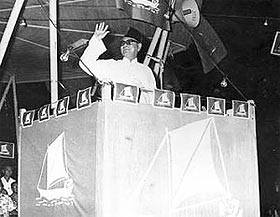 Indeed the contradiction in BN is not confined to that arising from Umno’s big bully role, as a race coalition is an inherently flawed political structure. It was only acceptable in the lead-up and transition of a newly independent multicultural state - as a national consciousness has not taken root.
Malaya saw the Alliance - consisting Umno, MCA and MIC - appropriate then, but as the nation marched on, those parties should have evolved into multiracial parties to pave the way for true national integration.
Race based coalition rot
A permanent racial coalition will be mired permanently in permanent negotiation and compromise - since all parties champion specific race groups. The parties will see each other as adversaries parallel to seeing them as partners.
Potential for friction increases in direct proportion to the degree of disparities among the races, whether in the social or economic field.
 So long as such a governing political structure continues to exist, friction and conflicts among the races will remain an omnipresent feature of government, thus posing an unacceptable stumbling block to racial integration and nation-building.
And such stumbling block becomes even more insurmountable, if the dominant party imposes systemic discrimination against races its partners wish to represent. This dominant partner is corrupt, perpetuating its rule through depraved institutions shielded by repressive legislation - resulting in racial polarisation, deteriorating rule of law and intractable economic morass.
The people feel the brunt of it, hardship despite years of economic boom led by unprecedented commodity price rises, which Malaysia exports.
That is why Pakatan’s offer of good governance and multiculturalism is a breadth of fresh air to the populace.
Heretical Ideologies
Pakatan’s rise has debunked the Umno deception, that its golden formulae was the only one possible for nation-building.
A reality with a fixed race coalition, and cemented extra-constitutional race exclusive privileges as birthrights - evolved from the New Economic Policy. These heretical ideologies have plagued the nation politically and economically.
There are good reasons why Umno leaders have perpetuated these myths.
 They are to ensure that, through these racial divide and rule strategies, party leaders’ political power and personal wealth can be permanently safeguarded.
And the leaders of these satellite race parties cannot abrogate responsibility in the sordid affair, as their abetment to the multiculturalism facade has perpetuated Umno’s hegemony.
At this time when the nation is facing unprecedented political and economic turmoil that may make or break the nation, it is the responsibility of every member of Parliament, in whose hands the fate of the nation has been entrusted, to ponder deeply what he must do that will most benefit the people.
Should he allow the nation to drift as it is for another five years until the next election is due, or should he promptly act to contribute towards making a decisive break from the past so as to open a new chapter of hope for the nation now, without going through the hazards of a prolonged corrupt rule?
Kim Quek is a retired accountant and a member of PKR.


Are you sure you want to delete this comment?
This action cannot be undone.