




From Gaza to KT: Anwar puts suspicions to rest
By-elections in Malaysia are fought with the same vigour, if not more, as the general election. Why this is so remains a mystery.
By-elections in Malaysia are fought with the same vigour, if not more, as the general election. Why this is so remains a mystery, especially when the ruling Barisan Nasional still has a comfortable majority in parliament despite the drubbing it got in the general elections last March.
But in a country with highly racialised politics, in which each political party needs to prove that its support base is multiracial although its manifesto may not be, by-elections are used to gauge not only the people’s sentiments, but also how a certain community — Malay, Chinese or Indian, in this case — perceive the government in the context of their own communal issues.
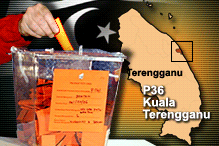 Having said that, the outcome of a by-election in a constituency of almost 100 per cent Muslims, as is the case in the constituency of Kuala Terengganu on Jan 17, had been eagerly awaited by observers to see how far the parties fare in the Malay heartland.
One thing many agree with is that the win is not PAS’ alone, although its machinery and support in the east coast, part of the Malay-Muslim heartland, cannot be underestimated.
But thanks to the still standing “agree-to-disagree” type of cooperation with PKR and DAP, a victory for PAS was predicted after winning over support from the once impenetrable non-Muslim electorate, tiny but decisive amid an almost equal political split among Malays.
 While most observers say that the defeat spells trouble for prime minister-in-waiting Najib Abdul Razak, after Prime Minister Abdullah Ahmad Badawi steps down in March, there are other dimensions to interpret the results.
One of these is that it puts to rest the suspicion about the opposition coalition’s grassroots support. While the Malay mainstream media, namely Utusan Malaysia, repeatedly played the Malay racial card to hammer the message that Anwar has an anti-Malay agenda, it was thought that the opposition was more dependent on non-Malay votes.
Shuffling the racial card
Its stance on issues such as equal opportunity for all races in the government sector, as well as a pledge to do away with Bumiputera policies, has been exploited by Umno.
On the other hand, the non-Malay component parties in the ruling coalition have been playing their own racial card to woo non-Malays, and their favorite bogeyman is PAS and its stance on the Islamic state and syariah, calls which surface periodically either as a reminder of the party’s hard-to-achieve goal, or for political mileage to assuage criticism from grassroots members.
Playing with issues to appeal to different people, it would seem, is not the ruling parties’ monopoly. During the last few years, parties which now form the Pakatan Rakyat too have learnt the art of shuffling the racial card, although it is done with subtlety.
 During the Permatang Pauh by-election that saw Anwar’s comeback to parliament last September, issues such as Anwar’s relationship with the West and his proposal to dismantle the New Economic Policy, as well as the vile allegations of sodomy, were played to the maximum to turn the Malay-Muslim voters against him.
Although he won with a bigger majority, the presence of a sizeable non-Malay electorate was thought to have given him the edge, and thus the argument that Malays were solidly behind him could not be conclusively proved.
This time around, all such perceptions have been shattered. Not only did the government fail to exploit some of the genuine failings and weaknesses of the opposition coalition due to its own shortcomings and image, it also failed in the character-assassination campaign against Anwar. The reason, strange but true, was the Israeli attack on Gaza thousands of miles away.
The Palestinian issue has always been passionately highlighted in the Malaysian media and politics. During the last two decades, then strongman Dr Mahathir Mohamad and his popular foreign policy earned Malaysia respect from Muslims worldwide.
Calls to boycott US products
Malaysia’s more developed status in terms of its economy and education, especially when compared to other Muslim countries, has also raised expectations for it to be more actively involved in a number of issues.
This time around it was no different and with a by-election occurring at a time when the Israeli aggression was reaching a climax, politicians from both sides, including non-Muslim politicians hitherto disinterested in issues such as this, lost no time coming out strongly in defense of Palestine.
Calls were made to boycott American products and suspend the Free Trade Agreement talks with Washington; different groups also rushed medical supplies to Gaza’s Rafah border with Egypt.
Donation boxes were placed in public places and a series of lectures and forums were held to educate the public on the history of the Palestinian resistance, in addition to the usual demonstrations after Friday prayers. All these took place during the campaign for the by-election.
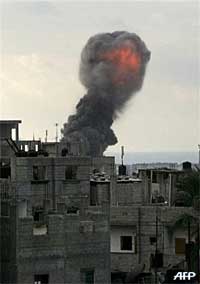 Anwar capitalised on these developments. He used his parliamentary time to debate a motion on Gaza urging the government to make a strong stance on the Israeli attacks, even asking Abdullah’s government to summon the US ambassador in the country.
Anwar said the government need not waste time waiting for Barack Obama to move into the White House because of his sympathies for the Zionists. He called for a regional action plan with Muslim neighbours Brunei and Indonesia to set an example to Arab governments that he described as meek and hopeless.
These are rare words from a man who, although enjoys strong sympathy among Muslims throughout the world over the personal ordeal that he went through, has been widely criticised for his more than friendly ties with shady Western characters.
Anwar the clear winner in KT
Coupled with a small group of close aides and long-time comrades who have the penchant of quoting Greek philosophers and criticising people who are against American imperialism, all for the sake of showing how liberal-minded a Muslim they are, Anwar’s image as far as his ties with these characters are concerned had been awaiting redemption.
Unlike the Arab leaders, who declined to seize the day and pay even lipservice for the Palestinian struggle, Anwar decided to come clear out of years of vague and pseudo-diplomatic statements on current events where the Muslim world and America collide.
When an election is contested based on a coalition of parties with a plethora of issues, it is sometimes difficult to tell which party emerged as the winner even after the results.
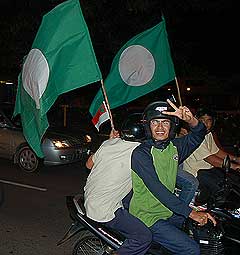 In this case, one can say that PAS was not the clear winner in the by-election. Instead, it was Anwar, who managed to redeem his political and personal image, at the same time managing to sustain opposition momentum against Umno and the status quo.
For now, Anwar’s charisma and his prime ministerial image linger on to give his former friends-turned-sworn enemies a beating he had longed for since his prison days.
This despite his failure to bring down half-a-century of Umno-led rule through defections of MPs as he had promised last year. And also despite the falling price of petrol that was for a short while thought to be the golden rule to gauge the government’s popularity.
It would seem that Umno cannot afford a replay of the loss in Kuala Terengganu. The last thing the BN wants now is a government backbencher to kick the bucket.
But the day will also come when Anwar too will be shown to be a mere mortal. This is a scenario that few in the opposition parties want to entertain at this time as they dance to the beat of their newfound good times tune.
ABDAR RAHMAN KOYA is editor at Islamic Book Trust based in Petaling Jaya.


Report this comment
Are you sure you want to delete this comment?
This action cannot be undone.