




Malaysia in transition
2008 was a watershed year for Malaysia socially and politically. After 50 years of comfortably winning elections, the Barisan Nasional (BN) received a backlash from the normally docile Malaysian electorate at the 12th general elections.
2008 was a watershed year for Malaysia socially and politically. After 50 years of comfortably winning elections, the Barisan Nasional (BN) received a backlash from the normally docile Malaysian electorate at the 12th general elections.
The BN, a coalition of 14 mostly race-based parties, commandeered by Umno, still won comfortably but for the first time in its history, lost control of five state governments in the peninsula.
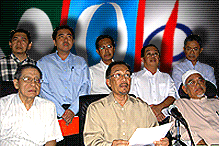 It was also denied the psychological two-third majority in Parliament required to change the Constitution when Pakatan Rakyat led by Anwar Ibrahim won 82 out of the 222 parliamentary seats.
Malaysia is often paraded as a model developing economy. By all internationally accepted standards, Malaysia has definitely done well.
It is touted as a moderate Muslim majority nation that has successfully managed to address issues related to communist insurgency, Islamic fundamentalism and racial tensions in addition to conventional development challenges.
This success however had come at the expense of democratic freedom. BN had developed a narrative that a strong government is necessary to ensure continued peace and prosperity.
This strong government had built a façade over the many problems that face Malaysians and also on the abuse of power, corruption and mismanagement that it propagates.
The run-up to the 12th general election and since, however, has seen direct challenges on this façade that the BN had created.
The 12th general election saw the near demise of BN’s major non–Malay parties, a clear indication that the non-Malay community in the Peninsular had rejected the BN. If not for East Malaysia (Sabah and Sarawak) and dubious electoral practices, the BN would now be in opposition at the federal level.
Demand for free & fair elections
The people of East Malaysia however continued to staunchly support the ruling party although socio-economically, they are the poorest among all Malaysians. The catalyst for the unravelling of BN can never be pointed out. However, the increasing dominance of Umno in the ruling coalition, the racial arrogance it displays in the public sphere and BN’s contempt for the rule of law clearly had a part.
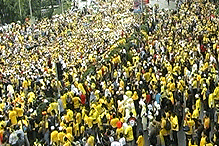 The event that galvanised the Malaysian public was the “Bersih Rally” on Nov 10 2007. An estimated 30,000 Malaysians, the largest since the sacking of Anwar Ibrahim, gathered in front of the royal palace to demand for free and fair elections.
This was quickly followed by the Hindraf (Hindu Rights Action Force) rally, which brought together another 30,000 from the Malaysian Indian community to voice their grievances against the government.
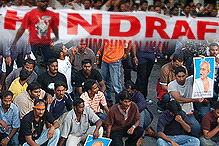 Malaysian Indians had always been loyal BN supporters. However, years of continued marginalisation forced the community to use direct democratic measures after pleadings through the community’s political representatives in the coalition (MIC) failed to bring any measures to address their worsening conditions. These demonstrations took place despite the threat of arrests from the police.
As Malaysians shed their fear of BN, loyalty to parties based on race became increasingly vulnerable. Civil servants, entrepreneurs, politicians – many who had benefited from BN’s policies, turned against them for various reasons. This opened a can of worms as individuals with “privileged” information aided with technology laid bare the extent of BN’s corrupt practices.
From the selection of judges, to determining outcomes of court cases, to how contracts are given out to cronies - all these were laid bare for the public. What were previously rumours were now documented in black and white and some even with audio-visual support. BN’s hegemony on information was circumvented through the internet.
As for Malaysia’s leadership, Abdullah Ahmad Badawi had been urged by his party members to step down in March 2009. However, the prime minister-in-waiting, Najib Abdul Razak is facing serious allegations of being complicit in the murder of a Mongolian national involved in defence deals while he was the minister of defence.
Najib seen as the best Umno can offer
 He has “sworn” his innocence in a mosque, although there are two sworn statements (affidavits) that he is involved. The courts however have not called on him or the individuals who made the affidavit in the ongoing murder trial.
Najib is also not immune to the many allegations of cronyism and corruption. In general, however, he is seen as the best Umno has to offer.
To its credit, in response to its dismal failure, BN has introduced several measures to win back the confidence of its citizens. High on the agenda is addressing the problem of corruption in Malaysia.
In the year 2008, several bills were passed to address these problems. The landmark bills were the Judicial Appointment Commission – an attempt to restore confidence to the judiciary and the Malaysian Anti-Corruption Commission, to strengthen anti-corruption efforts. The government also provided ex-gratia payment to the five judges that were dismissed in the Malaysian judicial crisis of 1988 – a face saving measure to acknowledge the Malaysian government’s wrong-doing.
Malaysia’s economic performance continues to be respectable although nowhere in comparison to China, India, Vietnam and Singapore. The Asian Development Bank forecasts that Malaysia would record a growth of 5.3 per cent in 2009.
However, a prolonged global recession may impact more severely as Malaysia is an open economy and highly reliant on trade. Partisan politics currently demonstrated in Malaysia will not be helpful for policy-making.
The oil price hike, the global financial crisis and the failure of the Doha Round is having serious effects on the Malaysian economy. However, the fixation with domestic politics has made analysis of these issues either negligible or from partisan interests.
2008 saw political reform in an unprecedented way in Malaysia. In many ways the nation is maturing. Najib will take over in March 2009. Will he choose to move the country forward in a non-partisan way or will he return to more traditional authoritarian ways of governing the nation? Only time and the will of Malaysians to continue on this reform path will tell.
GREG LOPEZ is a postgraduate student at the Crawford School of Economics and Government, Australian National University.


