




'Stop the train, I want to get off'
The recent announcement that the LRT extension proposals would be delayed to 2013 (at the very least) did not come as a shock to many Malaysians. After a long list of promises, plans, proposals, and more promises, people have gotten used to the delays.
The recent announcement that the LRT extension proposals would be delayed to 2013 (at the very least) did not come as a shock to many Malaysians. After a long list of promises, plans, proposals, and more promises, people have gotten used to the delays.
Like passengers waiting for a late bus or train, we occasionally look up, grumble a little bit, and go back to waiting some more.
For myself, the idea that the LRT extensions would be delayed was absolutely no surprise – it was to be expected.
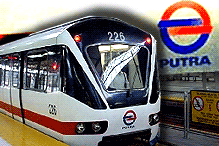 Given the state of affairs at Prasarana,the total lack of information about the need for the projects, the political wrangling within the civil service (Finance Ministry vs. Transport vs. EPU vs. Commercial Vehicles Licensing Board), as well as the unrealistic obsession with megaprojects, it was just a matter of when, not if, the LRT extensions would be delayed.
Despite all the research and the forums and the information and the papers and the promises and the effort and funds and revamps, it just seems that realistic solutions to our public transport nightmare cannot be found – or perhaps they are just hiding in plain sight and we are just not capable of seeing things properly.
I and many other people, including the members of TRANSIT – the Association for the Improvement of Mass Transit – are inclined to believe that the solutions are in plain sight – but for some reason, we are just blind and not able to see.
In 2007 and 2008, I wrote a series of articles analyzing our strange longing for megaprojects as the solution for our public transport nightmare. Considering how nightmarish public transport actually is, the term “LRT Dream” was and is very appropriate to describe this strange and confusing longing.
My criticism of the LRT dream and the proposed LRT extensions – did not endear me to many of my neighbours, who felt that such criticism would spoil the opportunity to improve transport in USJ, Subang Jaya and Putra Heights.
It was almost sacrilege to suggest that these communities – comprised mostly of large sections of double-story terrace houses – needed anything less than two full-sized LRT lines.
This particular attitude fuels the LRT dream. Never mind that LRT is a costly, time-consuming, and overall, inefficient solution for our public transport problems. Never mind that the construction period would be too long, and that it would cause more disruption to these communities including increased traffic congestion.
Examples of poor planning
Never mind that other projects like the Subang-Kelana Link were disruptive. Never mind that Prasarana had no interest in attending meetings with the Adun or the community.
When spending billions of RM in money (private or public but ultimately it is always public), there must always be a true justification. We simply cannot afford to make mistakes with infrastructure because if it does not work effectively, we cannot undo things and redo them again.
The existing LRT and monorail lines are, in many ways, examples of poor planning and execution of public transport project. The Putra LRT (now Kelana Jaya line) is too small for the communities it services and uses a costly technology provided by one company (Bombardier) with little competition to allow for lower prices in the future.
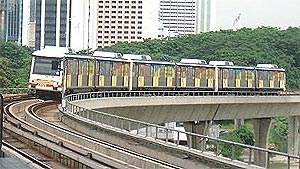 The STAR LRT (now Ampang line) travels along the Gombak River, disrupts Dataran Merdeka and Jalan Tun Perak, and then proceeds to hide behind buildings from Puduraya all the way to the terminal in Ampang.
The infamous interchange at Masjid Jamek LRT has caused the Klang River to become a narrower and deeper longkang (drain) – at the heart of Kuala Lumpur.
Then there is the monorail. It is described as PRT – Peoplemover Rapid Transit rather than LRT – which says a lot about what it is – a confused rapid transit line that is neither a “mainline” nor a “circle” or “people mover” line.
KL Monorail is rather like an unwanted child – it was almost never born, is smaller than it ought to be, and is continuously neglected by the government who promise attention but provide only neglect.
It was once promised that the monorail would be extended from the “KL Sentral” station (which should really be called “Brickfields” onto the KL Sentral complex – perhaps within the mall proposed “Lot G”, over the parking lot in between.
We know now that the KL Monorail will never enter KL Sentral, and to make things worse, the public buses that use KL Sentral will be thrown out for the construction of yet another mall – in a city that has more than its share of malls and far less public transport infrastructure than it needs.
Do we need more neglected lines?
All of the lines described above are like neglected children, never able to grow to their fullest potential. Like the unwanted children of immature parents, they have been ignored and pushed away until the only solution was an adoption by an outside party – in this case the government.
And yet, for some reason, the government keeps on encouraging projects like these. Honestly, do we need more neglected lines and wasted resources in the future?
I have stated clearly, without fear or favour, that we must have numbers and statistics and information to prove that LRT lines are needed in the surburban areas around Kuala Lumpur.
I have asked for proof to show that Subang Jaya is in desperate need for two LRT lines, and has a far greater need than other towns and cities – like Ampang, Puchong, and Petaling Jaya and the Federal Territory of Kuala Lumpur.
Of course there has been no response – but I never really expected one anyways.
It must be clearly stated that rapid transit projects cannot be successful if built in a vacuum – meaning, with no existing public transport service. “If we build it, they will come” does not count as adequate public transport planning.
Nor does “of course we need LRT, look at the traffic jams” count as justification for a mega-LRT project. Asking designer of Aerobus or a monorail company to suggest public transport solutions does not count as government research. And finally, putting articles in the newspaper and asking for feedback on your blog does not count as public consultation.
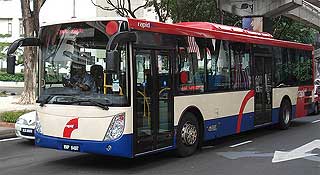 I have seen that there is adequate public transport service along some routes – with high demand and great potential for growth – that are parallel to the proposed Kota Damansara-Cheras line. This is why I have faith that this line will be successful – but it must be built as an MRT line, with room for lots of future growth.
As for the extensions of the LRT from Kelana Jaya and Seri Petaling, there are no stable existing bus routes with high demand to justify these LRT extensions. In Subang Jaya and USJ, RapidKL and Metrobus have been cutting service. In Puchong, most public transport routes use Jalan Puchong to get to KL.
Some people might argue that having an interchange of LRT and KTM at Subang Jaya would justify the extension. But for that same reason, extension of the Ampang Line from Seri Petaling to Old Klang road (an older proposal) and through Petaling Jaya would be an amazing solution for our public transport needs. It would create multiple interchanges – LRT with KTM, LRT with LRT, LRT with MRT, etc.
If the government wishes to extend the LRT lines they must go to the correct places where there are lots of existing demand and high potential for future growth. Subang Jaya, USJ, and Putra Heights do not meet these needs.
The Selangor Structural Plan is a legal document that reflects the expected plans for infrastructure development in Selangor state. The problem is that, aside from being incomplete and based on old data it is already out of date. It is also very unclear.
Let’s have some proper explanation
The transport side of the structural plan (for example) describes “Laluan Transit” and “Laluan Rel” but does not explain them properly. It also envisions many of these “laluan” as feeding lines off the KL-Port Klang spur line of the KTM railway – which has to share space with freight trains filled with containers offloaded from Port Klang and bound for Malaysia and Thailand.
The LRT lines proposed by the federal government are in an area loosely based on this out of date structural plan, which shows a “Laluan Rel” from Subang Jaya (not Kelana Jaya) to Putra Heights and a “Laluan Transit” from Seri Petaling to USJ17 (not Putra Heights).
But development in these areas has favoured single-family terrace houses and large tamans – not the kind of development that effectively supports massive public transport projects like LRT.
If that wasn’t enough, then there is the KL City 2020 Draft Local Plan, which envisions 11 or 12 lines criss-crossing the city. Most of these lines are high cost, low-capacity monorail lines – surely the DBKL and their planners might have learned something from the stunted KL Monorail line?
I am happy to see that there are some positive things. Some of the lines are proposed for places that already have public transport or have potential for improvements. So, there are some realistic lines among the unrealistic ones. The trick of course is to find a way of sifting out the vital lines from the unimportant ones.
Perhaps we will wake up from the LRT dream soon. Perhaps, we never will wake up. I said long ago that we should look at KTM as the solution to our public transport woes – KTM uses a simpler technology with lower costs and greater potential.
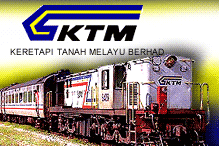 Most people disagreed that KTM was the “way to go” because of the poor service. But we can improve on poor service (as KTMB is slowly doing). It is next to impossible to rescue a city from poor planning.
As the LRT lines face delay after delay, the KTM Komuter extension from Sentul to Batu Caves is going ahead, only slightly behind schedule. The railway has been double-tracked and electrified and the stations are nearly built.
2009 will probably be the last year that there will be a “Special train for Thaipusam” because by 2010 Batu Caves will be seeing regular, frequent KTM Komuter service each and every day!
Perhaps the continued delay of the LRT and MRT projects will show the government that there are better, cheaper, more flexible solutions out there that can be implemented faster – if only they would open their eyes to the solutions that are lying in plain sight.


