


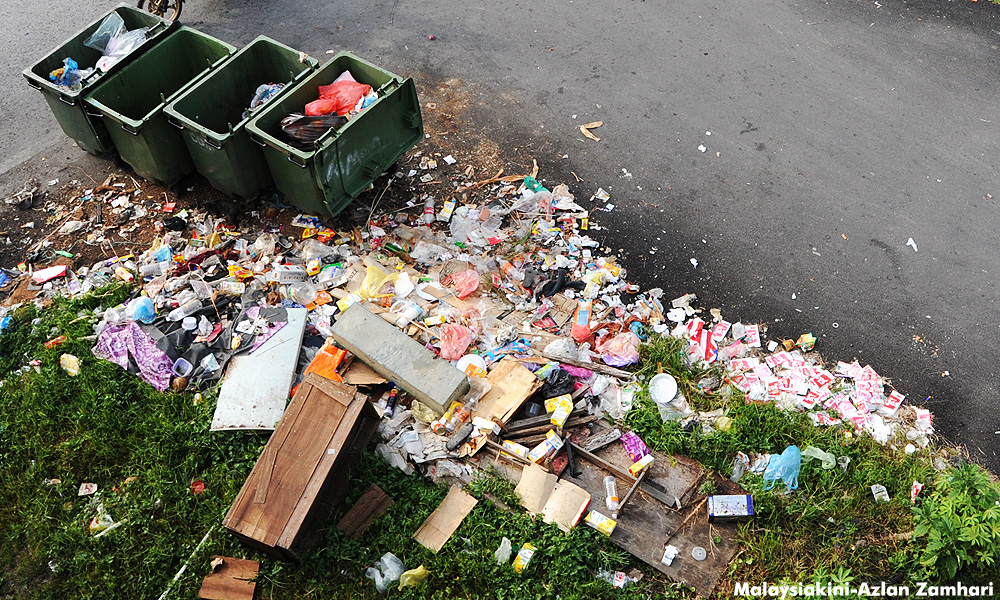

Talking trash - any changes so far?
The state of Malacca has banned non-recyclable plastic bags for over a year, and the federal government has issued a directive on trash sorting for those living in territories under its purview since 2015.
At the same time, it has been awhile since Selangor launched its 3R programme - reduce, reuse and recycle. The state has also banned polystyrene containers and plastic bags.
And yet, there hasn’t been an inkling of news whatsoever on whether any of these have made landfills less full, or even if there has been a growing movement in ‘down cycling’ whatever ends up in the garbage pile.
In fact, how are we even doing on the government-launched curbside recycling movement, where each household has to sort its trash? Does it reach recycling centres and is then made into goods?
This is usually the case with paper, aluminium cans and perhaps even glass, but plastics tend to end up in the fashion industry.
Plastic bottles, meanwhile, are shredded and used for insulation in winter coats, or mixed to become the thread in those tight exercise shirts you wear that look rather trendy by showing off the hard work at the gym.
The way the Urban Well-being, Housing and Local Government Ministry has gone about this issue is somewhat sketchy.
The authority over trash in six states and our Federal Territories (excluding Labuan for some reason) is SWCorp. They are tasked with collecting household trash separated between non-recyclables (twice a week) and recyclables once a week.
Insofar as curbside recycling goes, this seems simple enough, doesn’t it?
Hold on.
There is even a push to go one step further into separating recyclables into their specific types, in colour-coded bags which you will not even find sold in supermarkets or shops. If you do find the ‘white plastic bags’ designated for plastics, do inform everyone.
The national goal for Malaysia is to increase recycling from the current 10 percent to 22 percent by 2020. Meanwhile, Europe is looking at bans of landfills by 2025 and 75 percent recycling by 2030.
Malaysian urbanites in 2014 produced 1.25kg of waste per person daily. The nation will be producing 30,000 tonnes of trash daily by that period. Meanwhile, Europeans produce only a kilo of waste per person daily.
While it is all fine and dandy to focus on trash sorting and even the questionable usage of down cycling and even recycling, there is another aspect we need to look at - and that is making landfills expensive.
A tonne of waste in London will cost £100 (RM556) to be put into a landfill, and while Malaysia should adjust rates to coincide with it being just as painful, we would also need to push more on looking at financial benefits.
Tax break or rebate
Companies that use recyclable materials - be it non-government organisations, small businesses or even factories bulk-producing goods - should either get a tax break or a rebate due to their efforts in helping the government achieve its target.
And if local councils as well as the government are truly looking towards people taking recycling seriously, they should show it openly especially on the streets. Where are the walkway trash sorting cans in Kuala Lumpur?
In May 2016, a news report said that KL by itself generated 3,500 tonnes of domestic and industrial waste which costs them RM325 million a year.
When a mall such as Ikano Power Centre can do it for the past decade, is it not awkward that even the Kuala Lumpur City Hall doesn’t seem to be encouraging it openly on the side of the streets?
Now we head on to the biggest issue regarding waste management - gluttony. According to a piece in The Star, food waste makes up 44.5 percent of the trash in Malaysia. Unless we have a gigantic compost heaps, it all ends up in a landfill.
And since we have a minister so concerned with emissions to the point of wanting to ban kapchai motorcycles, this amount of food waste rotting in a landfill produces methane - a greenhouse gas which will affect the environment.
In fact, that is basically what you're smelling inside your cars when driving past a landfill, or a chicken farm, or even an industrial cow ranch. Or maybe even when you drive on the New Pantai Expressway in the early mornings to get to your jobs.
So perhaps a food wastage tax is in order, just like Singapore. We may be a bountiful land, but it truly seems that there are just those who don’t value it as much as others.
Yes, we need to reduce the amount of trash, but both soft and hard approaches need to be taken seriously. Having half-baked measures will not cut it in this day and age, and Malaysians need to meet this harsh reality with just as much zeal as they do with politics, if not more.
Worried about the future you’re leaving behind for your sons and daughters? Why don’t you start by sorting that trash you have, lessen food waste and as my friends constantly need to remind me - for gosh sakes, carry a tumbler to Starbucks!


