




Oil wealth to fuel DAP's shadow budget
The DAP has unveiled a shadow national budget that gives high priority to policies of decentralisation in fiscal matters and governance, and fairer distribution of the country’s oil wealth.
The DAP has unveiled a shadow national budget that gives high priority to policies of decentralisation in fiscal matters and governance, and fairer distribution of the country’s oil wealth.
 The highlight is a proposal to provide tax exemption for the first RM15,000 of chargeable income, with subsequent income taxed at 7 percent. This is a leap from the current threshold of RM2,500 and is aimed at assisting middle class working families.
The bracket for the top tier of income tax would be raised from RM150,000 in chargeable income to RM300,000, under the proposal.
The opposition party revealed details at a press conference this morning. The theme of this alternative budget is 'Democratising Malaysia's Economy'.
Another proposal would provide relief for road-users, through an allocation of RM25 billion (off-budget) to buy back toll highways from concessionaires including Plus. This would then lead to lower toll charges.
Other ‘lopsided’ government concessions, such as those signed with Independent Power Producers and water-management companies, would be reviewed through a new Unfair Contracts Act, established to ensure transparency.
The government’s overseas scholarship scheme will be split into two tiers, if the DAP has its way.
 At least 1,000 pre-university students who have secured admission to top universities will be provided with scholarships worth a total of RM500 million. A further RM200 million worth of scholarships would be awarded to top pre-university students from a poor background.
Currently only SPM top scorers are provided scholarships, which cover both pre-university and university education. More than 4,000 SPM top scorers can still vie for scholarships worth RM60 million, but only for their pre-university education.
To prove that DAP has its ears to the ground, the budget proposes to allocate RM50 million as a matching grant of up to RM250 per household for the hiring of security guards and installation of CCTVs for ‘high risk neighbourhoods’.
Small- to medium-size business owners can also take advantage of the grant, with an additional RM25 million allocated for this purpose.
There will also be a focus on SMEs through seed funding, thematic clustering and research and development.
Other key budget proposals:
- RM750 million to eradicate hardcore poverty within the next five years, in the form of direct handouts and capacity building through education, healthcare and transportation; the poverty line to be revised and RM500 million provided for a Social Safety Net programme for self-employed low income earners
- RM43.3 billion or 23.8 percent of the budget for educating, training and building “a real world class learning environment for young Malaysians and students”
- RM21 billion per annum to cover a 'fair wage’ programme for low income workers - those with a personal income below RM3,000 a month will receive up to RM3,000 annually via their Employees Provident Fund (EPF) account; their spouses will get RM1,500 annually if they are homemakers; and adjustments will be made to their monthly EPF contributions
- RM3 billion to develop basic amenities, such as water and electricity supply, in rural areas as well as in Sabah and Sarawak
- RM1.07 billion for a Senior Malaysian Bonus, through a two-tier system which determines pay-outs based on annual income and value of property owned; the money will be paid into the EPF account for immediate withdrawal
Milking the cash cow
To meet its expenditure and to ‘democratise’ the nation’s wealth, the DAP will reallocate the oil wealth. It claims that the past 12 consecutive years have seen no surplus or reserves owing to Malaysia’s oil wealth, despite sky-rocketing prices.
 Its remedy will involve new legislation governing the use of surplus oil and gas revenues. At least RM12 billion of the surplus payment reaped from Petronas will then be divided into three channels.
One of these is Khazanah Nasional, for investments in renewable energy, energy efficiency and green technology.
Money will also be deposited in a new National Stimulus Fund that will invest in building human capacity through education and training, additional to normal allocations.
The stimulus fund will be opened to the public whenever there is an economic slowdown, through the new Malaysia Reversed Bonus scheme and Special Risk-sharing Initiative.
The proposed legislation is expected to channel approximately RM50 billion into the government coffers, RM30 billion of which will be disbursed directly through the normal nominal budget.
More power to the rakyat
To empower the grassroots, RM400 million fund will go towards the reinstatement of local council elections. Money will also be channelled to delineation studies, as well as education and awareness campaigns after relevant amendments to the Housing and Local Government Act.
Community police teams are to be set up, made up of volunteers, full-time and part-time members, as well as retired police personnel. These will fill the vacuum after the proposed disbandment of the Rela corps, which has been accused of abusing its powers. DAP proposes to set aside RM542 million to finance the scheme.
 DAP also proposes to free up the nation’s wealth from the clutches of the federal government, through tax-revenue sharing agreements that will also empower state governments. The agreements will entitle each state government to keep 20 percent of individual and corporate income tax collected under its jurisdiction.
Richer states like Selangor and Penang stand to gain about RM3.2 billion and RM500 million respectively. Poorer states will not lose out as equalisation and development grants will be handed out based on population, poverty, area development, cost, human development and gross revenue.
States will be given the right to borrow from the federal government, up to 50 percent of their annual revenue.
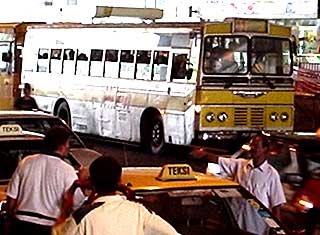 State governments will be given authority over the design and administration of public transportation, with a Transport Authority to be established in each city.
Smaller towns and suburbs will be grouped under a state-wide authority. In the Klang Valley, however, a single authority will oversee the management of this highly inter-connected area.
This new decentralised transport system will have a budget of RM13 billion, which will be divided among the states according to population and vehicle density.


Are you sure you want to delete this comment?
This action cannot be undone.