




DAP's shadow budget right on the money
Dubbed a "rakyat first" budget by Lim Guan Eng, the DAP shadow budget, unveiled on Wednesday, has been relatively well received by the public. And why not?
Dubbed a "rakyat first" budget by Lim Guan Eng, the DAP shadow budget, unveiled on Wednesday, has been relatively well received by the public. And why not?
The budget promises the "democratisation" of the nation's wealth, so that money will no longer be "under the monopoly of the federal government."
 Old and young, men and women, poor or middle class, the budget proposes goodies for all. But how would the budget fare in light of these recessionary times?
While the government is quick to say that the recession is only "technical" in nature (an economy is considered to be in a recession if it has experienced two consecutive periods of negative growth), a further slide of GDP in quarter three raised alarm bells of prolonged recession.
Quick to act, the government released two stimulus packages totalling a whopping RM67 billion - a move celebrated by many economists. Experts believe that quarter four GDP figures will show a growth 2.4 percent, on the strength of government expenditure due to the two fiscal stimulus packages.
Would DAP's proposal to reduce government expenditure, in aid of the fiscal deficit, thus run counter to the effects of the stimulus package?
The question of fiscal deficit
Generally speaking, a deficit occurs when one spends more than what is earned. In the case of a federal budget, a fiscal deficit happens when government expenditure is higher than revenue.
Such has been the case for the Malaysian federal budget throughout the past 12 years.
This, according to Guan Eng, is an indicator of poor management. "Over the decade, our fiscal deficit has ballooned to RM47 billion, about 7.6 percent of the GDP. A deficit of more than five percent of GDP is accepted to mean the economy is in danger," he said.
 And things are getting even worse. "If you listen to the government statements, it actually sounds like they are literally running out of money to spend," said Tony Pua (
right
), the national publicity secretary for DAP.
And things are getting even worse. "If you listen to the government statements, it actually sounds like they are literally running out of money to spend," said Tony Pua (
right
), the national publicity secretary for DAP.
To rectify the situation, DAP proposes a total overhaul of spending habits, and to make sure there are no holes in the government kitty. One gaping hole, according to Guan Eng, is corruption.
"Pemudah's conservative expectation of how much we can save if corruption is wiped out is RM10 billion. But that is a conservative expectation. I personally think we can recoup as much as RM20 billion without problems," said Guan Eng.
Further, in 2004, DAP cited in their budget that the Seberang Prai Municipal Council purchased RM1.5 million worth of flowers for five years, while in 2007, the Selayang Municipal Council spent RM240,000 on ‘Study Tours' to South Africa and Mauritius. Such wastefulness, they noted, is not going to do our growing deficit any favour.
Development for long term gains
Having a cash cow called Petronas has further entrenched such habits. According to Pua, instead of tightening their belt in times of crisis, the government has used up every single sen of oil revenues to feed this habit.
Worse still, the revenues have been used to fund operational expenses with little spent on developing our economic capacity and human capital.
"What we propose is to drop the operational expenses and spend more money in development for long term gains," said Pua. In their 2010 shadow budget, DAP intends to slash government expenditure by a total of RM 23, 945 million, automatically reducing the deficit by at least the same amount.
Interestingly, according to economic theory, government expenditure makes up the bulk of the GDP and reducing such will mean further shrinking an ailing economy.
 In practice, however, this may not be so straightforward. "In theory, in a recession, governments often resort to stimulating the economy by pumping in public funds and boosting expenditure. In practice...outcomes are not guaranteed," said Lim Teck Ghee (
left
) of the Centre of Public Policy Initiatives.
In practice, however, this may not be so straightforward. "In theory, in a recession, governments often resort to stimulating the economy by pumping in public funds and boosting expenditure. In practice...outcomes are not guaranteed," said Lim Teck Ghee (
left
) of the Centre of Public Policy Initiatives.
According to Teck Ghee, much of government expenditure in Malaysia goes to the pockets of cronies and other shady intermediaries. For example, he noted, large commissions may be paid out in military procurement. Reduction of such expenditure has no adverse impact on Malaysians and will not deepen the recession.
"Much of the illicitly accumulated wealth from corrupt practices, leakages or unjustifiable over-pricing practices are often taken out of the country or used for conspicuous consumption of high-priced imported goods," he added.
"This will actually make matters worse for the GDP with money flowing out of the country, demonstrating the DAP shadow budget was right on the money."
APs to be auctioned monthly
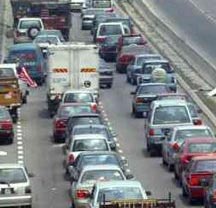
Besides dropping government expenditure, an increase in revenue is also a logical remedy for an unhealthy deficit. DAP recognises this by proposing that about 70,000 vehicle approved permits (APs) be auctioned monthly instead of current practice of annual issuance. "This is estimated to draw in an additional RM1.75 billion," said Pua.
 Another proposed source of income are "green taxes" where corporations are to be taxed RM25 per tonne of CO2 equivalent, while a 0.05 per cent severance tax will be charged for mineral and forestry extraction.
But will this fully compensate for a drop in revenue due to DAP's proposal to cut personal income tax?
Pua believes that the new sources of revenue will only partially compensate the loss of revenue from personal income tax. But it is a pay-cut that is necessary to help working families through the recession, and to pull the poor out of a poverty cycle which will ultimately burden the country.
Indeed money used to pay for bonuses and welfare payments made to working families, the poor and the youth are more likely to stay in the country than money which ends up in corrupt pockets.
So is it worth reducing deficit if it is likely to deepen the recession?
 Yes, according to the DAP, and this may not necessarily be the wrong move. According to Teck Ghee, the main factor in the severity of the recession is really beyond our control, and this is the state of global markets on which we are dependent.
It is therefore wiser to address what is in our control, an "unsustainable" deficit that is expected to be eight percent this quarter - the highest Malaysia has ever experienced.
In fact, the reduction of deficit will boost market confidence and further strengthen private sector growth.
After all, Teck Ghee noted, the BN government has also warned that the government needs to reduce its expenditure and the deficit as early as next year.
"In this sense, both the BN and DAP appear to be on the same page," he said.


Are you sure you want to delete this comment?
This action cannot be undone.