




Liberal economists: Free market economy best cure
A group of liberal scholars have argued that the free market is still the best approach for the economy despite governments' Keynesian economic approach that has become more dominant in the post global financial crisis era.
A group of liberal scholars have argued that the free market is still the best approach for the economy despite governments' Keynesian economic approach that has become more dominant in the post global financial crisis era.
The scholars said that this is because the recent financial crisis was fundamentally caused by poor governance in governments, especially in central banks around the world, and not the market itself.
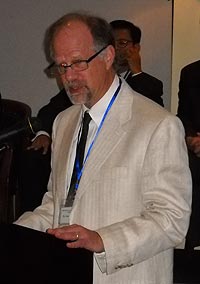 Professor Lawrence H White (
right
) from George Mason University felt that the central bankers were actually practising the "rule of man", rather than "rule of law" in governing the financial sector.
Professor Lawrence H White (
right
) from George Mason University felt that the central bankers were actually practising the "rule of man", rather than "rule of law" in governing the financial sector.
"Under rule of law, executive agencies and governments do nothing, but faithfully enforce statutes that are in the book. But under rule of man, by contrast, the executive authority has discretion to make up new decrees as they go along," he explained.
Among the central banks, the Federal Reserve of the United States led by Alan Greenspan and now Ben Bernanke, was the most criticised for creating the housing bubble by adopting a low interest rate policy between year 2002 and 2006, although the real interest rate was already falling into negative territory.
"Central bankers started the fire, and subsequently discovered the fire and put out the fire," said Professor White when he criticised the Federal Reserve as the authority that had caused the bubble, but now claims to be the "steadier" of the market.
The bursting of the housing bubble subsequently triggered the subprime mortgage crisis in 2007, which transmitted around the world through excessive securitization of risk and caused the global economic recession.
Most countries had since spent billions of dollars to stimulate their economies and called for an overhaul in the world financial regulation structure.
Self-correcting by the market
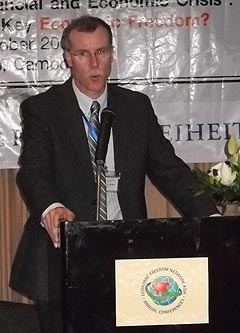 Former Executive Director of the Fraser Institute, Dr Mark Mullins' (
left
) also said the market has essentially self-corrected itself after central bank liquidity interventions restored confidence in the overall financial systems and the recession came to a close.
Former Executive Director of the Fraser Institute, Dr Mark Mullins' (
left
) also said the market has essentially self-corrected itself after central bank liquidity interventions restored confidence in the overall financial systems and the recession came to a close.
"Neither traditional monetary policy nor the current fashion for excessive deficit spending had major roles to play in the denouement of the crisis, though both will play a role in the early stages of economic recovery," he added.
He also called for the world economy to return to market mechanism and reduce the stimulus deficit spending because of the wastage of resources and market distortion that is being produced.
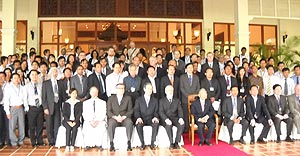
Both were among the speakers at the international conference in Siem Reap on Oct 8-9, with the theme "Overcoming the Global Financial and Economic Crisis: The Rule of Law as the Key to Economic Crisis?"
It was hosted by the Economic Freedom Network Asia (EFN Asia), which is a group of research institutes, practitioners, influential think-tanks, and individuals who believe in the free market economy.
It was also supported by the Friedrich Naumann Foundation for Liberty, a German political foundation that is linked to the classical liberal and pro business Free Democratic Party.
Interestingly, the party has just achieved an all time high record in the recent Germany election, boosting its popular support from 4.8 percent to 14.6 percent in terms of the national vote.
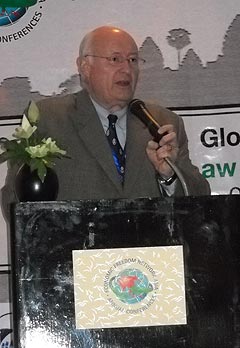 Other speakers included Dr Martin Krause of ESEADE Graduate School (Argentina), Dr Michael Walker of the Fraser Institute Foundation (Canada), Dr Parth J Shah of Centre for Civil Socity (India), Professor Kreignsak Chareonwongsak of Institute of Future Studies for Development (Thailand), Swaminathan S Aiyar of CATO (USA), Son Koun Thor of Supreme National Economic Council of Cambodia (Cambodia), and Ernest Leung of Foundation for Enhancement of Revenues (the Philippines).
"My preference is still the free market." said Professor Chareonwongsak.
"The market is like a democratic system, so little people can vote."
Economic freedom in Malaysia deteriorates
The two-day conference also launched the "Economic Freedom of the World: 2009 Annual Report" Cambodia Edition, which was prepared by the Fraser Institute.
Hong Kong was again first in the rankings of 141 nations and jurisdictions for economic freedom with 8.97 out of 10, while Malaysia (6.85) was 64th, behind two neighbouring Asean countries, respectively Singapore (2nd, 8.66) and Thailand (59th, 7.04).
 The EFW report uses 42 different measures to create an index ranking of countries around the world based on policies that encourage economic freedom.
These ratings were for the year 2007, the most recent year for which comprehensive data were available.
Economic freedom is measured in five different areas: (1) size of government; (2) legal structure and security of property rights; (3) access to sound money; (4) freedom to trade internationally; and (5) regulation of credit, labour and business.
According to Dr Walker, Malaysia once did well in terms of economic freedom during the 1980s and the 1990s as it ranked 13th or 14th in the index.
However, the ranking fell after the capital control measures were introduced during the Asian financial crisis of 1998.
"Year 1995 was a turning point for Malaysia. It was at No 14, but then fell to No 46 in the year 2000," he said.
He explained that the low ranking was mainly due to two main areas, which are the size of government and access to sound money when Malaysia ranked 64 (5.99) and 105 (6.78) respectively.
In term of the 42 sub measures, Malaysia scored zero for the freedom to own foreign currency bank accounts and 0.77 for capital control out of 10.


Are you sure you want to delete this comment?
This action cannot be undone.