




Don't shoot the cartoonist
Zulkiflee Anwar Haque, better known as Zunar, has been drawing cartoons for the past 20 years. He started at humour magazine Gila-Gila in 1986, later contributing cartoons to Berita Harian and the News Straits Times .
Zulkiflee Anwar Haque, better known as Zunar, has been drawing cartoons for the past 20 years. He started at humour magazine Gila-Gila in 1986, later contributing cartoons to Berita Harian and the News Straits Times .
 He gained notoriety after his work started appearing in PAS newsletter,
Harakah
, and
Malaysiakini
. This was after the 1998 reformasi incident that led to greater political awareness in the country.
He gained notoriety after his work started appearing in PAS newsletter,
Harakah
, and
Malaysiakini
. This was after the 1998 reformasi incident that led to greater political awareness in the country.
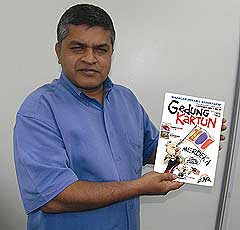
Zunar (left) now has his own production house Cartoonkafe , which produced the controversial political cartoon magazine, Gedung Kartun .
Speaking at a conference at the International Islamic University of Malaysia on Monday, he spoke about cartooning in the country and his personal cartooning philosophy.
Cartooning in Malaysia, Zunar said, started back in the 1940s. Cartoonists like Peng then had already started drawing editorial cartoons for local newspapers.
The 60s saw names like Lat, Mishar, Rejabhad and Nan who pioneered a new era in Malaysian cartooning. However, the cartoon industry only started to blossom in the late 70s when humour magazine, Gila-Gila , appeared in 1978. It was the local equivalent of the famed MAD satire magazine.
Gila-Gila became a space for cartoonists like Jaafar Taib, Zainal Buang Hussien, Tazidi, Don, Kerengge, Ujang, Reggie Lee, Fatah, Rossem, and CW Kee. Zunar attributed their success to the fact their cartoons were not only funny, but also reflected Malaysian life.
He estimates that there are currently more than 200 active professional cartoonists in this country. "A good number for a relatively small country like Malaysia," he said.
Cartoonists ‘fettered by culture of fear'
Zunar finds it strange that most of these cartoonists steer clear of politics.
He claims that some of the cartoonists are fettered by the culture of fear, preferring to play safe and maintain neutrality.
"How can I be neutral? Even my pen has a stand!" says the indignant cartoonist.
He considers it a failure on the part of Malaysian cartoonists, that they have not done their duty. That duty, Zunar says, is to relay the voices of people and to convey strong messages to the authority where it matters most.
According to him, "Very few senior cartoonists really touch fundamental issues". He notes that few local cartoonists address human rights, freedom of speech, press freedom, or the current problems with the police and judiciary in their works.
"Cartoonists should criticise, educate, and open up readers' minds in their own ways," Zunar says.
Zunar was keen to take his fight a step further by starting Gedung Kartun , along with other young emerging cartoonists like Jonos, Ronasina, Enot and Haili.
"This is the first and only (local) humour magazine that tackles current issues. (Those issues include) politics, the economy, human rights, the judiciary, corruption and the misuse of power in the police force."
 Right after the magazine hit the street, eight officers from the Home Ministry
raided
(right)
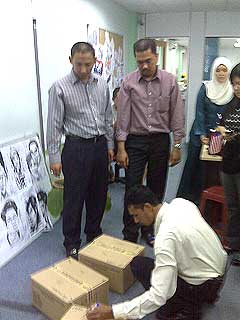
Zunar's office premises and seized 408 copies of Gedung Kartun. The next day the printing factory was also raided, confiscating the magazine's printing plates.
Right after the magazine hit the street, eight officers from the Home Ministry
raided
(right)
Zunar's office premises and seized 408 copies of Gedung Kartun. The next day the printing factory was also raided, confiscating the magazine's printing plates.
Accused of not having a public permit, Zunar is due to be charged under Section 5(2)(b) of the Printing Presses and Publications Act 1984. According to the Act, those found guilty can be jailed up to three years and fined up to RM20,000, or both.
He believes the action was "politically motivated to block alternative views and critical voices" and a "form of intimidation" against him and his team.
Zunar scoffs at the oversensitivity of the authorities about his magazine's subject matter. "Don't blame us cartoonists; we only transform (political issues) onto paper."
Despite the obstacles, Zunar says that the Gedung Kartun magazine will still continue. He plans to keep drawing alternative political cartoons, as well as training young cartoonists.
Ultimately, he believes, "The government should encourage (these) cartoons to grow for the betterment of the Malaysian cartooning industry".


Are you sure you want to delete this comment?
This action cannot be undone.