




Safe haven for 'invisible' kids
special report In the hustle and bustle of the Chow Kit slum, small alleys and Internet cafes are the typical playground of Kuala Lumpur's street children.
Their working-class parents are too busy or too poor to pay attention or to look after them. So, they kill time by loafing around the streets, sometimes being paid to look after cars and motorbikes.
special report In the hustle and bustle of the Chow Kit slum, small alleys and Internet cafes are the typical playground of Kuala Lumpur's street children.
Their working-class parents are too busy or too poor to pay attention or to look after them. So, they kill time by loafing around the streets, sometimes being paid to look after cars and motorbikes.
However, tucked in the corner of the street is a shophouse that provides a safe haven for these children. 'Nur Salam' gives them shelter, education as well as hot meals, functioning as a day-care centre, nursery, school and occasional hostel.
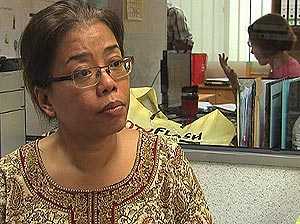 Raja Azizan Suhaimi Raja Abd Latiff (
left
), the founder of Nur Salam, used to scour the streets to pick up children and take them to the centre.
Raja Azizan Suhaimi Raja Abd Latiff (
left
), the founder of Nur Salam, used to scour the streets to pick up children and take them to the centre.
Over 400 children are now registered with Nur Salam, with most staying at the centre all day.
The learning centre consists of a kindergarten for children aged 5-6, and a primary school that caters to those between 7 and 12 years of age.
The school is located on the second floor of the building and is fully equipped with a counselling room, library/play room and even a computer room.
Elizabeth Yohanis, who has taught there for the past six years, told Malaysiakin i that the school provides education to those who cannot enter regular schools because they are the 'invisible children' of Malaysia.
Their nationality of some is unknown and their existence is not acknowledged by the government. They are the children of refugees, undocumented persons and stateless individuals.
This school operates with the same aim as community-run refugee schools which cater for children who have no access to formal education.
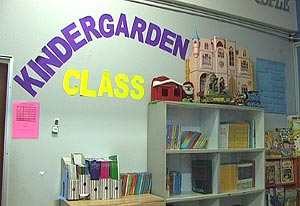 The difference is that Nur Salam operates under a licence from the Education Ministry and complies with the government's school curriculum.
It currently has two full-time teachers for the pre-school and primary school respectively.
They were trained by the Humana Learning Centre, a Sabah-based NGO that has provided education to plantation and stateless children in Borneo for the past 18 years.
"The entire syllabus is provided by Education Ministry. We follow the same guidelines and framework as the national schools," said Elizabeth, saying that the government monitors Nur Salam for compliance.
Subjects taught include Bahasa Malaysia, English, Mathematics, Science, Music, Moral and Islamic Studies. The books, learning materials and operation of the school are funded through donations.
Nur Salam general manager Hartini Zainuddin is thankful that the government has provided guidelines and controls, saying this makes the operations more systematic and easier to co-ordinate with other NGOs.
"We want to provide a comprehensive, holistic (schooling that is) more than just a basic education. This is because we do not know when or where the children will get their next level of schooling and whether the government will even allow them any access (to schools)," she said.
"These children should at least be able to complete Year 6 of their education."
Obstacles to education
There are a number of reasons why Malaysian children are not in regular schools. The most apparent, said Hartini, is that poor parents simply cannot afford to pay the annual school fee of RM130. In most cases, they make about RM600 a month - if they are lucky.
Children who have no personal documents are not admitted into government schools, but have to resort to private schools where the cost of education is exorbitant.
"Apart from the school fees, there are other costs as well - for computer classes, uniforms and books," explained Hartini.
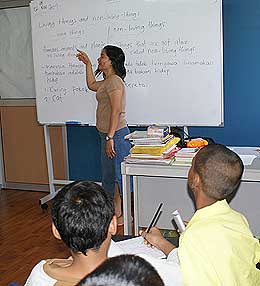 Refugees or undocumented foreigners, meanwhile, are not permitted to work, and so may not have any income at all.
At the Nur Salam learning centre, education is free and the children are provided with school books, bags, and even uniforms.
Parents of kindergarten children are encouraged to pay RM30 a month. Hartini said this is only because the centre wants them to understand that it is their responsibility to send their children to school.
"Logistics and protection of the children are a major concern here. When dropping off the children at the centre, the parents are open to the risk of being detained by the authorities because they lack proper documents.
"We provide shelter for some children who cannot go home because their parents might have been taken into custody. The centre takes precautions and measures to ensure that the children can go to school and (return) home safely."
However, the centre faces difficulty in getting funds because would-be sponsors do not want to breach government policy.
"They say that 'we do not want to help people who have entered the country illegally'. But refugees are different because they are fleeing persecution in their own country," Hartini said.
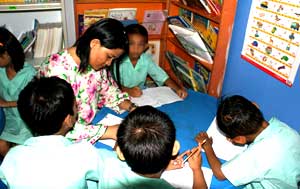 She said the enrichment programme is particularly important for these children because they are traumatised, abused, abandoned and malnourished, and must deal with many psychological issues.
"We believe that education is a big part in alleviating (their situation) and rehabilitating (them) and in giving them a chance to get out of poverty. The government needs to re-examine its policies because Malaysia has a large number of refugee and stateless children.
"When they do well and get a job, they will contribute to society. Refugee children are more appreciative of education, and research has shown that they tend to do better in school."
Therapist Sudha M Kudva who works with traumatised children at the centre, said they require a safe and disciplined environment so that they can cope with their emotions and move on with life.
She works with them in a small room filled with toys and brings them out of their shell by engaging them in play therapy.
"These sessions enable the child to move on and assimilate (with society)," said Sudha, adding that the children are treated with utmost respect.
Operations manager Asiah Ariffin said she believes that education should be open to everyone.
"To us every child matters. What will happen to them if they have no education?"
Related story: School in a shoplot


Are you sure you want to delete this comment?
This action cannot be undone.