




PM vows to woo back foreign investors, voters
Prime Minister Najib Razak has vowed to accelerate economic and political reforms in his Southeast Asian nation in a bid to woo back investment and regain political support.
Prime Minister Najib Razak has vowed to accelerate economic and political reforms in his Southeast Asian nation in a bid to woo back investment and regain political support.
Najib took the top job in April charged with renewing a government that was rocked in polls last year as voters forsook the coalition that has ruled the country for over half a century, tired of broken pledges to tackle graft.
While opinion polls suggest that Najib has rebuilt support for his own party which dominates the 13-strong Barisan Nasional coalition, smaller parties who represent substantial numbers of ethnic Chinese and Indian voters remain weak.
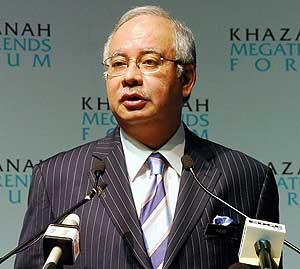 One option being considered could be to open BN to direct membership, a radical move that would fundamentally alter Malaysia's decades old race-based political party system.
"I think anything is possible because I don't think anything is a sacred cow within Barisan Nasional."
Najib has stabilised a government that was so wobbly in September 2008 that it had to ship 40 MPs to Taiwan to put them out of reach of opposition leader Anwar Ibrahim's bid to lure them to join him and topple the BN coalition.
Anwar's three-party alliance has won seven of nine by-elections held since the 2008 general election but has been hit by frequent infighting.
"Of course he (Anwar) is not without skills as a politician ... but there is a huge difference between running for office and managing the country," Najib said.
Anwar, a former deputy prime minister, will stand trial next month charged with sodomising a male aide.
If found guilty of what he says is a repeat of an earlier political conspiracy that saw him ousted from government, Anwar could be jailed for 20 years, ending his political career.
Najib: PKFZ a litmus test
Despite promises made by Najib and his predecessor to end corruption, Malaysia has fallen to a record low for the country of 56th place among 180 countries in anti-graft watchdog Transparency International's 2009 corruption perception index.
That has hit its image at a time when neighbours like Indonesia have made big progress fighting corruption and Malaysia's share of foreign direct investment versus Thailand and Indonesia fell to a touch over 30 percent in 2008 from over 50 percent from 1990-2000, according to United Nations data.
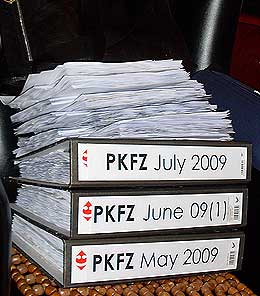 The issue hit the headlines recently with an investigation into a scandal over a port trade zone close to Kuala Lumpur that exposed links between politics and business.
False government guarantees given when the bonds were sold have triggered concerns among holders of US$1 billion worth of bonds that they might not be repaid
Three officials linked to the Port Klang Free Trade Zone (PKFZ) project have been charged for corruption, although none of them were politicians, prompting the opposition to say the government is still covering up.
"People believe, rightly or wrongly that PKFZ is a litmus test and we have proven that action will be taken," Najib said.
Investors pull RM55.3 billion out
His reform efforts so far have seen some elements of the New Economic Policy (NEP), a four-decades-old economic and social affirmative action policy for the Malays and other indigenous communities, rolled back.
While Najib has received a positive response for that and other measures to lift investment caps in areas such as finance and tourism, investment money has still not flowed.
The latest data showed that in the first three quarters of 2009, portfolio outflows pulled RM55.3 billion out of the country.
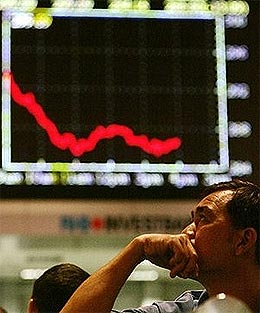 In a bid to reverse outflows and tempt money back into a stock market where foreign ownership stands a touch over 20 percent, lower than during 1998 Asian financial crisis, Najib has told state funds to cut their stakes in companies.
Bodies such as state investment fund Khazanah and the Employees Provident Fund (EPF) own almost 70 percent of Sime Darby, the country's largest company, limiting the stock available to foreign funds.
"It is up to the management of Khazanah (and) of EPF to decide the particular companies that they divest their holdings (in) but the government has given instructions to them and they do have specific road map to reduce their holdings," Najib said.
He also has pledged to cut Malaysia's budget deficit from a more than 20-year high and has taken the risky decision to remove universal fuel subsidies, a measure that caused the popularity of his predecessor to nosedive before it was reversed.
Najib said a new system to ensure that the poor continued to receive aid for fuel would be based on car engine size.
"If you drive a Mercedes 500, you don't need a fuel subsidy," he said.
- Reuters


Are you sure you want to delete this comment?
This action cannot be undone.