




MACC case: Councillor turns to apex court
Senior lawyer Karpal Singh filed a leave application to the Federal Court this morning, over the appellate court’s decision to allow the Malaysian Anti-Corruption Commission (MACC) to interrogate witnesses after office hours.
Senior lawyer Karpal Singh filed a leave application to the Federal Court this morning, over the appellate court’s decision to allow the Malaysian Anti-Corruption Commission (MACC) to interrogate witnesses after office hours.
Karpal said the appellate court's decision last Thursday is one of gigantic proportions and implications, as criminal suspects have better rights than witnesses in MACC investigations.
Under the Lock-up Rules 1953, suspects must be in their cells between 6.30pm and 6.30am.
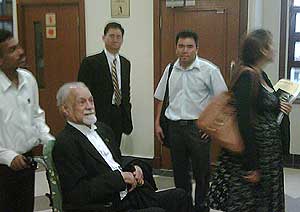 “As it stands, the MACC can behave like the Gestapo. It can go to the houses of witnesses in the middle of the night, like 2.30am, drag them out of bed and take them to its office to be interrogated,” Karpal told reporters.
“This may lead to a situation where not many witnesses will want to come forward to give statements. The appellate court's decision is counter-productive to curbing graft, as witnesses know they will be subjected to questions by MACC officers round the clock.”
Karpal, was accompanied by Kajang municipal councillor Tan Boon Wah and lawyer SN Nair in filing the application.
High Court judge Justice Mohd Ariff Md Yusof had, in a landmark decision on Nov 19, allowed the judicial review filed by Tan, saying that Section 30(3)(a) of the MACC Act 2009, does not empower the commission to investigate a witness “round the clock”.
“To do so would offend the intention of the legislature and curtail the ambit of personal liberty,” he said.
On Nov 25, MACC investigation division director Shukri Abdull issued a directive to all MACC offices to confine the questioning of witnesses to the working hours of 8.30am to 5.30pm.
However, the Court of Appeal then overturned the ruling.
Five questions of law
Karpal said he would try and push for the case to be heard next month and that he wants Attorney-General Abdul Gani Patail to lead the case.
 He expressed the hope that Abdul Gani
(left)
would not object to the leave application, so that the case can be heard directly on its merits and appeal.
He expressed the hope that Abdul Gani
(left)
would not object to the leave application, so that the case can be heard directly on its merits and appeal.
The application posed five questions of law for a decision:
- Whether in Section 30(3)(a) of the MACC Act, the phrase ‘day to day’ encompasses only office hours or whether it is to be interpreted to mean a continuous period of 24 hours followed by the next 24 hours until the investigations are completed;
- Whether the phrase ‘day to day’ should be interpreted literally or whether it is the purposive approach which ought to be adopted pursuant to Section 17(a)of the Interpretation act 1948/1967;
- Whether in interpreting Section 30(3)(a), reference can be made to Rule 20 of the Lock-up Rules 1953;
- Whether the appellate court was correct in not adhering to Justice Eusoffe Abdool Cader in the Mokhtar Hashim vs Public Prosecutor (1983) case, who stated: ‘We need hardly to remind those involved in the interrogation of witnesses and accused persons that any methods adopted in the process outside accepted norms and standards must be able to withstand the test of strict curial scrutiny.’; and
- Whether Section 30(1)(a) and Section 30(3)(a) of the MACC Act ought to be read conjunctively or disjunctively.
Karpal said the apex court must give a ruling of finality, as the decision would affect all investigative agencies as well as the rights of the individual.


Are you sure you want to delete this comment?
This action cannot be undone.