




Najib in 2010 - same old, same old?
Najib Abdul Razak, who took office on April 3, 2009, is hoping that Barisan Nasional (BN) will not suffer the fate of the Liberal Democratic Party (LDP) in Japan at the 13th General Election.
comment Najib Abdul Razak, who took office on April 3, 2009, is hoping that Barisan Nasional (BN) will not suffer the fate of the Liberal Democratic Party (LDP) in Japan at the 13th General Election.
The LDP, which had effectively been in power for six decades, was given a rude awakening when the people of Japan decided they had enough and voted in the Democratic Party of Japan.
Najib must see a parallel: BN (and its predecessor, the Alliance) which has ruled Malaysia since independence, now faces an electorate that is disgusted with it.
Najib has sought to restore public confidence in his administration, having come into power under the worst possible circumstances.
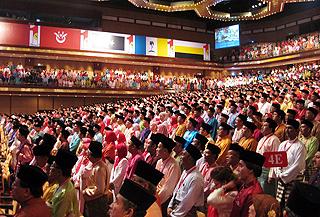
His first year in administration demonstrated his strategies - firstly regaining full control of the Umno leadership, which he skilfully did at its 59th general assembly.
His supporters and those acceptable to him (except Khairy Jamaluddin) won key leadership positions in the party.
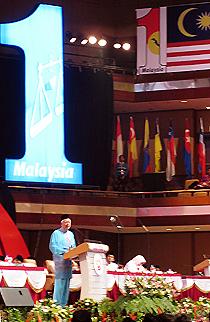 Nevertheless, ideologically, Umno and Najib remain divided between those who support Malay supremacy against the less racist concept of Malay leadership which Najib espouses.
To date he has failed to address this divide. Najib's second strategy has been to undermine the opposition coalition.
It is widely reported that Najib has used the judiciary, the police and the Malaysian Anti-Corruption Commission to hound opposition law makers and its key leaders, and discredit them.
Furthermore, Malay leaders in the opposition coalition have been accused of betraying the Malays, Malay institutions and Islam while non-Malay leaders have been accused of insulting the Malays, Malay institutions and Islam.
It goes without saying that this strategy is to distract Malaysians from substantive issues plaguing his administration and the nation, and to cripple the opposition administratively and through fear.
Najib's deadliest measure to undermine opposition state governments has been through withholding of federal funding.
Planned development budgets have been shelved indefinitely and Kelantan (one of Malaysia's poorest state and under opposition rule) has even stopped receiving payment for oil royalties.
Without the ability to raise their own taxes, opposition state governments are hard-pressed to find the necessary funds to meet their outlays.
Malay supremacy
Ironically, Najib's attempts to undermine the opposition have only further damaged his sullied reputation.
Najib's third strategy to regain public confidence is the promise of reforms. He introduced the 1Malaysia concept with the tagline: 'People first, performance now.'
There has been much hype in the mainstream media and government agencies about the 1Malaysia concept but the more seasoned sections of the electorate understand that this is nothing more than a BN ploy.
Mahathir is believed to be the first to use such a slogan when he introduced 'Bersih, Cekap, Amanah' (Clean, Efficient, Trustworthy) as soon as he came into office.
Mahathir's 23 years in power was marked by an administration that failed to embody this slogan.
 A more fundamental question posed by Najib's detractors is: If all Malaysians are equal as provided for in Federal Constitution, why the need for any other concept especially by a ruling party that espouses Malay supremacy?
Najib's tasks to restore public confidence in his administration are made difficult by a domestic and global environment that is unfavourable. Domestically, his coalition is in tatters.
All BN key component parties in the peninsular have been left for dead after the 12th General Election while in East Malaysia, the component parties who ensured that BN remained as government are now demanding payback.
They are happy to work with anyone (PR or BN) who will give them what they want.
This has forced Najib to deal directly with different parties and vested interests - departing from BN's formula of each race/communal-based party addressing problems within the community.
Symptomatic of these problems is the MCA, second in seniority in the BN, is facing a leadership crisis with its central committee passing a no-confidence motion against the president.
Umno had sought to intervene in the party but was criticised.
Najib has since dealt directly with various sections of the Chinese community (chambers of commerce, educational foundations, etc) sidelining the MCA.
Furthermore, MCA, together with Umno is also involved in Malaysia's biggest scandal to date - the PKFZ fiasco. It has continued to sully Najib's efforts to build his image.
Promises of reform
While crony capitalism is argued to be the hallmark of BN, the perception that Najib is corrupt is certainly damaging his efforts to restore public confidence.
Malaysia currently ranks 56 in Transparency International's Corruption Perception Index - a drop of 20 places since 2001 and its worst ever, despite the various measures to weed out corruption and promises of reform.
Malaysia's domestic situation has made Malaysia a lightweight on the international front. It is widely believed that Najib does not have the charisma of Mahathir or Anwar Ibrahim needed to become an international figure.
Furthermore, with the political baggage he brings, Najib has sought to please the big powers in an effort to restore his and Malaysia's standing.
 His recent moves to please the US especially, has damaged Malaysia's long held position of neutrality and a leader among developing countries.
On the economic front, Najib is finding it difficult to make the necessary reforms to restructure the Malaysian economy as vested interests are adamant economic policies remain the same, despite a global economy that has made Malaysia's export oriented economic model vulnerable.
Najib, as a face saving measure had announced his intention to move Malaysia into the 'High Income Economy' category (There is a consensus the Mahathir's Vision 2020 to turn Malaysia into a developed country will not be achieved) by focusing on the services sector.
However, it has been more than three months since the announcement was made but no detailed plan on how this is to be achieved has been provided. Najib has, no doubt, introduced several measures to liberalise the Malaysian economy.
However, these piecemeal efforts, supposedly done so as not to alarm the Malay chauvinists within Umno only demonstrates Najib's inability to put national interests above his and Umno's interests.
With the global economy making a slow recovery, his coalition in disarray, an electorate concerned about the quality of life and fed-up with the BN - and an opposition coalition capitalising on the Rakyat's' discontent, 2010 promises to be another challenging year for Najib and Malaysia.
Will Najib dish out more of the same, or will he sincerely attempt to reform his party, his coalition and the country?
GREG LOPEZ is a postgraduate scholar at the Crawford School of Economics and Government, Australian National University (ANU).


Are you sure you want to delete this comment?
This action cannot be undone.