




NEM may not lead to a more just society, say experts
The National Advisory Economic Council (NEAC) may have to work harder to prove that the mooted New Economic Model (NEM) will bring about a more inclusive society, said experts.
The National Advisory Economic Council (NEAC) may have to work harder to prove that the mooted New Economic Model (NEM) will bring about a more inclusive society, said experts.
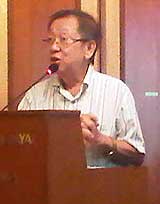 LLG Cultural Development Centre President Toh Kin Woon (
right
) said that while the first edition of the model, launched on Mar 30, acknowledges the growing income disparity in Malaysia, much of it runs counter to the aspirations for social justice.
LLG Cultural Development Centre President Toh Kin Woon (
right
) said that while the first edition of the model, launched on Mar 30, acknowledges the growing income disparity in Malaysia, much of it runs counter to the aspirations for social justice.
The forum, organised by women's rights NGO Empower, was attended by about 50 people and is part of the NEAC's activities to get feedback for the final edition of the model to be tabled with the 10th Malaysia Plan next month.
To begin with, Toh noted, the first edition of the NEM also clearly argues against the minimum wage, seeing it as a distortion of the market, championing instead wage increases through productivity gains.
But productivity gains, said the former Gerakan central committee member and Penang economic planning exco, do not automatically lead to rising wages .
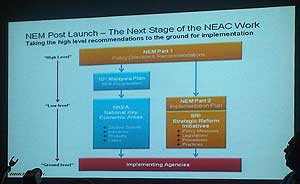 This is because a boost in productivity can also lead to low prices for consumers or higher profits for producers, who may or may not choose to pass it on to the workers.
‘GST is regressive'
Other contradictions pointed out by Toh were the proposed tax reforms, which appear to shift the bulk of government tax revenue stream from direct to indirect taxes.
"Direct taxes are progressive, the richer you are the greater the burden you bear. With the reduction of direct taxes comes the issue of what to replace the loss of revenue with, and that is the GST which is regressive," he said.
Leaving it all to the market, he noted, is ill-advised because widening disparity is actually a market failure.
"State intervention may work, but not if the government is right wing and conservative...and if the NEM assumes a free market paradigm," he said.
To the question from the audience why he is advocating government intervention when there is so little confidence in its ability, Toh said it was not an inherent thing that the public sector will fail.
This is especially so in a climate of greater democratisation, where "chances for public sector improvement are very bright," he said.
‘Do not fear political change'
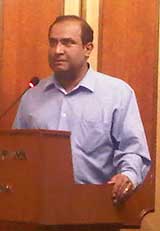
Like Toh, political economist Terence Gomez ( right) said that the NEM's approach follows the neo-liberal model championed by the likes of Margaret Thatcher and Ronald Reagen.
"The recent financial crisis has led to the complete discrediting of this model (and now many see the need to) reintroduce regulation in the economy," he said.
At the same time, he said, increased state intervention may further erode Malaysian investor confidence which took a severe blow when banks were consolidated following the 1997 financial crisis.
"Private investment has stagnated since the bank consolidation, which created the idea that the state had the capacity to expropriate wealth built up for generations...creating a crisis of confidence.
"It is a conundrum...how do we inspire investor confidence when the state needs to intervene?" he asked.
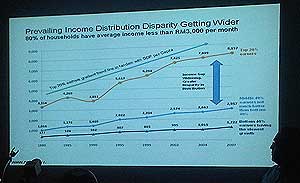 One route, he said, is to push for drastic institutional reforms through the "devolution of power", and by "ensuring that the public sector can deliver on policies"- a move fellow panelist and NEAC Executive Director Lee Chee Sung asserted is a focus in the NEM.
Gomez added such drastic reforms, however, are only likely to come about with political change.
"Taiwan's Kuomintang is similar to the BN, and when it was removed from power there were reforms. Political change does not mean stagnated growth. We need not fear.
"What we need to fear is whether or not there is political will to carry out reforms (if the same government is in power)," he said, to loud applause.
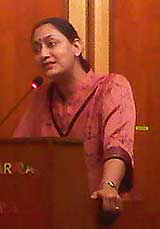 Also on the panel was gender studies expert Shanthi Thambiah (
right
) who suggested that focusing on early childhood education can be a two-pronged approach to propel Malaysia to high income status.
Also on the panel was gender studies expert Shanthi Thambiah (
right
) who suggested that focusing on early childhood education can be a two-pronged approach to propel Malaysia to high income status.
Better and affordable early education can lead to higher quality human capital, and encourage more women, who are currently caring for their children full-time, to participate in the workforce.
"Don't underestimate the power of the female purse. Put money in that purse by letting (mothers) go to work.
"Otherwise, we are spending more than we can afford on educating females who in turn are unable to join the workforce," she said.


Are you sure you want to delete this comment?
This action cannot be undone.