




Address rich-poor gap among Malays, Umno told
Parti Sosialis Malaysia (PSM) claims there is a conflict of interest between the social and economic status of Malays in the higher income bracket who form a minority and the status of Malays in the lower income group who form the majority in the country.
Parti Sosialis Malaysia (PSM) claims there is a conflict of interest between the social and economic status of Malays in the higher income bracket who form a minority and the status of Malays in the lower income group who form the majority in the country.
One case to point out is the privatisation of health care in the country where a few rich Malays can go to private hospitals which in turn pushes specialists from the government hospitals to migrate to the private sector for better pay.
 As a result, the poor are being left to make the best of what is left of the remaining medical personnel in the dilapidated public sector when in fact they should be getting inexpensive but quality healthcare.
Another area of contention is education where meritocracy gives way to the ‘well-connected' who are assured of scholarships and further education for their children whereas the poor are left to make the best of what crumbs are left.
Other areas that Umno needs to look with regards to the welfare of the poor Malays includes minimum wages, retrenchment benefits and affordable homes in the urban areas among others.
The socialist party therefore wants an explanation from Umno on its stand on Article 153 of the federal constitution that safeguards the rights, interests and well-being of all Malays.
"We are confused as to what Umno's stand is. Is it for the minority of rich Malays or for the majority of poor Malays?"asked PSM's Sungai Siput MP Dr D Jeyakumar (above).
Malays the largest group of poor
He said it is the duty of all Malaysians to safeguard the well-being of the poor of society especially the Malays who form the biggest group in this sector.
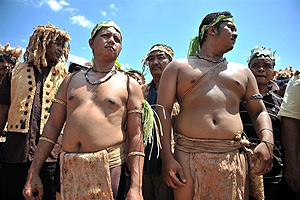 He said although the Orang Asli
(right
) are the poorest economic group in the country, in terms of population it was the Malays who form the largest demographic.
He said although the Orang Asli
(right
) are the poorest economic group in the country, in terms of population it was the Malays who form the largest demographic.
According to the Statistics Department, the social-economic structure of the Malay society in 2008 was divided into four economic categories namely:
1. Equity-rich Malays which include corporate sector movers and shakers and politicians who earn over RM20,000 per month. They make up 5% of the Malay population.
2. Bumiputera contractors who earn a monthly income of between RM10,000 and RM20,000 (they comprise 2.8%)
3. Middle-income group wage earners who work in government-linked companies at
management level who earn between RM3,000 to RM10,000 (34.6%) and
4. The lower-income group who earn RM3,000 and below (who are classified as Melayu marhain - a term coined by the late Indonesian President Soekarno) such as petty traders, small scale farmers, fishermen and factory workers( 62.1%).
Politician cum cardiologist Jeyakumar said that it was very hard to draw the line and make comparisons between poverty in the urban areas and rural areas because of the differences in income and the cost of living between the two sectors.
Question of pagar makan padi?
He cites the ten-year old case of Risda that promised settlers a replanting crop programme that eventually went awry resulting in the settlers being caught in a economic dilemma as the land they had mortgaged for the loan could not be repaid and now the bank has threatened to auction off their land.
 He claimed that bumiputera contractors are supposed to help the Malay rural areas to uplift their social status but many projects were of inferiority quality and as a result the rural poor suffered.
Jeyakumar further questioned where had Umno been all this while and what role it played to help out the majority of the poor Malays who suffered at the hands of the minority rich Malays.
"Is it a question of pagar makan padi? " he asked.
Another point he drove home was the issue of bumiputera shares whereby the rich took all and the poor are left behind as their monthly meagre earnings do not allow them such luxuries .
"How do you expect the poor Malays who are finding it hard to make ends meet to jump on the share bandwagon to ride to riches?" he asked.
The above were some of the points raised by Jeyakumar during the Parliament's sitting on March 23 and which were complied into a 20-paged booklet en titled Pagar Makan Padi? which was made available to Malaysiakini today.


Are you sure you want to delete this comment?
This action cannot be undone.