




A S'gor plan to shore up flagging support
COMMENT This week is Selangor Menteri Besar Khalid Ibrahim’s first full week back at work after the supposed ‘coup’ attempt against him. It was also announced at the end of last week that Khalid’s office would coordinate and lead the effort to produce a vision and action plan for Selangor for the next three years.
What should the different stakeholders expect from this plan? More importantly, can this plan be sufficient to ensure Khalid’s survival as Selangor MB in the next six months or so? And if so, can it help shore up the already flagging support, especially among the Malays, for the Pakatan Rakyat government in Selangor?
Finally, would the unveiling and subsequent execution of this plan be sufficient to placate Khalid’s rival Azmin Ali as well as the other disgruntled party leaders within PKR’s ranks?
COMMENT This week is Selangor Menteri Besar Khalid Ibrahim’s first full week back at work after the supposed ‘coup’ attempt against him. It was also announced at the end of last week that Khalid’s office would coordinate and lead the effort to produce a vision and action plan for Selangor for the next three years.
What should the different stakeholders expect from this plan? More importantly, can this plan be sufficient to ensure Khalid’s survival as Selangor MB in the next six months or so? And if so, can it help shore up the already flagging support, especially among the Malays, for the Pakatan Rakyat government in Selangor?
 Finally, would the unveiling and subsequent execution of this plan be sufficient to placate Khalid’s rival Azmin Ali as well as the other disgruntled party leaders within PKR’s ranks?
It would be a mistake to say that this new vision and action plan is only window dressing and hence, does not hold much policy or political implications. As the previous Malaysian plans have shown, at the very least, these plans have structured the spending decisions and priorities on the part of the federal government, even if they were not strictly adhered to. In the case of Selangor, the shortened timeline due to the heightened political stakes only increases the significance of this plan.
What would I, as a political analyst, look for in such a plan? I would look for the presence (or the absence) of four major components, most of which are explicitly spelt out but some of which can be implicitly implied.
The first component I would look out for are the actionable items. If I were to quickly wade through the high-level spin and grand-sounding vision statements, I will look for any specific action plans which can be quickly implemented, perhaps even as the details of this plan are being discussed and debated at the committee level as it is being unveiled.
Khalid simply does not have the luxury of time to sit idle while a high-level policy committee (made up of academics, politicians and NGO representatives) deliberates on the plan. While these actionable items should cover a broad constituent, I would look to see if there are any interesting ideas emerging from the MB’s office and the policy committee in regard to reaching out to the rural Malay voters, which are slowly but surely slipping out of the grasp of Pakatan in Selangor (and in other states too, I might add).
The second component I would look out for is how Pakatan plans to ‘market’ this plan. Of course, the marketing strategy itself would not be outlined in this plan. But if some of the components are designed with the intention of already using them to market to specific constituents i.e. the rural Malays for example, then it would be a sign that the drafters of the plan had already considered the marketing and communications strategy, much of which has been poorly executed under the current team in the Selangor state government.
How different will it be from 10MP?
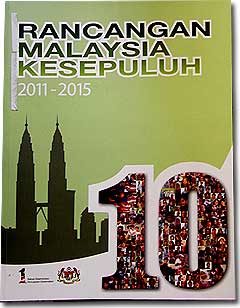
The third component I would look out for is to see how much or how little this plan tries to differentiate itself from the 10th Malaysia plan.
It would be a mistake for the policy drafters to distance itself completely from the 10th Malaysian Plan and even the ideas which are emerging from the National Key Economic Areas (NKEA) labs, coordinated and headed by Pemandu, with the help of many young, motivated and energetic Malaysians from within the ranks of Pemandu and from the ranks of the various industry players (and some expensive foreign consultants).
 Some of the ideas emerging from the Greater KL NKEA lab will require the cooperation and input of the Selangor state government. (It is interesting to note that no one from the MB’s office was invited to participate as one of the stakeholders in the Greater KL NKEA).
The extent to which the ideas from this specific lab and others such as the education and healthcare labs are incorporated into the Selangor vision and action plan and the extent to which new ideas are demonstrated in this plan are interesting markers because they indicate the presence or absence of strategic thinking in this dimension of policy making and policy implementation.
For example, the 10th Malaysia Plan emphasises the role of the private sector in driving future economic growth in the country. It would be a nice contrast if the Selangor vision and action plan has a much more inclusive driving force behind growth in the state which includes all of the stakeholders – government, private sector, NGOs, private citizens - in a economically and socially inclusive manner, even in the manner in which their opinions are sought, processed and then included in the final plan.
Finally, I would examine the comprehensiveness and coherence of such plan. While it would be unrealistic to expect such a committee to come up with a very extensive and comprehensive plan in three months or so, it would be a mistake to just focus on three or four main areas since the stakeholders who have been left out would criticise the plan (and perhaps rightly so).
While some of these ideas may only appear as a footnote or in the appendix, at least the stakeholders in these areas would feel that they were part of the process of creating this policy and hence would be more inclined to support it. And once these ideas are on the table, so to speak, the likelihood of them appearing again in a future document and hence, the likelihood of it being implemented would be higher as well.
Opportunity for Azmin to prove himself
What would, or should, newly appointed Selangor PKR chief Azmin Ali then do? The conventional way of doing things would be for him to distance himself from such a plan. If it doesn’t work, then Khalid gets the blame and Azmin can swoop in for the rescue.
 In fact, Azmin would be perfectly justified in not wanting to get involved, if let’s say, Khalid asked him to be part of the steering committee for this plan since Azmin is now in charge of political affairs of PKR in the state of Selangor.
Azmin’s political skills are very well suited for this task especially since Khalid does not or cannot deal with the issues related to building the institutional and financial capacity of the party. If Azmin can do this job well, leave Khalid alone on the policy front and protect Khalid from being attacked from within, then he would be on the way to proving himself as a national leader.
Of course, Khalid also has to ‘play ball’ with Azmin since he, in his capacity as MB, holds the key to the coffers of the state government, so to speak.
But if I were Azmin, I’d go a step further. Accept Khalid’s invitation, if one was forthcoming, to join this committee and find ways to contribute ideas to this committee. In fact, he should use his position on this committee to demonstrate his own vision of what Selangor can and should look like.
For example, he can always use his blog or other alternative channels to publish short concept papers on specific policy areas in which he has or in the process of recommending to the committee to adopt, and so on and so forth. This way, it’s a win-win situation for both Azmin and Khalid.
Both leaders share the blame, but hopefully, and more likely, both share the credit as well. This would be the way for Azmin to truly make his mark as a national leader – to show that he is capable of managing the political as well as the policy aspects of the state and by extension, the country.
ONG KIAN MING holds a PhD in political science from Duke University. He is in the process of setting up a Masters in Public Policy (MPP) course at UCSI University, formerly known as Sedaya. The views expressed here are his own.


