




'We won't give up our lifestyle'
SPECIAL REPORT While the majority of Orang Ulu have been resettled by the government to Sungai Asap in 1998, a few hundred have chosen to remain upstream of Sungai Balui to live on inherited land to which they exert native customary rights.
A report by the Coalition of Concerned NGOs on Bakun (Gabungan) says 189 families from five longhouses - Naha Jalei, Batu Keling, Long Bulan, Long Jawie and Long Lawen - have refused to accept the resettlement programme.
SPECIAL REPORT While the majority of Orang Ulu have been resettled by the government to Sungai Asap in 1998, a few hundred have chosen to remain upstream of Sungai Balui to live on inherited land to which they exert native customary rights.
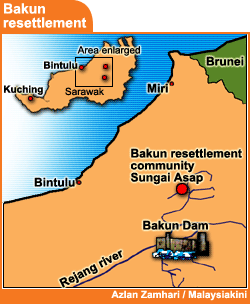 A report by the Coalition of Concerned NGOs on Bakun (Gabungan) says 189 families from five longhouses - Naha Jalei, Batu Keling, Long Bulan, Long Jawie and Long Lawen - have refused to accept the resettlement programme.
The government has closed the schools and clinics at the old settlements, which has deprived them to education and healthcare.
Children have to be sent to school in Sungai Asap or Belaga, which takes anything from six hours tp two days of travel by boat, depending on where they live.
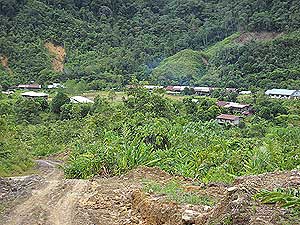 After 12 years of struggling with such difficulties, do they regret not following the majority to Sungai Asap?
Malaysiakini asked the question on a visit last month to Naha Jalei and Long Lawen (left) .
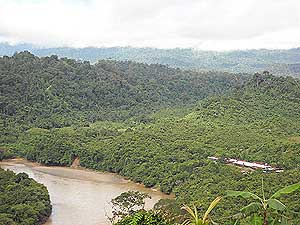
Naha Jalei, only accessible via the Sungai Balui, is a six-hour boat ride from the Bakun dam. The fare can cost up to RM3,000, depending on the size of the boat and the boatman’s skills.
Long Lawen can be reached over logging roads, but this takes about five hours from Sungai Asap.
Self reliance in Long Lawen
 At Long Lawen, headman Gara Jalong, 55, and other male villagers were carrying out a
gotong-royong
project at the nearby river to connect a water pipe.
At Long Lawen, headman Gara Jalong, 55, and other male villagers were carrying out a
gotong-royong
project at the nearby river to connect a water pipe.
He explained that the villagers rely on themselves to build everything - from houses to water supply facilities, since they are not part of the resettlement programme.
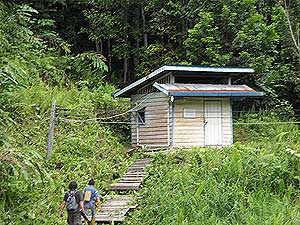
They have built a 10,000KW micro-hydroelectric dam (left) with the help of an American NGO, to supply electricity to every household.
Originating from Long Geng near the Sungai Balui, the 77 families refused to accept the government plan and chose to move to Long Lawen, a river valley once occupied by their ancestors.
“The three-acre plots of land that the government has provided in Sungai Asap is too small, so some of the Long Geng decided not to move there,” explained Gara.
Other struc
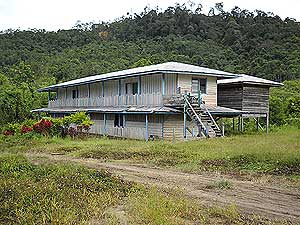 tures erected include a school
(right)
and clinic inside the village.
tures erected include a school
(right)
and clinic inside the village.
But the government has rejected their application for a teacher and medical officer to be stationed there on the ground that they have gone against the resettlement plan.
Gara has not given up hope that the government will hear the villagers’ plea for assistance.
Injok Along
(right)
, 74, who helped
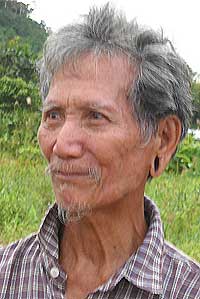 with the construction work, said pregnant woman are forced to travel to Sungai Asap two months before the delivery date to be near a clinic.
Children leave home at the age of six to study in Sungai Asap, where they must find a place to board.
Although their life is a hard one, the thought has never crossed their mind to relocate to Sungai Asap.
 Gara said life in Long Lawen is more suited to them, with the area being surrounded by jungle and river. There are plenty of food sources and other materials they need to sustain their life style.
“We can collect fruits and hunt for animals in the jungle. We can also plant enough padi for our own consumption.”
The villagers also find part-time work at logging site around the longhouse, earning about RM500 per month to cover basic expenses.
Bloody battle for land
At Naha Jalei, the Kayan community also listed education and healthcare needs as a main priority, saying they too are determined to stay where they are.
 In particular, this is because they are occupying land which their ancestors had defended with their lives.
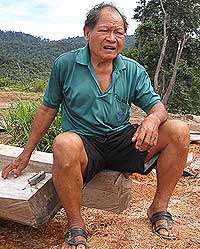
Headman Bato Bagi (left) , 78, said this was during a battle with the Orang Ulu.
“The government wants us to move to Sungai Asap, but I will not move. I will stay upstream regardless of life or death,” he said.
Another villager, Huring Aging, 60, said it would be a “sin” if they leave the area.
The villagers can open up land for farming at the site, and get about 80 bags of rice annually. Elsewhere, they would have to purchase every item of daily necessity.
“What we can farm on three acres of land in Sungai Asap? Life here is different, we rely on ourselves for everything,” he said.
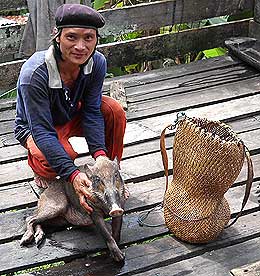 As a good example, his grandchild caught a wild boar in the jungle and served us a lavish dinner that day. The river abounds with a type of fish called
empurau
, that can easily be sold at RM460 per kg.
As a good example, his grandchild caught a wild boar in the jungle and served us a lavish dinner that day. The river abounds with a type of fish called
empurau
, that can easily be sold at RM460 per kg.
The community in Naha Jalei will lose their new-found home when water catchment begins at the Bakun dam.
This is because around 70,000 ha of land, equal to the size of Singapore, will be flooded - including the site of the longhouse.
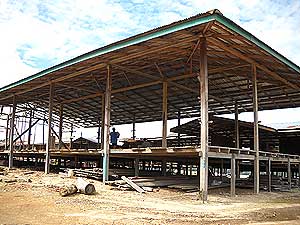
In preparation, the villagers are building new longhouses on even higher land across the river. All this, without any government support.
“I have around five ‘doors’ (dwelling units), so building the longhouse has cost me RM3,000 already,” Bato said.
Villagers like Uv
 at Bagi, 80, do not have enough money to complete their ‘door’ - he needs to raise some RM7,000 for this, but is fearful that he may not make it in time before the area is flooded.
A big worry is that the government will not inform them before the area is flooded.
Assemblyman Liwan Lagang visited them in March, said Bato, to tell them that water catchment would begin in June. There has been no further information on this.
It is understood that the whole process will take eight to nine months to complete.
Bato said three more longhouses upstream will face a similar problem, but have not made any preparations for this.
No faith in government pledges
Compensation for the Naha Jalei community has yet to be settled, with their case pending in court.
 Its suit failed in the High Court and Court of Appeal, and an appeal is now before the Federal Court, where it is scheduled to be heard next month.
Bato said he had urged Liwan to settle the issues of compensation and new housing in March.
“The matters have dragged on for 12 years already, until even the parang (machete) and hoe are no longer sharp. If the government (starts flooding the area now), we will protest.”
A state election must be held by July next year, so the villagers are exerting pressure on local politicians with some success.

 Bato said that, after a meeting in March, Deputy Chief Minister Alfred Jabu
(left)
told local leaders and the district officer that Chief Minister Abdul Taib Mahmud
(right)
is willing to allow them to stay upstream.
Bato said that, after a meeting in March, Deputy Chief Minister Alfred Jabu
(left)
told local leaders and the district officer that Chief Minister Abdul Taib Mahmud
(right)
is willing to allow them to stay upstream.
But he also asked them to move to a site with more land, so that the state government can build a school and clinic.
Bato has his reservations about such promises: “The government is like the tongue which is boneless. It can go up and also go down, and can say anything.”
THE BAKUN SERIES
Part 1: No way home for Bakun natives
Part 2 : 'We won't give up our lifestyle'
Part 3: In Bakun, information is POWER


Are you sure you want to delete this comment?
This action cannot be undone.