




Minimum wage not 'wrong approach'
COMMENT Human Resources Minister S Subramaniam still doesn’t quite get it. At a minimum wage forum on Oct 13, he expressed concern that fixing a minimum wage above market levels may cause job losses.
COMMENT Human Resources Minister S Subramaniam still doesn’t quite get it. At a minimum wage forum on Oct 13, he expressed concern that fixing a minimum wage above market levels may cause job losses.
 The minister should understand the basic principle that if the market is already delivering a decent wage, there is no need for society to impose a minimal floor. In other words, minimum wage must by definition be higher than the lowest market level.
Subramaniam ( right ) is clearly under pressure from powerful employer lobbies, so he understandably hedges against their fury.
And to his credit, he has acknowledged, after trusting for years in ‘market forces’, that there is nothing in the magic of supply and demand to stop employers from paying poverty wages. But is he already signalling that the eventual minimum wage, if instituted, may be less than prevailing lows?
Union leaders have expressed wariness towards the government’s sincerity, and legitimately so.
Let us not be quick to say forget the past and just move on. Firmness of commitment and clarity of intentions matter, especially in the case of minimum wage, that the BN has rejected - or promised and reneged on - for over 50 years.
The policy flip in favour of minimum wage is no small matter. It affects millions of workers, whose hope for at least a decent wage must not turn out to be false or fleeting.
There are also plenty of mixed, contradictory signals going around.
High-income country, not
The New Economic Model (Part 1) states categorically that minimum wage is a “wrong approach”. The NEM released a statistic that 40 percent of households have income of less than RM1500 per month, that has become widely cited.
 More startling though less circulated, the Economic Transformation Programme (ETP) reported that in 2009, 24.8 percent of individual workers earned less than RM750. That proportion is to be reduced to 14.2 percent in 2020. The ETP made no mention of minimum wage policy, or labour market reforms in general.
Prime Minister Najib must clarify. Are we seriously going to label ourselves a high-income country in 2020 if almost one in seven workers earns less than RM750? Moreover, according to the ETP, if there is to be a minimum wage it has to be substantially below RM750.
Firm commitment and clear intention also matter in handling the consequences of legislating an effective minimum wage.
Of course, minimum wage will raise costs; that’s plain and simple enough. However, government must, on behalf of workers, plainly and simply tell employers and capitalists to do the right thing: take a profit cut. For all the focus on wage levels, there is no attention to the quantity of profits and bonuses and whether they are proportionate.
Financial markets track profitability of firms relative to one another. In this respect, minimum wage is fair because all employers who are paying poverty wages are indiscriminately affected.
More fundamentally, so what if the distribution tilts from profits to wages? That’s not the end of the world. Higher wages boost demand, and can reduce the burden on families and children of overworked and underpaid parents.
A social institution
Another worry is the argued adverse effects of minimum wage on competitiveness. Here we must make a distinction between sectors; some compete internationally, some don’t. The services and construction sectors are mostly not exportable products; the threat of job losses due to loss of competitiveness carries little weight.
 These are domestic markets, and minimum wage will apply to all so none can claim to be unfairly disadvantaged. Yes, prices may go up and be passed on to consumers; some of the burden will be borne by society. Minimum wage is a social institution.
In manufacturing, competitiveness is a more relevant concern. How to compete when wages in Vietnam, Indonesia and China are already lower? But defending low-wage, low-skill production is regressive and out of line with our development objectives.
Every advanced economy, and countries that have escaped the ‘middle income trap’, have minimum wage laws in some form. They are competing quite well.
We have tried the gentler approach for decades, of coaxing producers to upgrade skills and technology, and have fallen short. Minimum wage is far from a panacea, but it can serve as a complement in this process, and provide a firmer push where persuasion and incentives have under-achieved.
 Understandably, some employers may genuinely struggle to pay minimum wage, especially small and medium sized firms, regardless of sector. We don’t have an unemployment insurance scheme to help displaced workers tide themselves over the transition; retrenchment packages are inadequate.
One option worth exploring is a voluntary and temporary wage subsidy programme for firms that struggle to pay the stipulated minimum but want to retain workers. Payroll and financial accounts of applicants will be stringently scrutinised, the prospect of which will deter some and moderate the overall cost.
We could make schedule the amounts on a sliding scale, with a larger subsidy for an initial period and progressively reduced. Suppose the programme averages RM300 per month per employee for six months, then RM200 per month for six months. If a million workers receive these payments, the total touches RM3 billion, which is less than 1.5 percent of annual federal government expenditure. Most of the funds will get recycled into the economy through personal spending. We can manage that.
Minimum wage commission a must
There has been and will be debate on the minimum wage level, but equally important is establishing an institutional structure for initial and continuous assessment. This too will require full commitment and true intention on the part of government.
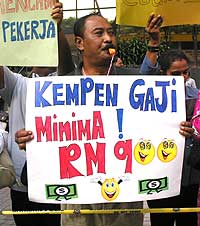 An independent and representative national minimum wage commission is the best institution to carry out the mandates of recommending minimum wage levels and monitoring progress.
It must be absolutely independent and highly visible, publishing annual reports, recommending minimum wage increments and proposing policies according to its analysis, and not just when the government asks for such advice. It can set up sectoral or regional consultative bodies as it deems appropriate.
The commission must have full access to national, tax-funded data on the labour market, industrial sectors, and income. So must the Malaysian people, in order to check on the commission.
Federal commissions are not having a good run of late, but that is due to the constricted mandate given to some of them, poor selection of commissioners, or the dismissive manner in which recommendations are received.
Minimum wage is a big political, social and economic deal. Whether we do it right will depend on whether we fully grasp it and boldly make it real.
LEE HWOK AUN is a lecturer in development studies at the University of Malaya.


Are you sure you want to delete this comment?
This action cannot be undone.