




GLCs sale to finance new wealth fund
Government unveiled plans on Friday to set up a second sovereign wealth fund, which would invest proceeds from the sales of stakes in government-controlled companies as it seeks to attract investment and boost competitiveness.
Government unveiled plans on Friday to set up a second sovereign wealth fund, which would invest proceeds from the sales of stakes in government-controlled companies as it seeks to attract investment and boost competitiveness.
However, it offered no clear time frame for the scheme and avoided the contentious issue of economic preferences for the Malay majority.
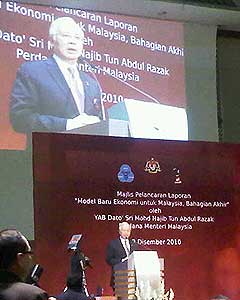 Prime Minister Najib Abdul Razak has pledged to reform an economy whose investment rates have not recovered from the 1998 Asian financial crisis and where foreign direct investment has fallen off a cliff from the heady days of the early 1990s.
"The government should consider capping its ownership of strategic companies to 30 percent of issued shares and adopt
less invasive strategic control methods such as golden shares, industry policies and foreign ownership," the National Economic Advisory Council said in a report.
The report is part of New Economic Model (NEM) which has been unveiled over the past few months. While most of the intentions have been lauded by economists, implementation remains a key barrier.
Government-linked companies (GLCs) which have long been criticised for crowding out the private sector, will be required to divest assets and will see more of their equity sold.
They also will have to work under new oversight to monitor their activities and their budgets, the report said.
Amomg these government companies, Sime Darby was recently hit by huge cost overruns and charges of mismanagement in its
energy division that pushed it to losses in the second half of this year and triggered the ousting of its top executive.
Crucially, the funds generated from the divestment programme will be channeled into a sovereign wealth fund that will be accountable and have to disclose its investments, rather than putting the funds into the state budget or into an existing fund called Khazanah which is under government control.
Missing social action, timeline
Missing from the report were concrete measures to reform the New Economic Policy which affords the country's majority
ethnic Malays preferential quotas including for businesses, although it did pledge to target aid at the poorest 40 percent
of Malaysians, regardless of race.
Investors have complained that abuse of the four-decade old policy has spawned a patronage-ridden economy and eroded
Malaysia's competitiveness compared to faster reforming neighbours including Indonesia.
The NEM promised to continue with affirmative action but said that it would "market friendly" and aimed at eliminating
"rent-seekers" in the economy to reduce corruption.
The plan also called for the government to implement a goods and services tax, a policy that has been repeatedly shelved for fear of upsetting voters, and to cut back on spending in the medium-term.
Malaysia's revenues are highly dependent on oil taxes which account for 37 percent of all revenues in 2008, the NEAC
said, while its subsidy regime has been a drag on public finances. Subsidy spending accounted for 15 percent of all government spending in 2009.
The thinktank said that Malaysia should use the concept of the "non-oil balance", ie excluding oil revenues to ensure
that a sharp fall in oil price did not cause "drastic" expenditure cuts.
The plan called for a widening of the country's tax base ny lowering taxes and removing credits as it said only 14.5
percent of Malaysians pay income taxes, leaving the country too dependent on commodities income.
The plan also pledged reforms to Malaysia's bloated civil service saying the sector that employs over a million people and is the largest per head of population would be "right-sized".
Reporting by Royce Cheah & Razak Ahmad
- Reuters


Are you sure you want to delete this comment?
This action cannot be undone.