




Tragedy of elections under repression
COMMENT At this time, when the BN leaders are indulging in an orgy of throwing public funds to buy votes in the current Sarawak state election, with polling only days from now (on April 16), it is indeed heartening to hear the Coalition for Free and Fair Elections (Bersih 2.0) insisting that all forms of material inducement for votes, including election promises, constitute an election offence.
Bersih 2.0 chairperson Ambiga Sreenevasan's statement came in the wake of Transparency International Malaysia (TI-M) president Paul Low's reservation as to whether election promises could be considered bribery, and minister Mohd Nazri Abdul Aziz's outright denial that goodies handed out during an election campaign is corruption.
COMMENT At this time, when the BN leaders are indulging in an orgy of throwing public funds to buy votes in the current Sarawak state election, with polling only days from now (on April 16), it is indeed heartening to hear the Coalition for Free and Fair Elections (Bersih 2.0) insisting that all forms of material inducement for votes, including election promises, constitute an election offence.
 Bersih 2.0 chairperson Ambiga Sreenevasan's (
right
) statement came in the wake of Transparency International Malaysia (TI-M) president Paul Low's reservation as to whether election promises could be considered bribery, and minister Mohd Nazri Abdul Aziz's outright denial that goodies handed out during an election campaign is corruption.
Bersih 2.0 chairperson Ambiga Sreenevasan's (
right
) statement came in the wake of Transparency International Malaysia (TI-M) president Paul Low's reservation as to whether election promises could be considered bribery, and minister Mohd Nazri Abdul Aziz's outright denial that goodies handed out during an election campaign is corruption.
Anyone who has read through Sections 10 and 11 of the Election Offences Act 1954 should not have the slightest doubt that the rampant bribery that is going now in the form allocation of funds for a sundry of projects and purposes by BN leaders are indeed serious election offences.
These election goodies are no vague promises but actual allocations of funds with specific quantum to specific recipients or for specific projects. In short, these intended disbursements are executive decisions, already made by the BN political leadership, for the obvious purpose of inducing voters to return BN to power.
Clear-cut bribery
Section 10 of the Act defines bribery, in meticulous and elaborate detail, as material benefits or promises in all forms dished out to induce votes. And Section 11 provides that such offences of "treating, undue influence and bribery" shall be punishable under the Criminal Procedure Code.
These laws are so clear cut that there should not be any room for any offender, enforcement body or the judiciary to wiggle its way from being accountable to the law.
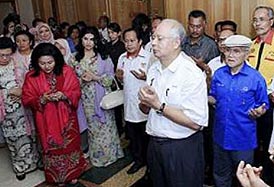 Take for instance the announcement made yesterday (March 30) by Deputy Prime Minister and Education Minister Muhyiddin Yassin in Kuching, Sarawak, RM73.68 million were were allocated to three types of schools in Sarawak.
He said RM25.68 million was for 130 missionary schools, RM20 million for 197 Chinese type national schools and RM28 million for 1,266 national schools.
Muhyiddin further said RM50,000 would be given to each missionary school in the near future through the BN representative in the area concerned. An initial disbursement of RM6.5 million to these schools will be followed by payments of the balance in the second round.
Now, isn't that the clearest act of bribery? Any fool can see that such a sudden avalanche of ad hoc funds to the schools in the state, only days before polling, is intended to induce the electorate to vote in favour of the BN.
And why single out Christian missionary schools for early payment? The reason is that Christians have been riled up by BN government lately through detention of their Malay language Bible and such promise of early disbursement would at least soothe some ruffled feelings to minimise electoral damage.
And why only disburse the funds through BN representatives? This is of course a subtle blackmail that, unless the BN candidate in your constituency is returned in the election, you may not get the promised cash endowment.
Election body must act
Muhyiddin and BN are therefore guilty of not only bribery and blackmail, but also abuse of power, as the funds that are used to buy votes are not BN money but public funds that belong to the people.
I see no reason why the Election Commission (EC) should not immediately give a stern notice to Muhyiddin that he has committed election offences; and the EC should also promptly make a report to both the police and the Malaysian Anti-Corruption Commission to take the necessary action for prosecution under the Criminal Procedure Code.
BN leaders have been observed to flout election laws with increasing impunity, as exhibited in their openly corrupt conduct in the last few by-elections; and the current Sarawak election may yet see them achieving new heights in this direction.
Only two days before the dissolution of the Sarawak state assembly, both Prime Minister Najib Abdul Razak and his deputy Muhyiddin individually made announcements in Sarawak allocating funds that total well over RM300 million.
On that day (March 19), Najib announced in Serian that BN had allocated RM252 million for infrastructure projects that included rural electrification, clean water supply, roads and health clinics for the 7,700 households in the district.
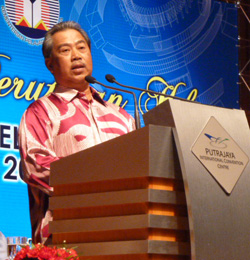 The same day, Muhyiddin (
left
) announced in Sri Aman that BN had allocated a RM81 million for the area. These include RM60.8 million for building a school in Lingga, RM18.5 million for the 15km Stumbin-Tanjung-Bijat-Stirau road, RM50 million to upgrade the Sembau-Stumbin road, RM1 million for flood mitigation projects in five Malay villages and RM600,000 for several longhouses.
The same day, Muhyiddin (
left
) announced in Sri Aman that BN had allocated a RM81 million for the area. These include RM60.8 million for building a school in Lingga, RM18.5 million for the 15km Stumbin-Tanjung-Bijat-Stirau road, RM50 million to upgrade the Sembau-Stumbin road, RM1 million for flood mitigation projects in five Malay villages and RM600,000 for several longhouses.
There are of course many other goodies, announced and unannounced, big and small, such as the 2,000 hectares of land awarded to Chinese schools to generate incomes to supplement their operating expenditures, and the ubiquitous 1Malaysia NGO organising sumptuous meals daily, complete with stage shows and lucky draws to make the electorate happy - with compliments from BN, of course.
We have not reached the formal campaign period yet, which will officially start on nomination day, April 6. God knows how many more millions of ringgit in public funds will be abused and dumped on the Sarawak electorate by then, and how many more ingenious inducements will be unleashed to procure votes for BN.
Collapse of law enforcement
A scenario of Muhyiddin being nabbed by the law, as suggested earlier, is of course a theoretical construct. In reality, none of the errant BN leaders is at risk of being convicted.
This is due to the fact that the entire chain of law enforcement, from EC and police to prosecutors and judges, function more as henchmen of the incumbent power to preserve its rule, rather than as institutions that owe their loyalty to the country and the people.
 Under these circumstances, the only constitutional redress lies with the electorate - if only they will exercise their votes to mete out punishment to the political leadership that has betrayed the people's trust. But that is a big ‘IF'.
The prerequisite to the people acting wisely as the final arbiter is that the people must first be enlightened on the truth. In a democratic country, this is no problem, as the people are well informed by an independent and free media.
In fact, such flagrant transgression of election laws could never have happened in a democracy, for the ruling party would have been hounded out of office by unstoppable media onslaught alone, without waiting for the electorate to do the sacking.
However, this is not so in a repressive country like Egypt under Mubarak or Tunisia under Ben Ali, or for that matter, the Umno hegemony.
The reason is simple, in addition to iron-fisted control through repressive legislation and degraded institutions, the country's tightly-controlled mass media ensures that the majority of people are kept in the dark.
Repression leads to people power
The people of Egypt and Tunisia succeeded in overthrowing their autocratic rulers, people power style, only because of the presence of a combination of factors, among which is the breakout of the information stranglehold through skilful utilisation of modern information technology such as Internet and mobile phones.
These devices enabled a large section of the populace to be instantly informed of the latest true picture, as well as facilitated prompt mobilisation of mass movement.
While it is outside the scope of this article to look into the various factors contributing to these people power phenomena, one important lesson we must learn is about elections in a repressive country.
Take the case of Mubarak, who reigned for three decades. At the last election in 2005 when he was re-elected for a fifth six-year term, he garnered 88% of the votes cast in a ‘democratic' election.
But when the people power came, he was literarily chased out of office through irrepressible anger that was expressed almost unanimously by the masses across the land.
If the thumping majority he received in every one of the past five elections over three decades had been obtained through really democratic elections, is it conceivable that the entire population would have turned violently against him overnight?
The lesson is that the so-called democratic elections held under repressive conditions, such as those in Egypt, Tunisia and Malaysia, are potential time-bombs. The explosion will come when there are enough people who come to know the truth, ignited by a spark in a combustible atmosphere.
Let BN be warned that its unrestrained violation of democratic norms are moves that are channelling the country towards that regrettable destiny.
KIM QUEK is a retired accountant and author of the banned book ‘The March to Putrajaya'.


