




UN intervention sought in S'pore death row case
The lawyer of 23 year old Yong Vui Kong, a Malaysian on death row in Singapore for drug trafficking, has submitted an urgent appeal to the United Nations for intervention in halting his client’s execution.
The lawyer of 23 year old Yong Vui Kong, a Malaysian on death row in Singapore for drug trafficking, has submitted an urgent appeal to the United Nations for intervention in halting his client’s execution.
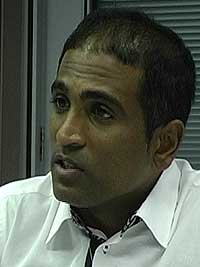 Jointly submitted by M Ravi (
right
) and London-based NGO Harm Reduction International, the appeal to the UN special rapporteur on extrajudicial, summary or arbitrary executions detailed Yong's case, and why the latter should be given a second chance at life.
The letter sent to the UN last week, also outlined the International body's stand on death penalty and various reasons why it should be abolished.
In his appeal, Ravi said that neither Yong’s age nor personal circumstances could be taken into account in his sentencing due to Singapore’s mandatory death penalty policy.
He added that UN officials including its Human Rights Committee and the Inter-American Court of Human Rights including NGOs and numerous national courts had criticised such mandatory death sentences that cannot consider mitigating considerations.
Furthermore, it has long been established that drug offences do not reach the standard of ‘most serious crimes’ as articulated by United Nations, argued Ravi.
Right to life
"International bodies have devoted considerable attention to limitations placed on the lawful application of the death penalty,” he said, in an email to Malaysiakini .
 “According to decisions by human rights monitors, scholars and international jurisprudence, capital drug laws are at odds with the right to life as articulated by Article 6(2) of the International Covenant on Civil and Political Rights,” he added.
“It states that the death penalty may only be applied for what the treaty terms ‘most serious crimes’,” he stressed.
Ravi said this statement has been affirmed by several UN bodies including its Special Office on Drugs and Crime.
Although Singapore is not a party to the International Covenant on Civil and Political rights yet, this principle has been endorsed by UN in a 1984 resolution of the Economic and Social Council of the United Nations (ECOSOC), he added.
 The resolution upheld nine safeguards on the application of the death penalty, affirming that capital punishment should be used “only for the most serious crimes”, he said.
On Nov 14, 2008 Yong received the mandatory death sentence and his petition to the Singapore president for clemency was rejected the following year.
Just four days before his sentence was to be carried out, Yong filed a criminal motion for leave to pursue his case at the Court of Appeal based on the argument that the sentence was unconstitutional.
Although leave was granted on Dec 9, 2009, the appeal was dismissed on March 14 the following year.
Minister prejudiced process?
Shortly before the decision was made public, comments attributed to the Law Minister and Second Home Affairs Minister K Shanmugam were published defending the mandatory death penalty for drug trafficking.
 Shanmugam had reportedly warned that if drug lords are under the impression that young and vulnerable traffickers will be spared then they will be more inclined to use them as mules.
‘Then you’ll get 10 more. There’ll be an unstoppable stream of such people coming through as long as we say we won’t enforce our laws,” the media quoted him saying.
Shanmugam has refuted Ravi's remarks in a press statement sent via the Singapore High Commission in Malaysia last year, where he said the lawyer was inaccurate in attributing to him statements that he did not make.
The minister denied commenting on any case in the Court of Appeal, specifically on Yong's matter, as he had only mentioned the government's legislative policies and whether that would change.
Ravi then filed a final appeal based on several arguments including the by law that it is the President “who has the power to decide whether or not to grant any fresh clemency petition which the appellant might file”.
 In his appeal, Ravi argued that “the Law Minister’s conduct had irreversibly tainted the clemency process in respect of the appellant with apparent bias”.
"(Because of this) Yong was entitled to be pardoned on account thereof or was, alternatively, entitled not to be deprived of his life," said Ravi.
This appeal, however, was rejected on Apr 4 and Yong is expected to be executed in three months unless the republic's president grants clemency.
Yong, currently a devout Buddhist, appears to have accepted his fate, evident in letters he has written from Changi prison to Yetian, a member of the Save Vui Kong Campaign, sharing stories about his life and experiences.


Report this comment
Are you sure you want to delete this comment?
This action cannot be undone.