




Affordable homes need more than just land
With affordable housing having been a hot election topic across the Causeway, and house prices similarly escalating to record highs on our own shores, the situation here too is nothing less than a ticking time bomb.
With affordable housing having been a hot election topic across the Causeway, and house prices similarly escalating to record highs on our own shores, the situation here too is nothing less than a ticking time bomb.
The solution, it seems, lies in a two-pronged attack.
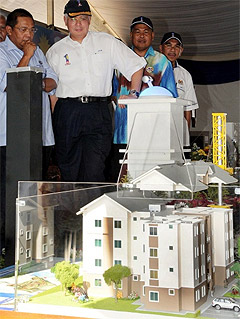 After announcing the First Home Owner programme, where the government guarantees 100 percent loans for house buyers aged under 35 earning less than RM3,000 for property costing below RM220,000, the prime minister last week announced a supply side approach.
According to PM Najib Abdul Razak, the scheme, dubbed Affordable Housing Programme, would see the government setting aside land for developers to build low-medium cost housing costing under RM220,000 to meet the demand.
The prime minister also mooted the use of Industrialised Building Systems (described by industry players as "like Lego, only more advanced") to bring down prices further.
But according to Real Estate and Housing Developers' Association (Rehda) president Michael Yam, there are other considerations beyond land, which makes up about 20 percent of the final gross development value.
"Depending on building types, land generally constitutes only 20 percent of the total gross development value, while construction, professional fees, utility contribution, interest cost and cross subsidies make up as much as 60 to 70 percent.
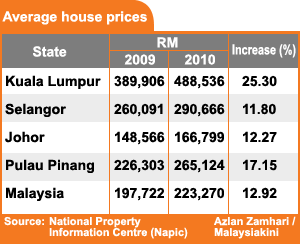 "Although in this new programme, land costs are borne by the public sector, several more measures need to be taken to ensure that properties fall within the RM220,000 threshold, especially within the Klang Valley and in Penang," he said in a statement last week.
Yam added that the IBS system was also not likely to bring down costs, since much of Malaysia's construction work was not dependent on this system but on conventional labour.
Tax, duties and fee exemptions
For town planner Goh Bok Yen, the success of the plan hinges on the government's ability and will to give up premiums associated with land.
 "The government should waive the land conversion premium and other charges on public infrastructure, including sewage fee charged by the Drainage Department. This alone can cost up to RM3,000 per acre," he said.
Goh said these additional costs to construction and land could add up to at least 20 percent of the construction cost.
Additionally, the government can look at providing tax exemptions on construction material reported to have risen by at least 10 percent and up to 40 percent in the case of steel reinforcements.
Such exemptions would require hefty revenue cuts on the part of by both the federal and state governments, under whom land matters fall.
For the federal government, losing out on taxes on construction material and footing the bill for sewage is a costly measure for a cash-strapped administration that is even forced to embark on unpopular measures such as slashing subsidies.
According to the Selangor budget, income from land makes up 75 to 80 percent of total state revenue and giving away free land could deliver a fair blow to the state coffers.
However, Goh claims that there is still money to be made by states with many idle parcels of land that can now be converted into residential plots.
"This could include some forest land reserves which have no more forest value, and former mining land. They would also need to take back land which is currently leased," he said.
The federal government could also look at converting government quarters within the Klang Valley, which sit on federal land, including those considered to be brown land.
"Most of these buildings are old and their density low, so the government can rebuild them to become a better places for living, with the density raised to 300 to 400 units per acre," Goh added.
Property development company Hua Yang Bhd chief executive officer Ho Wen Yen feels the government should not balk at footing such a bill as it is its responsibility to provide proper housing.
Developers won't build for free
As such, Ho is wary of Najib's statement that "if possible", the houses built by developers under the Affordable Housing Programme will be done without profit, as a form of corporate social responsibility.
"It is national duty, or else what is the state doing? Why are developers expected to pay standard corporate rate taxes but still made to provide housing (without profit)? The government is expected to provide certain things," Ho said.
As it is, private developers of housing projects exceeding five acres have to allocate at least 30 percent of houses as low-cost units.
According to Ho, there were many private-public partnership models when it comes to housing, and these could be pursued without developers having to build at a loss.
In most of the models, the state provides land, either for developers to build and sell each unit at a fixed price or for the developers to sell them back, lock stock and barrel, for the state to redistribute.
 He added that there are also state-owned development companies like the Selangor-owned PKNS, which can play the role if the state cannot guarantee developers' profits.
"It is better to have a private-public venture, because the private sector is more efficient and better at gauging demand," he said.
Even if the state is willing to give up land for nothing, the National House Buyers' Association (HBA) pointed out, other considerations need to be taken into account for the programme to take flight.
One of them is for the houses to be built within city limits, a requirement that HBA official Tan Chong Leng believes is not possible, considering the lack of public land in the city.
Much of it has been sold to private developers who are unwilling to build low-medium cost houses after purchasing the land at costs of up to RM2,000 a square foot.
In search of land
Thus far, Deputy Finance Minister Donald Lim has announced that some of the houses under the programme will be built at Sungai Buloh and Sungai Besi, both 20km away from the city centre.
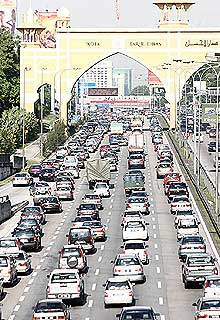 While this is promising, HBA believes that the government will be forced to give up land in outlying areas. These could include Selayang and Rawang (about 40km from Kuala Lumpur).
"Traffic jams will mean two hours on the road and we don't know when this mass rail transport system will take off," Tan said.
The quality and design of the houses is also an important factor for buyers, with many preferring to rent, rather than buy a unit that is either poorly built or poorly maintained.
"It should also fulfill the future needs of young workers, as most of them will use the units for 10 or 15 years before they move to bigger houses. So, these houses must fulfil the needs of young families too," Goh said.


Are you sure you want to delete this comment?
This action cannot be undone.