




Professionals against special body for Islamic laws
Several Member of Parliaments and lawyers have expressed reservations about a proposal by the Malaysia Muslim Lawyers Association (PPMM) for Islamic laws to go straight to the Council of Rulers, bypassing parliamentary debate.
Several Member of Parliaments and lawyers have expressed reservations about a proposal by the Malaysia Muslim Lawyers Association (PPMM) for Islamic laws to go straight to the Council of Rulers, bypassing parliamentary debate.
PAS Supreme council member Dzulkefly Ahmad described the proposed move as undemocratic.
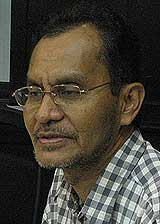 Dzulkefly, (
right
) who is also the Kuala Selangor MP, said the PPMM proposal needs to be thought through thoroughly.
Dzulkefly, (
right
) who is also the Kuala Selangor MP, said the PPMM proposal needs to be thought through thoroughly.
"The idea needs to be thoroughly debated and thought out, but personally I feel it is undemocratic as we have a legislature which is supposed to pass laws. It would be seen as if Islam is suppressing the views of others in driving through a piece of legislation.
"This would also go against the democratic purpose and principle in the setting-up of the legislature. This is not the way to go out at it (the Islamic legislation) at all.
"This is my personal view on the proposal and it needs to be further debated and thought out," said Dzulkefly, who is also a member of the PAS political bureau.
His counterpart, Batu MP Chua Tian Chang or better known as Tian Chua, ( below ) said going by Zainul Rijal's logic, it would not resolve the problem.
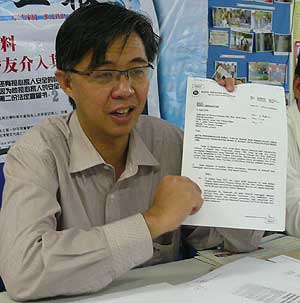 "According to the constitution rulers follow the advice of the menteri besar or chief minister or prime minister (on the implementation of a policy or laws). So how can such a proposal work its way from being drafted and go straight to the rulers?" he asked.
They were commenting on PPMM president 's proposal for Islamic laws to be excluded from parliamentary debate.
In an interview with Utusan Malaysia on Thursday, PPMM said it wants Islamic laws to be excluded from parliamentary debate, as Zainul Rijal Abu Bakar felt the present procedure is outdated and could be changed without amending the constitution and that any bill on Islamic matters drafted by the Islamic Development Department (Jakim), be referred to the National Council of Islamic Affairs of Malaysia (MKI) and the Malaysian Council of Rulers for approval.
"Then, it should go to the cabinet for endorsement without debate because the bill has been approved by the Yang di-Pertuan Agong.
"The same goes for the first and second reading (in parliament) there is no need for debate because it had been approved by the Conference of Rulers," Zainul was reported to have said.
Bar Council: parliament enact laws
Bar Council chairperson, Lim Chee Wee pointed out that Malaysia is a constitutional democracy which provides for the legislature (parliament and state assembly) to enact laws.
He said the members of the legislature are elected by the people and hence, laws are thus not promulgated by edict or administrative decision.
"This is a fundamental and basic structure of the Federal Constitution. Such fundamental and basic structure cannot be by-passed," he added.
PPMM, president Zainul Rijal Abu Bakar's suggestion that matters relating to Islamic laws and Islamic affairs bypass parliamentary debates contradicts the legislative process and Federal Constitution, he said.
 Generally, Lim (
right
) said matters pertaining to Islamic law is enacted by the state legislative assembly, except for the Federal Territories of Kuala Lumpur and Putrajaya (which come under the purview of parliament).
Generally, Lim (
right
) said matters pertaining to Islamic law is enacted by the state legislative assembly, except for the Federal Territories of Kuala Lumpur and Putrajaya (which come under the purview of parliament).
This, he said is provided for under Article 74 read together with the second List set out in the Ninth Schedule in the Federal Constitution.
"Thus, legislative powers as regards Islamic law are generally under the State's legislative jurisdiction, save for certain general legislation previously passed by parliament, such as the Syariah Courts (Criminal Jurisdiction) Act 1965 (Revised 1988) which empowers all Syariah courts with jurisdiction to deal with matters enacted by states pursuant to their powers," he said.
In any event, he said there is no distinction between the legislative process between laws relating to Islam and non-Islamic matters where for example, the Syariah Courts (Criminal Jurisdiction) Act 1965 mentioned above was passed via the normal legislative process of parliament.
Further, the Federal Constitution, under Article 66(1) provides parliament with powers to make laws that are exercised through bills passed by both Houses (parliament and the senate) .
Law, he pointed out is defined under Article 160 of the Federal Constitution as ""Law" includes written law, the common law in so far as it is in operation in the Federation or any part thereof, and any custom or usage having the force of law in the Federation or any part thereof". Thus, there is no distinction as to what type of law (Islamic or otherwise) which the parliament has power to make.
Lim said Zainul Rijal's reliance on Article 11(3) of the Federal Constitution is wholly misplaced.
"The said provision does not allow religious groups (in this case, Islamic religious groups), the right to legislate Islamic laws. The power lies with the respective legislative bodies (either state legislative assembly or parliament) and does not and cannot be extended in the context put forth by Zainul.
"Taken to the broad extreme, as Article 11(3) states "religious group", this would necessarily also mean that any religious group (be it Islamic or otherwise), may legislate any law by their whims and fancies, thus giving rise to legislative anarchy," said Lim.
Article 11(3) of the Federal Constitution, he said provides that every religious group the right to "acquire and own property and hold and administer it in accordance with law".
"Zainul's selective interpretation is untenable. "Administer" under the said provision must be read in the context of the whole provision, i.e. "acquire and own property and hold and administer it...". "it" refers to "property", not "administering their religion" (which is a wider and incorrect interpretation).
Needs amendment to Federal Constitution
According to Malaysian Centre for Constitutionalism and Human Rights campaigner, Edmund Bon, Zainul Rijal's proposal requires the Federal Constitution to be amended.
Bon, a former Bar Council Constitutional committee chairperson, said the proposal would bestow more powers to the rulers and hence it would require an amendment.
"Furthermore, it will change the status of our rulers from constitutional monarchs to giving them near absolute powers to make laws. Rulers are unelected and this proposal takes us further away from our (system) of parliamentary democracy," he said.
 "On another note, it would affect public policy as it divides our system of governance on one side a method of lawmaking for non-Muslims and one for Muslims. This does not augur well for national unity," said Bon (
left
).
"On another note, it would affect public policy as it divides our system of governance on one side a method of lawmaking for non-Muslims and one for Muslims. This does not augur well for national unity," said Bon (
left
).
He added that such proposals would require amendment to the Federal Constitution so as to enable to give more powers to the rulers to do this.
Yesterday, constitutional expert Abdul Aziz Bari, argued that while the said article 11(3) in general, guarantees practitioners of all religions the right to manage and run their own affairs, it does not allow for such exclusivity when it comes to the passing of laws.
Abdul Aziz further argued that it would put Islam in a bad light if carried out.


Are you sure you want to delete this comment?
This action cannot be undone.