




Another season of 'expert analysis' on PAS ends
COMMENT This year, like past several years, there has been no shortage of analyses and 'expert' opinions in both the government-controlled and independent media on the recently concluded PAS general assembly.
COMMENT This year, like past several years, there has been no shortage of analyses and 'expert' opinions in both the government-controlled and independent media on the recently concluded PAS general assembly.
One common feature of these analyses, whether they are done in good faith or to undermine the party's Islamic outlook, has been the obsession with terms such as 'reformists', 'ulamas' and 'professionals', despite repeated insistence by PAS leaders that these are just labels created by the Islamic party's detractors.
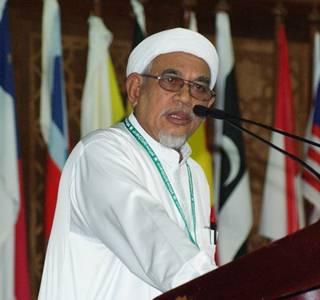 Far from ignoring them, PAS president Abdul Hadi Awang (
left
), in his closing address at the muktamar, could not help but point out yet again that these terms had no relevance in PAS.
Far from ignoring them, PAS president Abdul Hadi Awang (
left
), in his closing address at the muktamar, could not help but point out yet again that these terms had no relevance in PAS.
Perhaps aware of the futility of explaining his case, Hadi stopped short of blaming journalists covering the three-day muktamar, but offered a light-hearted response.
"There are media claiming that the new leadership represented the Erdogan group. Let me tell you that this (line-up) is no Erdogan. It is 'Nik Aziz' and 'Hadi Awang'. Not AK Parti but Parti Islam Se-Malaysia," he said in his speech.
Had it not been for the almost total acceptance of most local writers of the labels, Hadi could have done well to simply ignore them. These labels have so far failed to stand the test of time.
Take for example when the mainstream media as well as internet portals described the election of Nasharudin Mat Isa as the PAS deputy president in 2005 as a victory against the 'ulama' faction. Then, the media hailed his win as a victory of the 'professionals' and therefore marked the diminishing role of the 'conservative' faction, or in media parlance, the ulama.
Four years later, Nasharudin found himself being lumped with the 'conservatives', while the so-called 'professionals', who in media parlance are the 'non-ulamas', were identified and indirectly promoted or derided.
Media jargon takes over
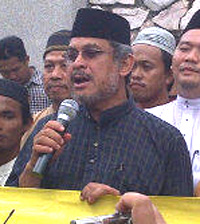 So when PAS' Shah Alam member of parliament Khalid Samad (
right
) recently spoke out against the MTV concert in Shah Alam, it was clear that his days in the so-called 'professional' camp will also be numbered.
So when PAS' Shah Alam member of parliament Khalid Samad (
right
) recently spoke out against the MTV concert in Shah Alam, it was clear that his days in the so-called 'professional' camp will also be numbered.
The truth is, as part of the global Islamic movement, PAS has to face this reality. There will not be a shortage of media jargon from analysts eager to give their two sens' worth, dishing out what little knowledge they have of Islamic politics and 'political Islam', the latter being a phrase with all its Western baggage.
Every time the Islamic party's general assembly is in session, local analysts and political commentators would suddenly turn into experts on Islamic politics, using terms that have no real meaning. Groping in the dark to give an intellectual cover for their arguments, both PAS's friends and foes end up speaking the same language.
Such was the case during the past week, with a sudden surge in the use of terms such as 'Erdogans' and 'ulama' to suggest the existence of a gap between so-called professionals and religious scholars.
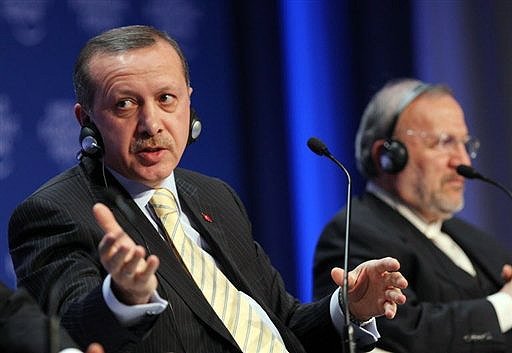 'Erdogan' of course refers to the current Turkish prime minister Recep Tayyip ErdoÄŸan (
left
), the former football player-turned mayor-turned political prisoner turned-prime minister, who leads the Justice and Development Party (AK Parti) which currently holds the majority in the Turkish assembly.
'Erdogan' of course refers to the current Turkish prime minister Recep Tayyip ErdoÄŸan (
left
), the former football player-turned mayor-turned political prisoner turned-prime minister, who leads the Justice and Development Party (AK Parti) which currently holds the majority in the Turkish assembly.
His name has been used, rightly or wrongly, to refer to those in an Islamic movement who would like to "move to the centre". This theory of course accepts without question a common shortcoming among Western contemporary historians in understanding the Islamic movement, that those in this group occupy the 'right' of the political spectrum.
It is no coincidence that such seasonal 'experts' of Islamic politics also emerge whenever Iran holds its presidential elections. While the Western media could not find any fault in the legitimacy of the elections despite the noisy propaganda against Iran's post-Islamic Revolution system since 1979, the West would find it self-fulfilling to indulge in labelling the 'hardliners' and 'reformers'.
At one time, these 'experts' even accorded the name 'Khatami' to the 'reformists' in Iran, only to be disappointed when it later emerged that Khatami during his presidency was in no rush to do the bidding for Uncle Sam, like what Washington expects from the rest of the Muslim leaders eager to please their masters.
Analysts need to do their homework
Of course, not many - perhaps none - of our local commentators in whose writings are littered the terms 'Erdogans' or 'reformers' have actually cared to qualify their usage of these words, much less reflect any knowledge about the history of Islam vis-a-vis Turkish politics, which goes back long before Erdogan was born.
When some journalists, who hitherto wrote only about MCA-MIC politics or who had been only interested in our smut-filled political gossip, also resorted to such terms (probably to increase their word count), the futility of responding to these comments seems to have been confirmed.
The truth is that Hadi will not be the last president in PAS to deny the so-called rift within PAS. While one cannot confidently deny differences of opinions or even rifts in PAS, the fact is that there is nothing to prove the suggestion that they are rooted in educational or professional differences, or by the fact that some leaders prefer the turban and others prefer to be bareheaded.
Meanwhile, until such a time when our journalists and political commentators care to do a little bit of homework on Islam and politics, we should be ready to stomach another round of 'expert analyses' at the next muktamar.
ABDAR RAHMAN KOYA is managing editor at Islamic Book Trust, Petaling Jaya.


Report this comment
Are you sure you want to delete this comment?
This action cannot be undone.