




DAP cautiously lauds postal voting changes plan
DAP today said that it welcomes the Election Commission’s plan to amend postal voting to extend this to Malaysians overseas, and to introduce advance voting for police and armed forces personnel.
DAP today said that it welcomes the Election Commission’s plan to amend postal voting to extend this to Malaysians overseas, and to introduce advance voting for police and armed forces personnel.
However, DAP publicity chief Tony Pua told reporters that the party will not pop the champagne until the “surprise” announcement is implemented.
“There seems to be quite a bit of flip-flopping so we will be cautious not to rejoice until we see it in action,” he said.
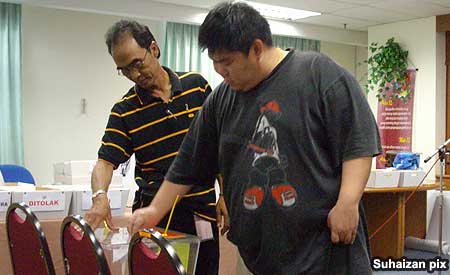 Nevertheless, the Petaling Jaya Utara parliamentarian conceded that the move to introduce advance voting, especially, addresses “most of the gripes” about postal voting.
“The concern with postal voting is that the ballot paper is taken out, and could be marked separately by someone other than the voter before it goes into the ballot box. This would solve most of the gripes,” he said.
He, however, noted that this is only if party agents are allowed to observe the polling process at advance voting stations.
“We have had situations in Sarawak where our polling agents were made to stand across the room from the ballot box, further than the 50m distance stipulated. Some were made to stand outside the room where polling happened, but within the 50m range,” he said.
Election Commission chairperson Abdul Aziz Yusof also revealed that the commission is currently studying the use of either indelible ink, biometric system or both in the next general election to prevent possible multiple voting by one individual.
 Commenting on this, Pua said that the DAP has always supported the use of indelible ink and the demerits of the biometric system has been “spoken of to death”.
The MP, who had founded a public-listed IT firm in Singapore prior to entering politics, reiterated that the biometric system for elections would need to be “huge” and can pose problems due to faulty connectivity.
“Even if it is a standalone system for each stream, it cannot address problems if a voter’s name is not there. What if the laptop crashes? There are many thing that could go wrong that is out of the EC’s control,” he said.
He added that the system could cost “hundreds of millions of ringgit” but indelible ink would cost less than RM5 million.
“The choice is obvious... but maybe the profit margins for indelible ink is smaller,” he said tongue-in-cheek.
Related stories :
EC 'penalising' DAP with new voter rule
Some cry foul over 'automatic' voter listing
Changes to overseas postal voting need 2 months
EC, spell out what reforms are doable
Allow prisoners and detainees to vote


Are you sure you want to delete this comment?
This action cannot be undone.