




Flowers and prayers for Aung San Suu Kyi
COMMENT The current meeting of the Association of Southeast Asian Nations (Asean) in Bali has elected Burma to take the chair of this regional grouping for the year 2014.
COMMENT The current meeting of the Association of Southeast Asian Nations (Asean) in Bali has elected Burma to take the chair of this regional grouping for the year 2014.
Asean is the only international organisation that has given Burma the recognition that the country so desperately needs to raise its standing in our region.
This move by Asean is no less than epoch-making on the world stage. It has broken 50 years of national isolation Burma suffered because of the absolutist military junta in charge of the country.
Asean has opened the doors for Burma to re-enter the international forum as a legitimate member of the community of nations, thereby freeing the country from a state of apparently permanent ostracisation.
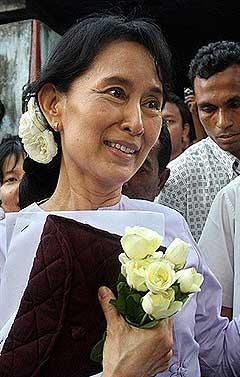 The move by Asean to re-introduce Burma to greater international recognition is welcome news to those people who have delighted in the recent gradual thawing of the freeze on Burma in all aspects of international relations.
This latest development has also taken place against the backdrop of the gradual opening of this nation by Burma's own military regime to the rest of the world.
Burma's most respected political leader, Aung San Suu Kyi ( left ), recently announced that she has invited President Barack Obama to visit her country, signalling the prospect of a visit by a US Head of State to this reclusive country for the very first time.
The US Secretary of State, Hillary Clinton, will also be visiting Burma, personally, in the foreseeable future.
In the past half a century, Burma has suffered much from international sanctions. There is not much economic activity of note in Burma, aside from the ambitious regional power, China, serving as its trading partner.
Trade cannot be initiated without improvement of friendly relations with Burma's neighbours. This beautiful country is in pressing need of developing its infrastructure to allow for modern economic development.
An entire nation in a time warp
In a sense, Burma has been living in a time warp. The opening of its borders to the rest of the world will provide a lifeline to this backward country.
The people of Burma have suffered grievously, including from a shortage of food in this former 'rice bowl of Asia'.
Today, a year after the release of Suu Kyi, the elected national leader who has spent seven years under house arrest, political developments in Burma are moving at a frenetic pace.
The supposedly civilian administration, under former general Thein Sein, has taken a number of steps that have been welcomed by human rights campaigners, including relaxing its controls on the media and releasing prisoners of conscience.
But Burma is far from seeing the end of its troubles. According to the country's provisional constitution, the military still controls 25 percent of the parliamentary vote, thereby placing Burma in a straightjacket of semi-military rule.
A start will have to be made by Burma and her neighbours to restore full civilian rule to the people, where it has always belonged.
Burma's progress to a full democracy will be a long and arduous road. But this prospect of occupying the chair of Asean may signal the beginning of the loosening of state control over the lives of the Burmese people.
Suu Kyi's painful journey
I daresay, without much fear of contradiction, that nearly the whole world is rooting for Suu Kyi. The history of persecution of this noble lady has been well documented.
Her story is one of the most touching episodes in the modern political history of mankind. The whole world is eager for her success in reforming the deadened political system in Burma.
Until today, Burma remains one of the world's most fossilised political systems, and a radical change is urgently required to breathe new life into the national destiny of its people.
Against all odds, Suu Kyi has been freed, and has now even been allowed to take part in national elections.
Of course, the cynical military regime can always close Burma off again at a moment's notice, as it has done before.
But given the climate for political change, including in the Asean countries, it is increasingly difficult to see Burma's military choosing to go back to its bad old days.
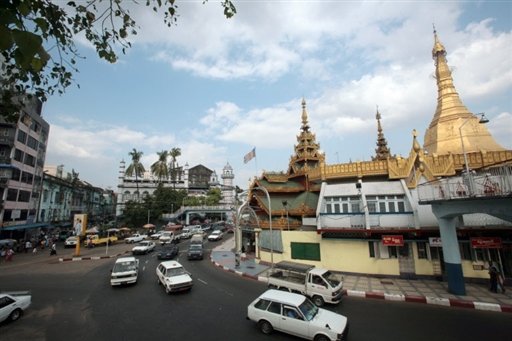 Burma is a fabulously rich country with plenty of land, forests and natural resources like oil and gas, besides being one of the world's biggest exporters of precious stones as well.
By right Burma ought to be an affluent country, in contrast to the moribund state of extreme poverty suffered by its people.
On paper at least, Burma may still have a bright future, if only the country can get its political act together.
We Malaysians are close neighbours to the people of Burma. Many of us also know some among the countless number of workers from Burma who are now eking out a pitiable living in Malaysia.
I myself know an intelligent, personable, young Burmese man, working in a KL coffee shop as a shop assistant. He has a degree in Geography from his country, but he is reduced to menial work, sustaining a miserable existence in a land far away from home and hearth.
The quasi-military government of Burma is an outdated form of government that has long outlived its lifespan. It is time for real political reform to begin in that unfortunate country.
We, the people of ASEAN, must do everything in our ability to help the Burmese realise their true potential and experience security and happiness. This is the call of solidarity among neighbours.
Let us ordinary Malaysians all offer a flower, and a prayer, for Aung San Suu Kyi - and offer material and moral support as best we can - to bring new hope to Burma.
SIM KWANG YANG was Member of Parliament for Bandar Kuching, Sarawak, from 1982 to 1995. He can be reached at sky8hornbill@gmail.com. All comments are welcome.


Are you sure you want to delete this comment?
This action cannot be undone.