




The media in a post-BN Malaysia
"If and when an opposition comes to power, then it has to be answerable immediately, from the first second it is in office, to a strong and fearless and true press," said author and Malaysiakini columnist Dean Johns.
"If and when an opposition comes to power, then it has to be answerable immediately, from the first second it is in office, to a strong and fearless and true press," said author and Malaysiakini columnist Dean Johns.
"Malaysia has a huge media space with all kinds of newspapers that could carry all kinds of flavours and opinions in a post BN-world," he added.
 Johns joined
Malaysiakini
editor-in-chief Steven Gan for a panel discussion on "the role of the media in a post-BN world", moderated by associate professor and dean of the Faculty of Creative Industries at the Universiti Tunku Abdul Rahman, Carmen Nge.
Johns joined
Malaysiakini
editor-in-chief Steven Gan for a panel discussion on "the role of the media in a post-BN world", moderated by associate professor and dean of the Faculty of Creative Industries at the Universiti Tunku Abdul Rahman, Carmen Nge.
"Mainstream media, not only the newspapers, all the media, will have a vital role in a post BN-Malaysia. And the market will be in a position to decide who is going to survive," Johns ( right ) predicted.
Gan compared Malaysia with other countries in the region, saying that if changes come, they might be bumpy.
"There will be uncertainty - that is expected for a country going through transition, especially looking at Indonesia, Taiwan, Korea, where the ruling party has been in power for a very long time."
"Hopefully, Malaysia will take the Indonesia path, where generally the media show a sense of responsibility as well as a respect for privacy and respect for truth."
He also pointed to the positive examples of Burma and Thailand.
 Gan expressed surprise at the pace of change that took place recently in Burma.
"Burma may be much freer than Malaysia," he quipped.
In Burma, he reported, the dissident online news portal Mizzima - which is based in India - had been invited by the Burmese government to assist in drafting the new media law for the country.
"Can you imagine the BN asking Malaysiakini editors, or anyone of you, for your opinion in rewriting the Printing Presses and Publications Act?" he asked to chuckles from the audience.
Morphing RTM into a Malaysian BBC
While lamenting the lack of media diversity in his home country, Australia, Johns pointed to the ability of its public broadcaster ABC to deliver independent quality journalism.
Gan expressed hope that RTM could be converted into a public broadcasting station similar to its Thai counterpart - a statutory body that gets government funding and yet able to provide independent investigative journalism.
 "Although the Thai Public Broadcasting Service receives funding from the government, the journalists and editors are protected from any form of interference."
"It's a model we should look at," he argued.
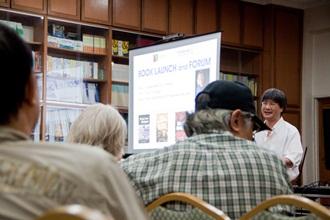
The occasion for the debate was the official launch of Johns' four books containing a selection of his Malaysiakini columns.
A lively audience of 30 attended the book launch hosted by his publisher Gerakbudaya Pubishing House at the Kuala Lumpur and Selangor Chinese Assembly Hall.
Johns, an advertising executive turned writer and educator, has started publishing selections of the weekly columns in 2007 with Gerakbudaya.
His latest volume ‘1Malaysia.con' was published in July 2011.


Are you sure you want to delete this comment?
This action cannot be undone.