




'Scrapping tax won't rob Proton, Perodua's edge'
Pakatan Rakyat's plan to scrap excise duty on cars should it take over Putrajaya, will not rob local car producers such as Proton and Perodua of a price edge over competitors, says PKR.
Pakatan Rakyat's plan to scrap excise duty on cars should it take over Putrajaya, will not rob local car producers such as Proton and Perodua of a price edge over competitors, says PKR.
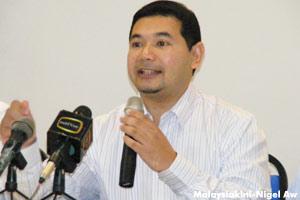 PKR strategy director Rafizi Ramli today took a swipe at his Umno counterparts - who said removing the duty would
spell doom
for local carmakers - for failing to understand the taxes.
PKR strategy director Rafizi Ramli today took a swipe at his Umno counterparts - who said removing the duty would
spell doom
for local carmakers - for failing to understand the taxes.
He said they did not know the difference between excise tax, which is applied across the board, and import tax, which only applied to foreign cars.
"There are some parties that try to paint a picture that a tax revamp will mean that Proton will be at the same price as other (imported) cars.
“That's not true. Proton and Perodua will still have their price edge in the market," Rafizi told a press conference at the PKR headquarters today.
This, he explained, was because the abolition of the excise tax would cause car prices, both local and foreign, to fall proportionately.
 "For a RM50,000 to RM60,000 local car that is taxed at 85 percent, if you remove it, it will fall to below RM30,000.
“So your Proton Persona or Gen 2 will be around RM27,000 or RM28,000. Similarly, if you remove the excise tax for a foreign Honda car costing RM80,000, it will come down to about RM50,000.
"So it is between buying a RM30,000 car or a RM50,000 car.
“I believe many in the lower income group want a car because they have no choice, and they would choose the cheapest and most reliable car.
“They would not want to be in debt for nine to 10 years just to get a Honda Accord or Honda City," he said.
He added that the RM300 to RM400 a month each household can save when the excise tax is done away would "mean a lot" for the families.
'Non-KLites need cars too'
Under the current taxation system, Rafizi said, there was not much difference in the excise tax between high-end and ordinary vehicles.
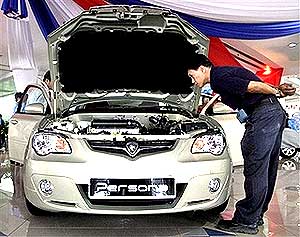 For example, he said, an under 1,800cc locally manufactured vehicle is taxed 85 percent while that above 2,500cc and also locally made is taxed 105 percent, only 30 percent higher.
Addressing criticism that the move would cause of a flood of vehicles on the roads, Rafizi said the matter should be viewed beyond the context of Klang Valley.
"We should not penalise the other 23 million Malaysians not living in the Klang Valley. This taxation system does not only apply in Klang Valley but to all of Malaysia.
"The situation is even more dire in Sabah and Sarawak, where the road network is poor and people need to buy four-wheel drives, which are even more costly," he said.
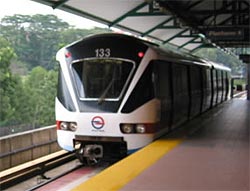 He said funding for public transportation has often been used as an excuse to keep car prices high.
"If we see from the era of former prime minister Abdullah Ahmad Badawi, the BN government said it was keeping the prices of cars and petrol up to fund improvements to public transportation, but that did not happen," Rafizi said.
Even though the MRT system was in the works, it would only be completed by 2017 or 2018, during which time people in low-income groups would still require a vehicle for transport.
However, Rafizi gave his assurance that should Pakatan capture federal power, the abolition of the excise tax on cars would be carried out in tandem with improvements to the country's public transport.
PKR: Approved Permit to be revamped for cheaper cars


Are you sure you want to delete this comment?
This action cannot be undone.