




GM mosquito trial in Bentong hailed as a success
Researchers of the Bentong genetically-modified (GM) mosquito trial have hailed their experiment as a success, and suggested that it should be followed with trials in inhabited areas.
Researchers of the Bentong genetically-modified (GM) mosquito trial have hailed their experiment as a success, and suggested that it should be followed with trials in inhabited areas.
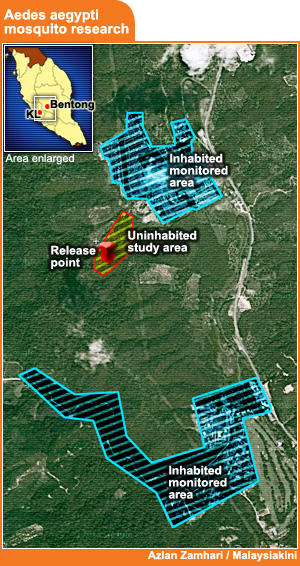
The trial was conducted in an uninhabited forest and is meant to test the modified aedes mosquitoes’ ability to survive and spread in the wild, as part of efforts to assess its suitability to be used as a pest-control method.
 The researchers also say that the results obtained would also be used to evaluate risk assessments in subsequent studies.
These include studies to assess the modified mosquitoes’ ability to compete for mates in the wild, which is still being planned but would take place in a populated area in Malaysia on a larger scale.
The researchers say that the results were encouraging, since those with the modified gene disappeared quickly from the environment and did not spread more than a few hundred metres.
“The main caveat is that these observations should be repeated in an environment more typical for (aedes mosquitoes) and where wild (aedes mosquitoes) are present.
“Given the highly urbanised, human-associated nature of this mosquito, that means an inhabited area,” wrote the 25 researchers led by Renaud Lacroix and Andrew R McKemey, both scientists from the company that developed the mosquito Oxitec.
Other researchers hailed from local institutions like the Institute for Medical Research (IMR) and Universiti Malaya, and the UK’s Oxford University. The latter is also Oxitec’s parent company and holds the patent for the modified gene.
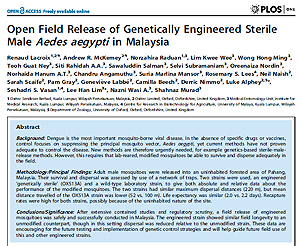 The study was reported in the August 2012 issue of the peer-reviewed journal
Plos One
and is available
online
for free.
The study was reported in the August 2012 issue of the peer-reviewed journal
Plos One
and is available
online
for free.
Aedes mosquitoes could transmit a virus that causes dengue fever and dengue haemorrhagic fever.
According to Health Ministry figures, the disease infected over 46,000 people in Malaysia in 2010, of whom about 130 died.
The male mosquitoes used in this study carried a genetic defect, dubbed the OX513A, that would cause its offspring to die prematurely unless bred in the presence of the antibiotic tetracycline.
Over 6,000 of these mosquitoes were released on Dec 21, 2010 for the experiment, along with over 5,300 unmodified aedes mosquitoes for comparison.
Pest-control strategy
Releasing sterile insects in massive numbers to compete for mates with healthy ones in the wild had been an effective pest-control strategy against several types of pests since the 1950s.
However, the x-rays used in the sterilisation also left mosquitoes too feeble to compete for mates, leading to studies on whether genetic engineering would be a more suitable method of sterilisation for mosquitoes and other pests where x-rays proved ineffective.
It remains unclear whether genetically modifying mosquitoes would weaken them too much to find mates, which is the question being addressed in ongoing research including this study.
Efforts are also being made by other researchers to explore the idea of using bacteria to infect and kill mosquitoes.
 The researchers in the Bentong study found that the life expectancy and maximum range of both types of mosquitoes were similar, although the average range of the modified mosquitoes was half of those of their wild-type counterparts.
Monitoring the release area with a network of 45 traps until no more of the two groups of mosquitoes were caught, they have determined that the modified mosquitoes had a life expectancy of two days, an average range of 52.4 metres, and maximum range of 220 metres.
In comparison, the wild-type mosquitoes flew an average of 99.8 metres, a maximum of 223 metres and had a life expectancy of about 2.3 days.
Despite the lower average range of the modified mosquitoes, the researchers wrote, “(Modified) males show adequate dispersal capacity for their intended use in a sterile-male-release programme, though this should also be examine in an inhabited area.”
The traps, along with another 75 ovitraps (egg traps) also found no indication that the mosquitoes had reached populated areas, the nearest of which is 500 metres away from the release site.
Objections from civil society
In addition, researchers reported that the ovitraps did not find any larvae of the modified mosquitoes, suggesting that no mating had occurred with the lab-grown and wild mosquitoes in the area.
“This is unsurprising given the low number of available females in the uninhabited area and males, if any, likely to have travelled to adjacent villages where higher numbers of females are present,” the researchers wrote.
 They noted while there were many mosquitoes in the test site, very few were of the aedes species.
The report also spells out steps taken by the researchers to obtain regulatory and community approval , including newspaper advertisements, notices, writing to NGOs, and public meetings, the latter of which was reportedly positive.
However, no mention was made in the report of objections from civil society, including an open letter endorsed by 22 NGOs.
“Genetic engineering often results in unintended effects...
“We do not know enough about the GM mosquitoes and how their interactions with non-GM mosquitoes in the wild, other species in the ecosystem, the dengue virus and human populations, will be affected,” the letter said.
Some groups had pointed out that the modified mosquitoes are not completely sterile , but Oxitec’s own studies had found that three to four percent of the offspring are viable even when bred without the presence of tetracycline.


Are you sure you want to delete this comment?
This action cannot be undone.