




Penang leads nation with 'gender-responsive' budget
Two local councils in Penang are implementing a three-year Gender Responsive Budget project to promote participatory democracy among ratepayers.
Two local councils in Penang are implementing a three-year Gender Responsive Budget project to promote participatory democracy among ratepayers.
 This is different from the current policy- and decision-making processes which take a top-down approach in public spending.
Penang is the first state in Malaysia and among Asean member-countries to adopt the concept at local government level.
The Penang Women’s Development Corporation (PWDC) has been commissioned by the state government to run the three-year project up to 2014.
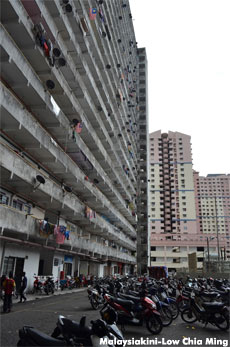
The Penang (MPPP) and Seberang Perai (MPSP) municipal councils have selected a public housing scheme on the island (River Road flats in Sungai Pinang) and the mainland (Ampang Jajar low-cost flats in Butterworth) for the pilot projects.
MPPP and MPSP have allocated RM63,000 and RM200,000 respectively to run the projects this year.
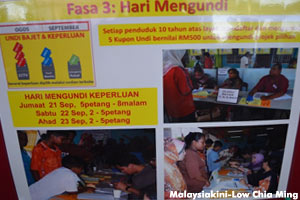
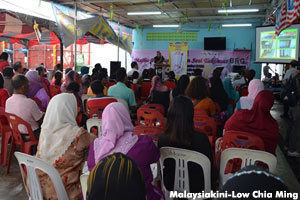 Residents in the two housing schemes were given an opportunity to express their most pressing needs and concerns via a voting process.
After several target-group discussions, the residents cast their votes in September to decide how to use their budget allocation effectively.
With every resident above the age of 10 being considered eligible to vote, the turnout rate in both housing schemes exceeded 50 percent.
Of the 1,050 Ampang Jajar flat residents, 597 voted from Sept 7-9 to decide their areas of concern and how to spend the budget allocation.
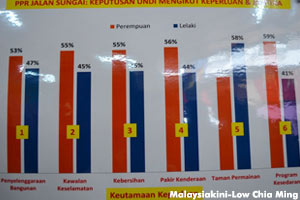 Seven priority issues identified included the need for a recreation park, security facilities, traffic control at the entrance, trading sites, an activity centre, building maintenance and general cleanliness.
Of the 1,667 people in the River Road flats, 1,160 voted on similar issues, including building maintenance, a recreation park, security facilities, general cleanliness, a car park and awareness campaigns.
‘ Equality’ according to needs
PWDC chief executive officer Sri Husnaini Sofjan said ‘equality’ does not mean providing the same treatment to all, because different groups - based on gender, age and ability - have varying needs.
“The Gender Responsive Budget is to understand such differences and take their needs into the consideration when drafting the budget,” said Sri Husnaini, the former UN Fund for Women ountry manager in Acheh, Indonesia.
She expressed the hope that the three-year programme can be advanced to state level.
Sri Husnaini, said Selangor is also interested in a pilot programme and that she will share the Penang experience in Seoul where she is due to deliver a talk.
 Penang state executive councillor Chow Kon Yeow said that, typically, the government budget is drafted by officers and department heads.
This may sometimes be out of touch with real needs at the grassroots, he noted.
“Now we let the residents decide. Other than deciding how to spend the allocation, they can choose the colour of the paint for walls, for example, although they need to reach a consensus on what colour they want, and not have different colours for different buildings,” he said.
“This programme allows residents to express their needs and demands, while providing opportunities for officers to understand more about the community. We learnt the Gangnam style from Korea, now they can learn this from us!”


