




'Time for Singaporeans to contemplate change'
INTERVIEW After years of 'trading off' political freedom for economic prosperity, the time has come for Singaporeans to contemplate rejuvenating their political system by voting out the long-ruling People's Action Party (PAP), says a political exile from the island republic, Tan Wah Piow.
INTERVIEW After years of 'trading off' political freedom for economic prosperity, the time has come for Singaporeans to contemplate rejuvenating their political system by voting out the long-ruling People's Action Party (PAP), says a political exile from the island republic, Tan Wah Piow.
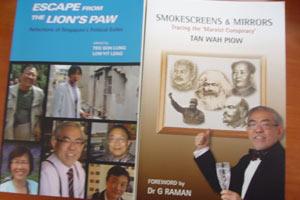 Tan, who fled from Singapore in 1976 and was later accused by the Singapore government of being the mastermind of a Marxist conspiracy, is now a United Kingdom citizen and a human rights lawyer there.
He is now in Malaysia for this weekend's launch of his two books - 'Smokescreens & Mirrors' and 'Escape from the Lion’s Paw'. The second book was co-authored by his fellow political exiles detailing their arrests, detention and life in exile during Singapore's infamous 1987 Operation Spectrum.
Tan earlier this week gave an interview to Malaysiakini .
Operation Spectrum, also known as the 'Marxist Conspiracy', saw the detention without trial of 22 dissidents in 1987, under Singapore's draconian Internal Security Act. The PAP government at that time was led by Lee Kuan Yew.
The detainees were accused of being involving in a Marxist conspiracy, plotted by Tan, to turn the island into a Marxist state.
Tan, a student dissident in the 1970s, was charged in court in 1974 and jailed for eight months for unlawful assembly and rioting. After his release, he fled to the UK and sought political asylum there, before Operation Spectrum was launched.
In 'Smokescreens & Mirrors', Tan tells the background story on his arrest, and analyses the government’s action for doing so. The book is a reproduction of his earlier book, 'Let the People Judge' in which he denies the state's allegations against him.
The two books were first launched in Singapore in June this year to commemorate the 25th anniversary of Operation Spectrum.
Speaking about the books, Tan said his main interest was to use the historical events and experiences to highlight the Singapore practise of placing economic development above citizens' rights.
“...Until now, it has been on the basis for Singapore trading off our human rights, we trade off our individual rights. We trade off all the protections that are within the constitution in order to attain material goods”.
Tan conceded that this practice was supported by Singaporeans in the past, as reflected by the electoral victories of PAP. However, he said, the practice has lost its relevance in modern Singapore, which is now one of the countries with the highest gross domestic product (GDP) in the world.
The new generations of Singaporeans, Tan said, have realised that economic and political rights go together, as demonstrated by countries like Japan and America, while Taiwan and South Korea have shown that changes in government do not jeopardise their economies.
Therefore, his two books, Tan said, are to highlight to the Singapore people that there should be a movement to rediscover and rejuvenate the constitution.
“PAP is incapable of taking and giving due respect to the constitution and after 50 years of rule, the next era of Singapore - the post-Lee Kuan Yew era - it is time for the population to contemplate voting out the PAP, and only by voting out the PAP can they create that political-cultural environment,” he said.
 During the interview, Tan did not mince any words in his criticism of the opposition parties in Singapore for failing to portray themselves as an alternative government to PAP.
“There is nothing wrong to start contemplating a post-PAP period, not just a post-Lee Kuan Yew period. In Singapore, they argue that if you want to criticise them you must join a political party and then, in the opposition parties, one would not dare not say, 'my aim is to replace the PAP'.
“So, the opposition parties say, 'our aim is like a co-driver' or a 'backseat driver' and I think that distorts the whole notion of democracy,” Tan added.
Below is the excerpt of interview with Tan. It has been edited for brevity and clarity:
Is there a specific purpose for timing the launch of the books; 'Smokescreens & Mirrors' and 'Escape from the Lion’s Paw'?
Well, both the books were published in Singapore, interestingly in the middle of this year, in June and intended to coincide with Operation Spectrum. The issue of detention without trial was focused at a public forum at the Hong Lim Park after the lack of freedom of speech over the years. The importance of raising the issue on the 20th anniversary is to focus on issue of detention without trial.
Operation Spectrum is one particular action of the government that many in Singapore, not just ex-political detainees but even those within the Singapore elite, one of the Deputy Prime Ministers, Tharman Shanmugaratnam , has raised reservations about it. The whole justification about detaining the 22 in 1987 was in claiming that there was a Marxist plot and that I was the mastermind and all that, and that the Catholic church played a role in it. Current relevance is the whole issue of political control. The issue of to what extent the Singapore system should give due respect to the constitution.
Do you have a figure for the number of exiles who fled Singapore?
Oh, the number of exiles is small. 'Escape from the Lion’s Paw' only highlights a number of those as in the book. But if one were to extend to the numbers of those deported from Singapore from the 1950s onwards, then probably many hundreds. During the campaign at Hong Lim Park, one of the demands was to let the exiles come home. It is a more general hope that Singapore government should review the circumstances that forced people in different periods to flee the country.
How has the response been towards the books?
So far, I’m not sure how many copies were published but I understand that they are selling well. In fact, not many are left for selling in Malaysia, so they are thinking of a reprint. The interesting thing about the publication and the response to it is that the government did not openly comment on it. The second aspect is that when the pre-publicity went out, it was made clear by Singapore Straits Times Holdings and bookshops that they are not going to order the books. They were sold in two main bookshops. The National Library only took those books for reference purposes and not for general borrowing.
So, there is some degree of sensitivity. But I will not read too much into the lack of any overt censorship about the book because if we look at a very recent incident, the banning of James Michin, a pastor from Melbourne, Australia, and the author of the book 'Singapore’s Lee Kuan Yew: No man is An Island' from entering Singapore a few days ago. Michin spoke in a television talk show, organised by the opposition Singapore Democratic Party (SDP) and they put a ban on him. So it is an indication that although the Singapore government is trying to appease the younger generation with more openness they also want to send the message that they still want to exercise a high degree of control where they can.
Is there any possibility/indication that Singapore will let the exiles come back anytime soon?
One indication was when my mother passed away recently. She was 102 years old and the members of the National University of Singapore (NUS) National Union of Students Alumni made a plea to the High Commissioner to let me go back to attend the funeral. The High Commissioner is someone from the student union from 1974 and I know him personally. He expressed condolences but also sent a message that there is nothing to stop me from going to Singapore but they cannot guarantee a safe passage.
I think so far the ruling government operates the policy of maintaining hegemony over politics then whatever degree of openness has to be within that limit. I think within that limit they would not tolerate the return of exiles unless the exiles who wish to return, which no doubt a number of them are, on their terms. One of the terms normally would be to submit to their interrogation, to provide them with the information and also a commitment that they don’t get involved in politics.
What do you think is the reaction of the young people to all these stories and experiences?
For them it's history. In fact, for many of them who participated in helping to organise the 25th anniversary, it was a revelation to them because its contrary to what they learn in school about Singapore history.
My more urgent interest is to use those incidents and our experiences to highlight certain points, that in as far as the Singapore narrative is concerned until now, has been on the basis that we trade off all the human rights, we trade off our individual rights. We trade off all the protections that are within the constitution in order to attain the material goods.
We’ve reached a stage now where we have achieved our economic excellence as one of the countries with highest GDP in the world, with the highest material goods. I also take into consideration that they (young generation) belong to the cyber age generation where individual freedom are what they exercise in their personal choice in terms of voting in or voting out what you do not want.
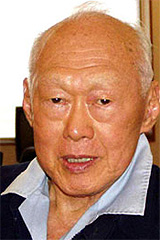 We have achieved and the people are looking for more. That’s why one of the things which I’m trying to push for in the process of writing Smokescreen and Mirrors is to say that there should be a movement to rediscover our constitution, as to rejuvenate our constitution. PAP is incapable of taking and giving due respect to the constitution and after 50 years of ruling.
For the next era of Singapore; post Lee Kuan Yew ( right ) era, it is time for the population to contemplate voting out the PAP and only through voting out the PAP, can you create that political cultural environment.
PAP has been trying to mellow down, appease and offer some rectification by allowing the debate of some of the issues faced. Do you think that is helpful?
That is helpful within their own terms of maintaining a semblance that even without the opposition, they are a responsive party. They want to create that image that you don’t need a two-party system, that the PAP government is all embracing, they can take onboard any range of ideological choices for the country.
But my notion is that in any society, there will always be (different ideologies) and it is healthy to have a contention of different political choices which is a rarity in any society. The next stage in the post Lee Kuan Yew era I fear is the long term battle for Singapore for a time to come where they must be an occasion for change of government so that you can clear the “cobweb”, an opportunity to have a thorough revamp of the constitution.
There has been some criticism directed towards the opposition, saying that they are too quiet and not raising certain issues. How would you rate the opposition?
Well, I think the opposition parties should define their objective more than just as a watchdog. My view is that the purpose of the political party, and especially if you are a party in the opposition, is ultimately to prepare for an alternative government.
Whether or not you are able to achieve it within a certain framework is a different matter but you need not shy away from criticising the government, from proposing an alternative view, and this is where sometimes within the Internet you see those who are critical of the opposition party describing them as a “ wayang- wayang party” (a puppet party), as a party that shy’s away from issues like the Internal Security Act.
Why should one be in an opposition and be afraid of offending the government? What is so frightful about thinking of voting out the PAP and government?
What is your role in the upcoming elections?
My role is only incidental as I wrote two books. There is nothing wrong to start contemplating a period of a post-PAP, not just post- Lee Kuan Yew. In Singapore, they would argue that if you want to criticise them you must join a political party and then as opposition parties you dare not say that my aim is to replace the PAP. So the opposition party says our aim is like “co-driver” or a “backseat driver” and I think that distorts the whole notion of democracy.
Do you think Lee Hsien Loong can make more changes if he manages to break through his father’s waves?
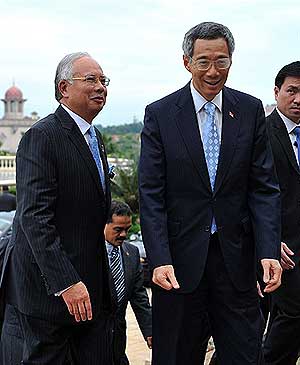 If Lee Hsien Loong (
right in photo
) says that we will remove the editorial control of the media and using the intelligence, special branches to target opposition parties, to disrupt and sabotage in order to have the public assurance of that.
If Lee Hsien Loong (
right in photo
) says that we will remove the editorial control of the media and using the intelligence, special branches to target opposition parties, to disrupt and sabotage in order to have the public assurance of that.
Will he open the books about the Operation Spectrum and provide the assurance that such things will not happen again? I think that if he is willing to do that then that is an indication that the PAP has come to maturity that they are prepared to see a possibility that they may be replaced. I am not sure whether he has that intention.
Additional reporting by Nandini Balakrishnan and Leanne Tan.


Are you sure you want to delete this comment?
This action cannot be undone.